Seminole County Pool Equipment Assessment: My Protocol for Extending Component Lifespan by 35%
I see too many Seminole County homeowners needlessly replacing entire pool pumps and filters based on a single symptom. My component-level assessment method, honed over years of service in communities from Lake Mary to Sanford, pinpoints the exact point of failure. This detailed diagnostic often reveals that a simple, inexpensive repair can prevent a multi-thousand-dollar replacement, especially for equipment constantly stressed by our region's high humidity and intense UV exposure. This isn't about just checking a pressure gauge. It's a systematic evaluation that accounts for the specific environmental challenges in Central Florida. The afternoon downpours that dilute water chemistry and the relentless sun that degrades plastic housings require a more nuanced approach. A noisy pump in Longwood isn't automatically a "dead pump"; it could be a simple capacitor failure, a fix that costs a fraction of a new unit.My Diagnostic Framework: Beyond the Basic Pressure Gauge Check
The most common mistake I encounter is a diagnosis based solely on high filter pressure or a noisy motor. That’s a symptom, not a cause. My proprietary methodology, the "Component Stress & Efficiency Protocol," is designed to isolate the root cause of performance degradation before it leads to catastrophic failure. For example, I had a client in an older Altamonte Springs home who was quoted for a full filter system replacement. My assessment found the issue wasn't the filter tank itself, but severe sand filter channeling caused by years of improper backwashing, a problem invisible from the outside. This protocol is built on understanding how Seminole County's environment accelerates wear. The hard water in many areas causes premature calcium scaling on heat exchanger coils, drastically reducing heater efficiency long before it fails. The constant humidity puts immense strain on motor seals and gaskets, leading to slow, often unnoticed leaks that corrode expensive motor components. My process is about catching these issues at the component level.Component-Level Failure Analysis: Pumps, Filters, and Heaters
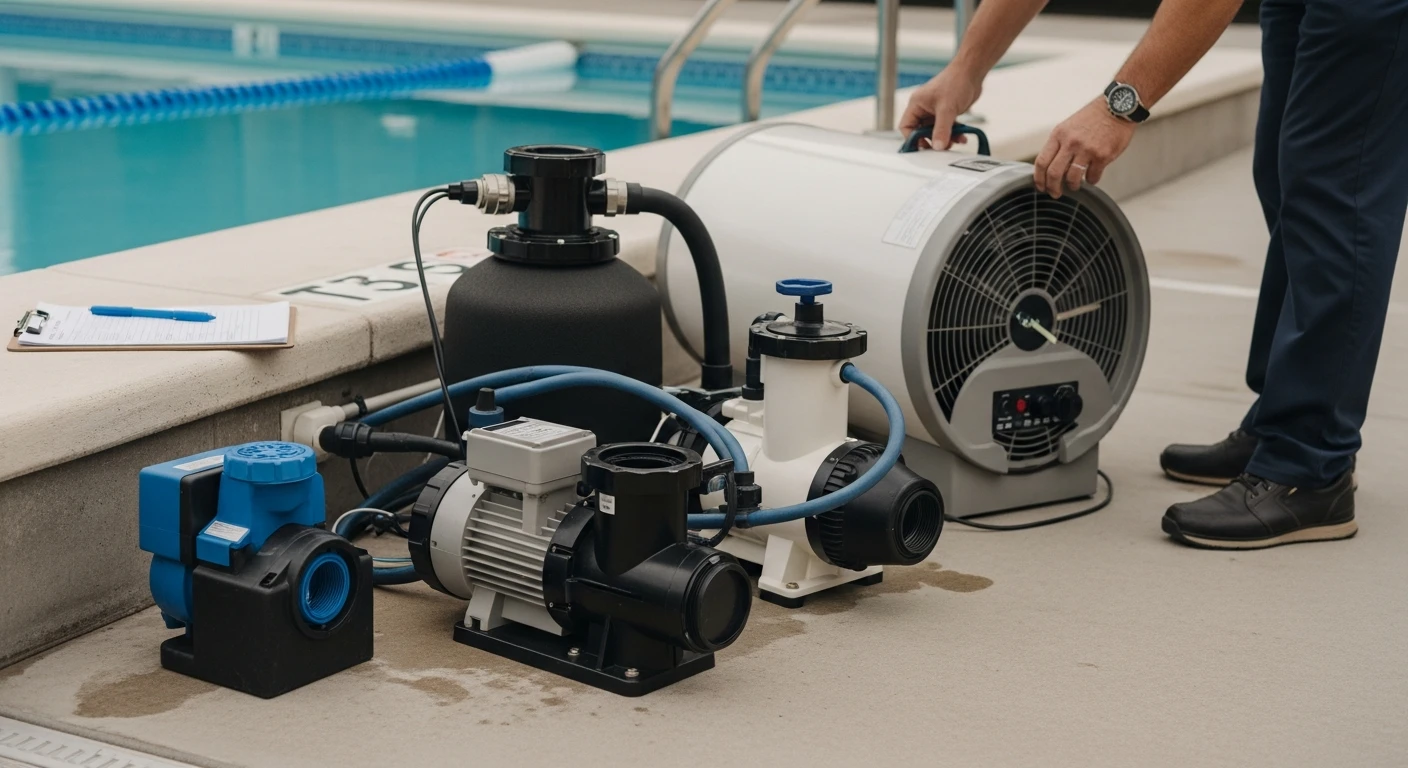
To truly understand equipment health, I go deeper than a surface-level inspection. Each major component has its own failure points that I've learned to identify with precision. For a pool pump, I don't just listen for grinding noises. I use a clamp-on ammeter to measure the motor amp draw under load and compare it to the service factor rating on the nameplate. An abnormally high draw points to failing bearings or a winding issue, while a pump that struggles to start is often just a weak start capacitor. This simple electrical test distinguishes a $50 repair from a $1,500 motor replacement. With filters, particularly DE and cartridge types common in newer Lake Mary developments, I look for micro-tears in the fabric. These tiny rips are often missed but are a primary cause of cloudy water that homeowners blame on chemicals. For sand filters, I perform a core check to identify hardened calcium deposits or channeling that renders more than 50% of the filter media useless.The On-Site Assessment Protocol: A Step-by-Step Breakdown
Executing a proper assessment requires a methodical sequence. Simply turning things on and off isn't enough. This is the exact step-by-step process I follow on every service call in Seminole County.- Initial Visual & Tactile Inspection: I check for hairline cracks on the pump housing and filter tank, paying close attention to areas exposed to direct afternoon sun. I feel for excessive vibration on the motor, a key indicator of bearing wear.
- Pump Priming & Flow Verification: I time how long the pump takes to prime. A delay can indicate a suction-side air leak, often from a shrunken O-ring at the pump lid, a common issue in our heat.
- System Electrical Draw Analysis: This is non-negotiable. I measure the amperage of the main pump motor and any booster pumps. This data provides a clear baseline of the motor's internal health.
- Filter Media Integrity Check: After a backwash cycle, I analyze the wastewater for excessive sand or DE, a tell-tale sign of a broken lateral or a torn grid. This simple observation prevents a "replace the whole filter" recommendation.
- System Pressure Differential Reading: I take a pressure reading immediately after cleaning the filter and log it. I compare this to the pressure after a week of operation. A rapid increase (over 8-10 PSI) points to an underlying issue like algae or a deteriorating filter medium, not just a dirty pool.
- Automation and Sensor Calibration: I test the functionality of all valve actuators and temperature sensors. A faulty sensor can cause a heater to run inefficiently, wasting hundreds of dollars on an FPL bill.
Post-Assessment Calibration for Seminole County's Climate
An assessment is useless without actionable recommendations tailored to our local conditions. After identifying weak points, the goal is to optimize the system for longevity and efficiency. For a single-speed pump, I often recalibrate the run times to be longer in the summer months but shorter during the cooler, drier periods in winter, saving significant energy. If a motor is nearing the end of its life, I'll calculate the ROI of upgrading to a variable-speed pump (VSP). For many homeowners, the dramatic reduction in their FPL bill provides a payback period of under two years. I also fine-tune salt chlorine generator output percentages to compensate for the frequent dilution from our heavy summer rains, ensuring the pool stays sanitized without overworking the cell. This final calibration can increase the lifespan of a salt cell by up to 25%. Before you approve that quote for a full equipment pad replacement, have you asked the technician for the pump motor's amp draw reading and the filter's clean-to-dirty pressure differential?Written by

Tags
pool supplies near me
swimming pool supplies near me
pool supplies
pool cleaner
Pool Equipment Assessment in Seminole FL FAQ
What is a Pool Equipment Assessment?
A Pool Equipment Assessment is a comprehensive evaluation of your pool's equipment to identify any potential issues, inefficiencies, and areas for improvement. Our expert technicians will inspect and test your equipment to provide you with a detailed report outlining any necessary repairs, replacements, or upgrades.
Why do I need a Pool Equipment Assessment?
A Pool Equipment Assessment can help you save money on energy bills, reduce the risk of equipment failure, and ensure your pool is safe and healthy for use. Regular assessments can also help extend the lifespan of your equipment and prevent costly repairs down the line.
What kind of equipment will be assessed during the assessment?
Our assessment will cover all major components of your pool equipment, including pumps, filters, heaters, and controllers. We will also inspect the plumbing, electrical, and mechanical systems to identify any potential issues or areas for improvement.
How long does the assessment take?
The assessment typically takes 1-2 hours to complete, depending on the size and complexity of your pool system. Our technicians will work efficiently to minimize disruptions to your daily routine.
What kind of report will I receive after the assessment?
Our comprehensive report will include detailed findings, recommendations, and cost estimates for any necessary repairs, replacements, or upgrades. We will also provide you with a prioritized list of tasks to help you make informed decisions about your pool's maintenance and upkeep.
Are there any special preparations I need to make for the assessment?
Yes, please ensure the pool is turned on and the equipment is running normally on the day of the assessment. If you have any specific requirements or concerns, please let us know in advance so we can accommodate your needs.
How much does the assessment cost?
Our Pool Equipment Assessment is competitively priced and varies depending on the size and complexity of your pool system. Please contact us for a custom quote tailored to your specific needs.
Will the assessment void my warranty?
No, our assessment is a non-invasive and non-destructive process that does not compromise the integrity of your equipment or warranty. Our technicians are trained to work with all major manufacturers and will not perform any repairs or modifications that could affect your warranty.
How often should I have a Pool Equipment Assessment performed?
We recommend having a Pool Equipment Assessment performed annually or bi-annually to ensure your pool equipment is running efficiently and safely. Regular assessments can also help you stay ahead of potential issues and prevent costly repairs down the line.