
Pressure Cleaning Pavers Manatee County: My Method for Preventing Joint Sand Loss & Extending Paver Life by 30%
As a specialist working directly on pavers across Manatee County, I’ve seen the devastating effects of our subtropical climate firsthand. The intense humidity and constant rain create a perfect breeding ground for aggressive black mold, algae, and stubborn efflorescence, especially on pool decks in Parrish and driveways in Bradenton. The common mistake I see homeowners and inexperienced contractors make is believing that higher pressure (PSI) is the answer. This approach is a critical failure; it not only fails to kill the organic growth at its root but also blasts away the essential joint sand, leading to paver shifting and an immediate destabilization of the entire surface. My entire methodology is built on a counterintuitive principle: effective paver restoration is about chemistry and technique, not brute force. By focusing on a pre-treatment saturation process and using calibrated equipment that balances Gallons Per Minute (GPM) with the correct pressure for the specific paver type—be it delicate travertine on a lanai in Lakewood Ranch or sturdy brick pavers downtown—I can achieve a deeper, longer-lasting clean while completely preserving the structural integrity of your hardscape. This is the difference between a temporary cosmetic fix and a genuine restoration that adds years to your investment.Beyond PSI: The Critical Flaw in Most Paver Cleaning Approaches
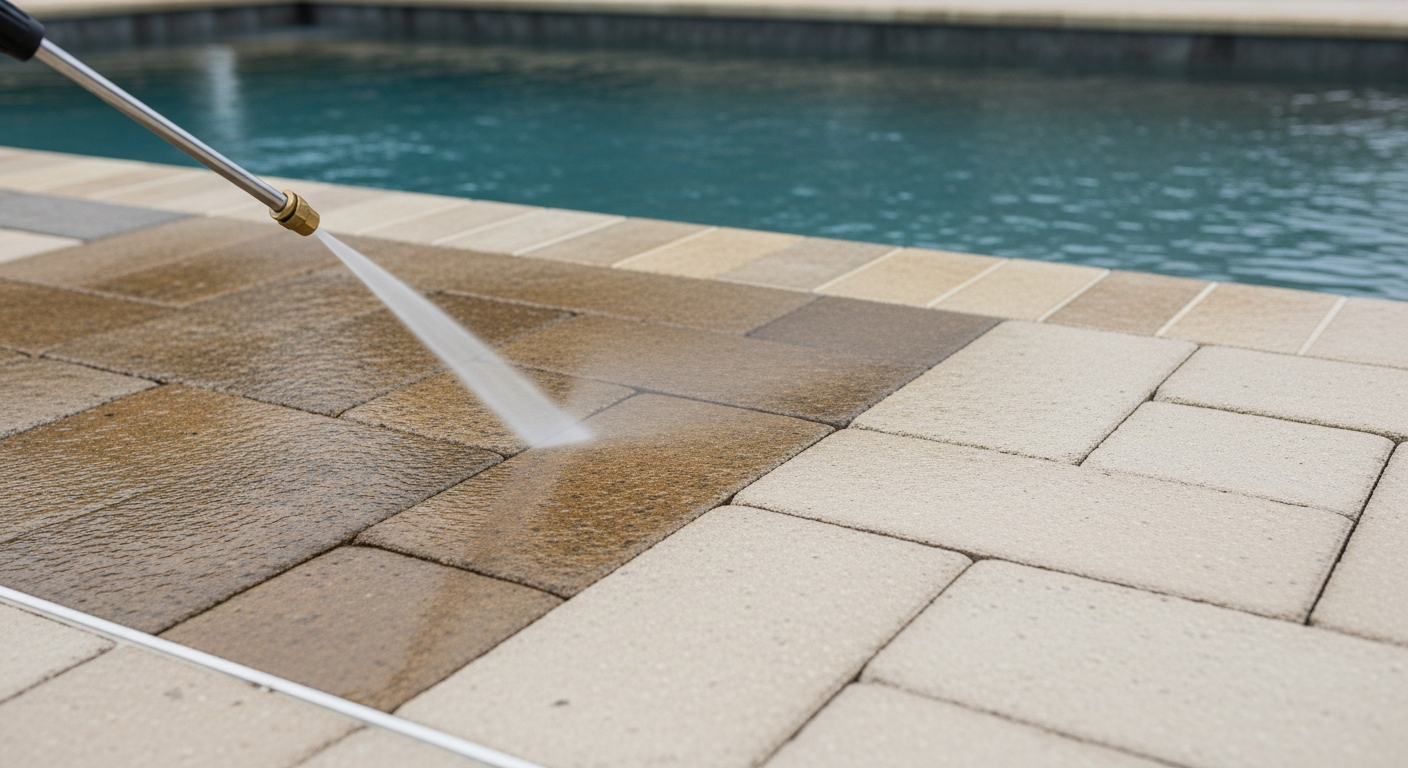
The single biggest misconception is the obsession with PSI (Pounds per Square Inch). I once had to salvage a large travertine pool deck on Anna Maria Island where a high-PSI wand left permanent "zebra stripes" etched into the stone. The real performance metric for cleaning without damage is a controlled balance of PSI and GPM (Gallons Per Minute). High GPM provides the necessary rinsing volume to lift and carry away contaminants without needing excessive force that erodes the paver surface and, most critically, the joint sand. My work begins not with a pressure washer, but with a diagnosis. The dark staining common in Manatee County isn't just "dirt"; it's a living organism. Algae, mildew, and lichen have root systems that penetrate the porous surface of the pavers. Blasting them with high-pressure water merely shears off the top layer, leaving the roots intact to regrow thicker and faster within weeks. This is why a "clean" driveway often looks dirty again after the first summer rain. The only effective solution is a chemical one that achieves a 100% kill rate on these organisms before any significant pressure is applied.My Diagnostic Protocol: Assessing Paver Type, Stain Origin, and Joint Integrity
Before I even mix a cleaning solution, I perform a three-point assessment on site. This is a non-negotiable part of my process that prevents the costly errors I'm often called in to fix. First, I identify the paver material and porosity. Is it soft travertine, which scratches easily, or dense concrete pavers? This determines the maximum allowable PSI and the type of cleaning head I will use. Using a high-pressure turbo nozzle on travertine is a recipe for disaster. Second, I analyze the stain origin. Is it purely organic (green and black algae), or are there also inorganic stains like rust from patio furniture or oil from a vehicle? Each requires a different chemical agent. Applying a standard sodium hypochlorite solution to a rust stain, for example, can make it permanent. Finally, I assess the joint integrity. Are the joints already low on sand? Are there weeds present, indicating a complete failure of the old joint sand? This dictates whether the project requires a simple cleaning or a full re-sanding with polymeric sand for long-term stabilization, a frequent necessity for properties in high-growth areas like Parrish.The 4-Stage Paver Restoration Process I Personally Execute
My field-tested method ensures a consistent, high-quality outcome that protects the client's property. I never deviate from this sequence because each step is foundational for the next.- Stage 1: Chemical Pre-Treatment. I apply a calibrated solution, typically a buffered sodium hypochlorite mixture, to the entire paver surface. I let this dwell for a specific time, allowing it to penetrate the paver pores and neutralize all organic growth at the root level. This does 90% of the work before any pressure is introduced.
- Stage 2: Calibrated Surface Cleaning. I use a commercial-grade flat surface cleaner, not a wand. This tool contains the water pressure, distributes it evenly, and prevents the damaging "striping" effect. I run the machine at the lowest effective pressure, typically between 800-1500 PSI depending on the paver, but with a high GPM to rinse effectively.
- Stage 3: Joint Restoration. After cleaning, this is the most critical step. I thoroughly rinse out all the dead organic matter and loose, contaminated sand from the joints. Once the surface is completely dry—which can take up to 48 hours in Manatee's humidity—I sweep new, high-grade polymeric sand into every joint. This type of sand contains a polymer that, when activated with a light mist of water, hardens to lock the pavers in place and inhibit weed growth.
- Stage 4: Protective Sealing. The final step is applying a high-quality sealant. This isn't just for looks; it's a protective barrier. It penetrates the paver to protect against UV rays, salt degradation (critical for coastal homes on AMI), and future stains, making subsequent cleanings far easier.
Fine-Tuning for Manatee County's Climate: Sealing and Efflorescence Control
Applying sealant is where true expertise shows. Trapping moisture in a paver by sealing it too soon is a catastrophic error I've seen lead to a permanent cloudy haze under the sealer. Here in our humid climate, I always use a digital moisture meter to confirm the pavers are bone dry before sealing. A simple surface touch is not enough. Another local issue is efflorescence—that white, chalky substance that appears on pavers. It's salt migrating from within the paver as water evaporates. My post-cleaning process includes a final pH-neutralizing rinse that helps mitigate this. When selecting a sealant, I often recommend a breathable, siloxane-based sealant. This type of product provides excellent protection without trapping the water vapor that causes efflorescence, ensuring a stable, long-lasting finish that can withstand our demanding weather cycles. After a full restoration including polymeric sand and two coats of sealant, what is the minimum cure time you must enforce before allowing vehicle traffic back onto a driveway to prevent tire marking and joint failure?Written by

Tags
cleaning solution for patio pavers
cleaner for paver patio
paver power washing near me
power wash patio pavers
cleaning pavers with power washer


