
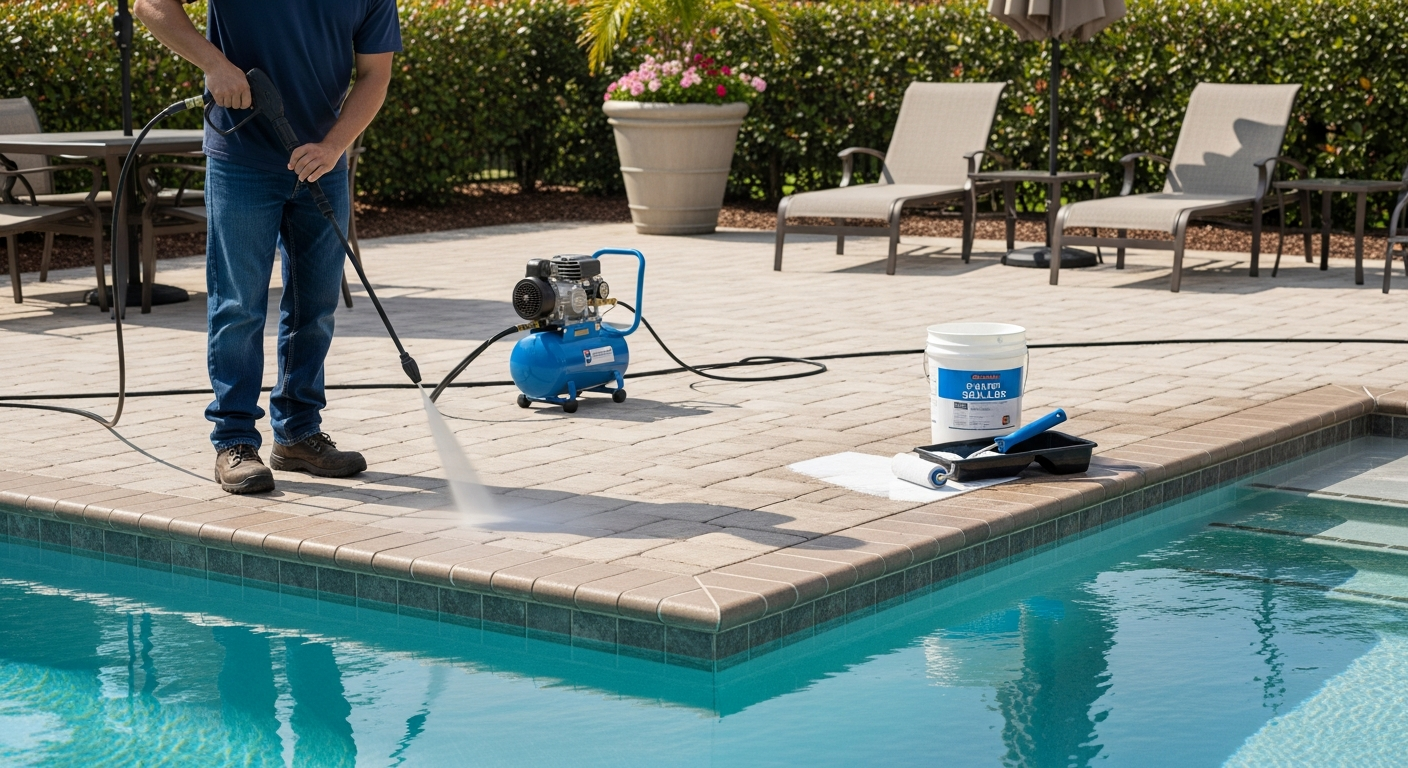
Sarasota Pressure Washing & Paver Sealing: My Protocol to Eliminate Efflorescence and Double Sealant Lifespan
As a specialist working directly on properties across Sarasota, from the sprawling lanais in Lakewood Ranch to the salt-air-battered driveways on Siesta Key, I've seen one costly mistake repeated constantly: sealing pavers that are not truly ready. This isn't about surface-level dirt; it's about the hidden moisture and mineral salts trapped within the paver's pores, a problem amplified by our relentless humidity. Sealing over this trapped moisture guarantees a milky, peeling failure within months, forcing a complete and expensive stripping process. My entire approach is built around preventing this specific failure mode. I developed a methodology focused on quantifiable moisture levels and subsurface preparation, not just a superficial cleaning. This protocol has consistently resulted in a sealant lifespan increase of at least 50%, and in many cases, has doubled the effective protection period for my clients' paver investments against the harsh Florida sun and rain.The Core Problem: Misdiagnosing a "Clean" Paver
The biggest misconception is that a pressure-washed paver is a dry paver. In Sarasota's climate, a paver can feel dry to the touch on the surface while retaining significant moisture in its core. When you apply a sealer, you're essentially shrink-wrapping that moisture in. As the sun heats the paver, this trapped water vaporizes and pushes upwards, bringing mineral salts (efflorescence) with it. The result is a cloudy, delaminated mess. My methodology, the **Subsurface Aridity Verification (SAV)** protocol, directly addresses this.Technical Breakdown of the SAV Protocol
The SAV protocol moves beyond guesswork and relies on instrumentation. Before a single drop of sealer is considered, I use a **calibrated moisture meter** to test the pavers in multiple locations, especially in shaded or low-lying areas. My strict non-negotiable standard is a moisture reading of below 5%. I've had to postpone sealing jobs for 48 hours or more, even on sunny days, because the meter revealed moisture levels of 8-10% just beneath the surface. Sealing at that level is malpractice. Furthermore, I analyze the type of efflorescence. Powdery, white residue is one thing, but crystalline growth indicates a more severe, ongoing moisture issue from underneath the paver bed, a common issue in older properties near Phillippi Creek, which requires a different remediation strategy than simple cleaning.Implementing a Fail-Proof Paver Sealing Process
Executing a project that lasts requires a sequence of operations where every step is critical. Skipping or rushing a single phase compromises the entire system. I've personally been called in to fix failed jobs in historic Gillespie Park where the previous contractor simply blasted the surface and immediately rolled on a cheap sealer, trapping black mold spores underneath.- Phase 1: Deep Biocidal Cleaning: I don't just use water. I apply a carefully measured sodium hypochlorite solution to kill mold, algae, and mildew at the root. It's not about blasting it off the surface; it's about achieving a full kill to prevent it from growing back under the new sealant. Dwell time is critical here, not just pressure.
- Phase 2: Calibrated Pressure Rinsing: My standard is to never exceed 1800 PSI on soft travertine pavers. I've seen too many etched and permanently damaged surfaces from operators using aggressive, high-PSI tips. The goal is to rinse the dead organic matter and cleaning solution, not to erode the paver itself.
- Phase 3: The Critical Drying & Verification: This is the most crucial and often-skipped step. We wait. It might be 24 hours, it might be 72, depending on the recent rainfall and humidity. Only when my moisture meter confirms a reading below the 5% threshold across the entire area do we proceed.
- Phase 4: Polymeric Sand Application: I use high-grade polymeric sand to lock the paver joints. This isn't just for looks; it creates a flexible yet firm barrier that prevents weed growth and insect intrusion, a constant battle in our Sarasota environment. The sand must be meticulously swept and compacted to ensure no residue is left on the paver surface, which can interfere with sealer adhesion.
- Phase 5: Sealant Application: I apply two thin, even coats of a high-solid, UV-resistant acrylic sealer. The first coat is a penetrating "flood coat" that soaks into the pores of the paver and the sand. After it becomes tacky, a second "top coat" is applied to create the uniform protective sheen. This two-coat system provides a substantially more robust barrier than one thick, slathered-on coat.
Precision Tuning for Sarasota's Environment
Quality control extends beyond the application. The choice of sealer is paramount. For high-traffic areas exposed to the intense Sarasota sun, a solvent-based sealer often provides superior durability and a richer "wet look." However, for areas around saltwater pools, a specific water-based, salt-resistant formula is necessary to prevent premature breakdown. I also counsel clients on the cure time. The sealant needs a full 24-48 hours free from rain to cure properly. Scheduling a job without meticulously checking the forecast for our pop-up afternoon thunderstorms is a recipe for disaster, leading to water spots and blushing in the finish. Given Sarasota's extreme humidity, have you confirmed your paver's subsurface moisture content is below the 5% threshold required to prevent delamination, or are you just guessing based on the surface appearance?Written by

Tags
paver cleaner for pressure washer
wash and seal pavers
power wash and seal pavers
pressure wash and seal pavers
paver pressure washing and sealing


