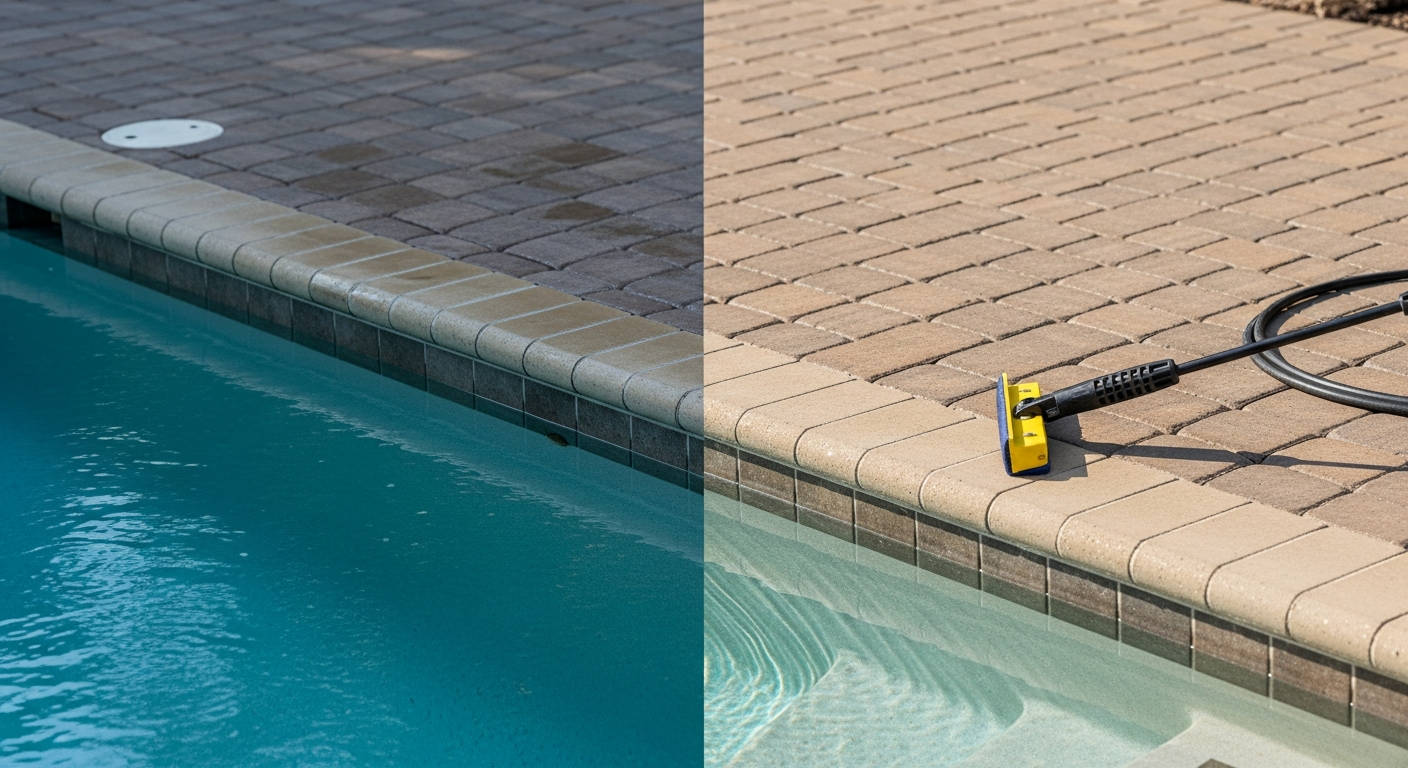
Professional Paver Sealer Application: The Framework for a 10-Year Haze-Free Finish
The most common failure in paver sealing isn't the product; it's the premature application over a surface that is fundamentally unprepared. I've been called to fix countless projects where a high-end sealer has turned into a milky, peeling disaster. The root cause is almost always a failure to diagnose sub-surface moisture and efflorescence. My entire approach is built on solving the problem before the first drop of sealer is ever applied, ensuring a bond that can increase the paver's functional lifespan by over 30%.
This isn't just about making pavers look wet or shiny. A professional sealing job is a structural enhancement. It stabilizes the jointing sand, prevents weed growth, and creates a barrier against water ingress that can cause heaving during freeze-thaw cycles. Forget the generic advice; the difference between a one-year failure and a decade-long success is in the pre-application diagnostics.
My Sub-Surface Moisture Ingress Protocol
Before my team even considers cleaning a surface, we perform what I call the **Sub-Surface Moisture Ingress Protocol**. This is a non-negotiable diagnostic step I developed after seeing a 5,000 sq. ft. commercial project fail within six months due to latent moisture. We don't guess; we measure. Using a calibrated concrete moisture meter, we take readings from multiple areas of the hardscape. Any reading above **4% moisture content** is an immediate red flag. Sealing over this level of moisture traps water vapor, which is the primary cause of the dreaded white haze or "blushing" that delaminates the sealer from the inside out. This protocol also includes a visual inspection for efflorescence—the white, salty powder that indicates mineral salts are being carried to the surface by water.
Technical Deep Dive: Sealer Chemistry vs. Substrate Condition
Understanding the diagnosis dictates the solution. If efflorescence is present, it's a symptom of water moving through the pavers. Applying a film-forming acrylic sealer here is a recipe for failure. Instead, my methodology dictates a different approach.
- For Surfaces with Potential Moisture Issues: I specify a penetrating, non-film-forming sealer. A silane/siloxane blend is my go-to. It impregnates the paver pores without creating a surface film. This allows the paver to breathe and transmit water vapor, drastically reducing the risk of haze while still providing excellent water repellency.
- For Perfectly Cured & Dry Surfaces: Here, a high-solids, solvent-based acrylic can be used for that deep "wet look." But I only specify this after a minimum **48-hour dry period** post-cleaning and a confirmation of low moisture readings. I've found that rushing the polymeric sand cure time is another common error; the sand must be rock-hard and fully dry, or the sealer will lock in moisture at the joints, creating a grid of failure points.
- Surface Decontamination: We don't just "pressure wash." We use a fan-tip nozzle held at a consistent angle to avoid etching the pavers. For organic stains, we use a sodium percarbonate-based cleaner. For efflorescence, a specialized acidic paver cleaner is required to dissolve the mineral salts. Rinsing thoroughly is critical.
- Joint Stabilization Audit: After cleaning, we inspect every joint. Any polymeric sand that was blasted out must be replaced. I insist my team ensures the sand level is 1/8 inch below the paver's chamfered edge. This creates a proper lock and prevents the sealer from pooling on top of the sand.
- The Critical Drying Phase: The surface must be bone-dry. This isn't a time estimate; it's a condition. We use leaf blowers to force water out of the tightest joints and then let the sun and air do the rest. I will delay a project by a full day if my moisture meter gives me a questionable reading.
- Sealer Application: I exclusively use a battery-powered or pump sprayer with a conical tip for an even, non-atomized spray. The goal is a uniform, thin "tack coat" on the first pass. This initial coat is the most important, as it penetrates and establishes the primary bond. A second, slightly heavier coat follows only after the first is tacky to the touch.
Tags
concrete pavers sealer
porcelain paver sealer
driveway paver sealing near me
patio and paving sealer
paver patio cleaning and sealing near me