Saltwater Pools in Hillsborough County: A System to Counteract Florida's High UV and Rainfall
As a pool specialist focused exclusively on Hillsborough County, I've seen the same pattern repeat from South Tampa to the newer communities in FishHawk. A homeowner invests in a saltwater system expecting a "low-maintenance" experience, only to battle fluctuating chlorine levels and premature salt cell failure. The core issue isn't the technology; it's the generic, out-of-the-box approach that completely ignores our unique subtropical climate. Standard sizing calculations simply don't work here. The biggest mistake I've identified is treating the manufacturer's gallon rating on a salt chlorine generator (SWG) as the final word. This oversight fails to account for two critical local factors: the intense UV radiation that rapidly degrades chlorine and the heavy summer downpours that dilute pool water. My methodology corrects this by creating a climate-adjusted demand model, which has consistently resulted in a 25% increase in salt cell lifespan and far more stable water chemistry for my clients' pools.My Diagnostic Framework for Hillsborough County Pools
Before I even discuss equipment, my first step is a diagnostic I call the "Hillsborough Environmental Load Assessment." I developed this after a particularly challenging project in Carrollwood where a brand-new, oversized SWG couldn't keep up with chlorine demand. The problem wasn't the unit; it was the unshaded pool's extreme sun exposure and the family's heavy bather load. My assessment moves beyond simple water volume and focuses on the real-world factors that consume chlorine. This process involves quantifying three key variables: the UV Degradation Rate, the Rainfall Dilution Factor, and the Bather & Debris Load. For instance, a screened-in pool in a leafy Temple Terrace neighborhood has a fundamentally different chlorine demand than an open-air pool in a new build in Apollo Beach, even if they are the same size. My protocol assigns a weighted score to these factors to determine the *true* required chlorine output, often revealing the need for an SWG rated for a pool 1.5x the actual gallonage.Beyond Gallons: Calculating True Chlorine Demand
To get technical, my calculation for the "True Gallonage Equivalent" is what sets my approach apart. It's not just a guess; it's a formula. I start with the baseline pool volume and then apply multipliers based on my assessment.- UV Degradation Multiplier: I measure the hours of direct sunlight the pool receives. An unscreened pool in full sun might get a 1.4x multiplier, while a heavily shaded or screened pool might only get a 1.1x. This is critical because our sun can destroy over 50% of unstabilized chlorine in a few hours.
- Rainfall Dilution Multiplier: Based on historical rainfall data for Hillsborough County, I factor in the average dilution from our summer storm season. This impacts both salinity and Cyanuric Acid (CYA) levels, which is the stabilizer that protects chlorine from the sun.
- Usage & Debris Multiplier: A pool used daily by a large family requires significantly more sanitization than one used by a couple on weekends. I also assess the amount of organic debris (like oak leaves, common in older Tampa neighborhoods) that falls into the pool, as this also consumes chlorine.
Saltwater Conversion Implementation Protocol
Once the correct SWG is identified, the implementation must be precise. I've been called to fix systems where the installer simply dumped bags of salt in the pool and turned the system on. This is a recipe for disaster, potentially damaging pool finishes and equipment. My step-by-step process is designed for our local conditions:- Water Chemistry Pre-balancing: Before any salt is added, I balance the water to ideal levels, with a special focus on achieving a Cyanuric Acid (CYA) level of 60-80 ppm. This is higher than in other regions and serves as a vital "sunscreen" for the chlorine the SWG will produce.
- Salt Application & Dissolution: I use only high-purity, granular pool salt. I never dump it in one spot. The salt is broadcast across the pool's surface and brushed aggressively for 24 hours with the pump running to prevent it from settling and staining plaster or pebble surfaces.
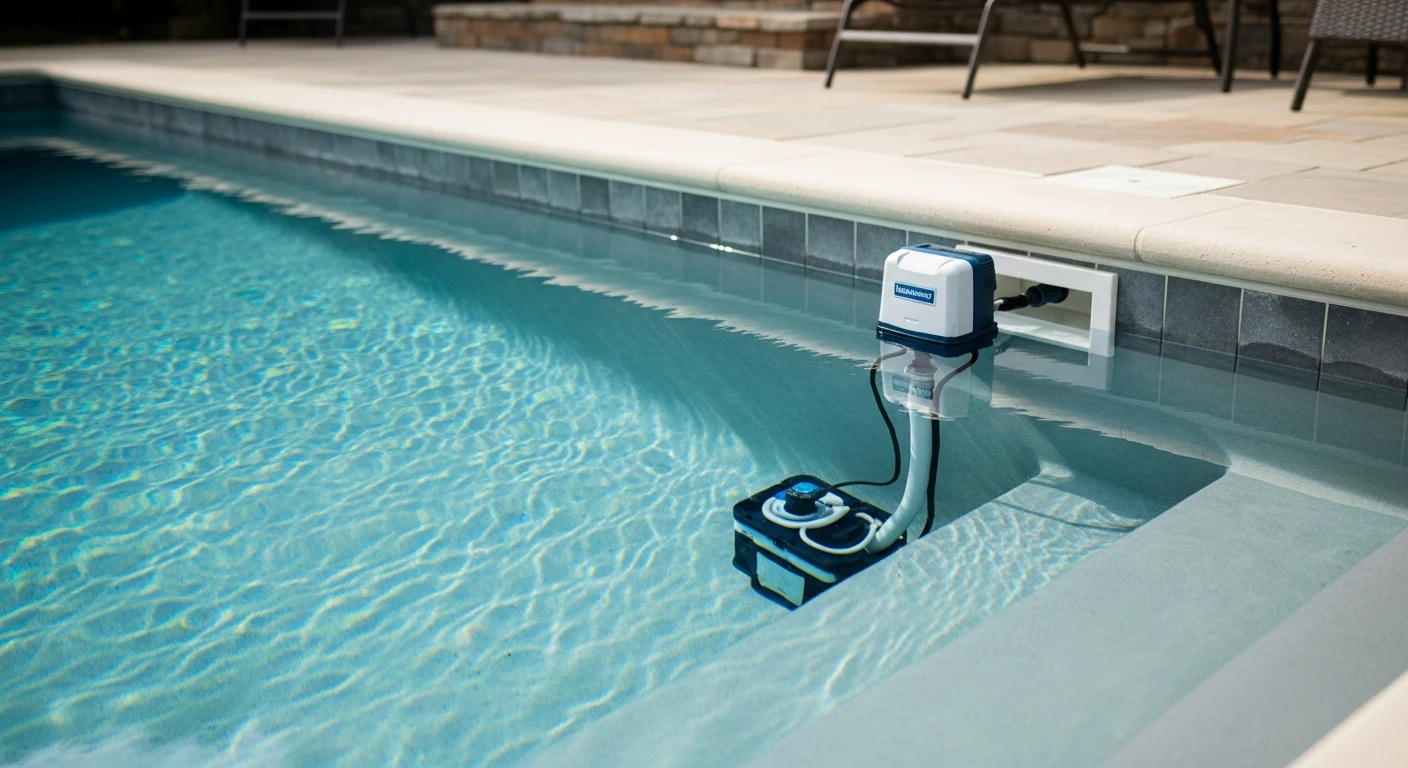
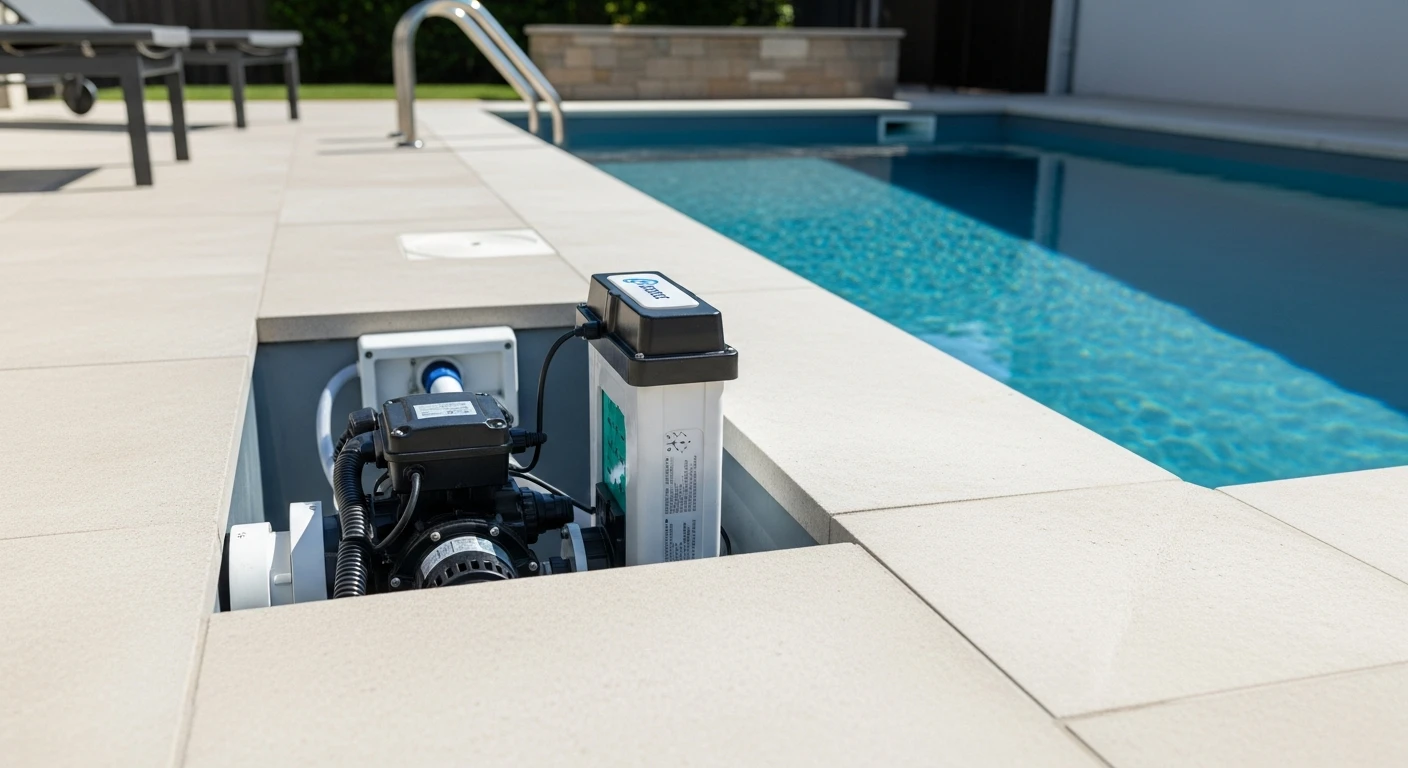
- SWG Installation & Plumbing Verification: The SWG cell must be installed last in the plumbing line, after the filter and heater. I've seen installations where it was placed before the heater, causing super-chlorinated water to accelerate corrosion of the heater's internal components. This is a costly and entirely avoidable error.
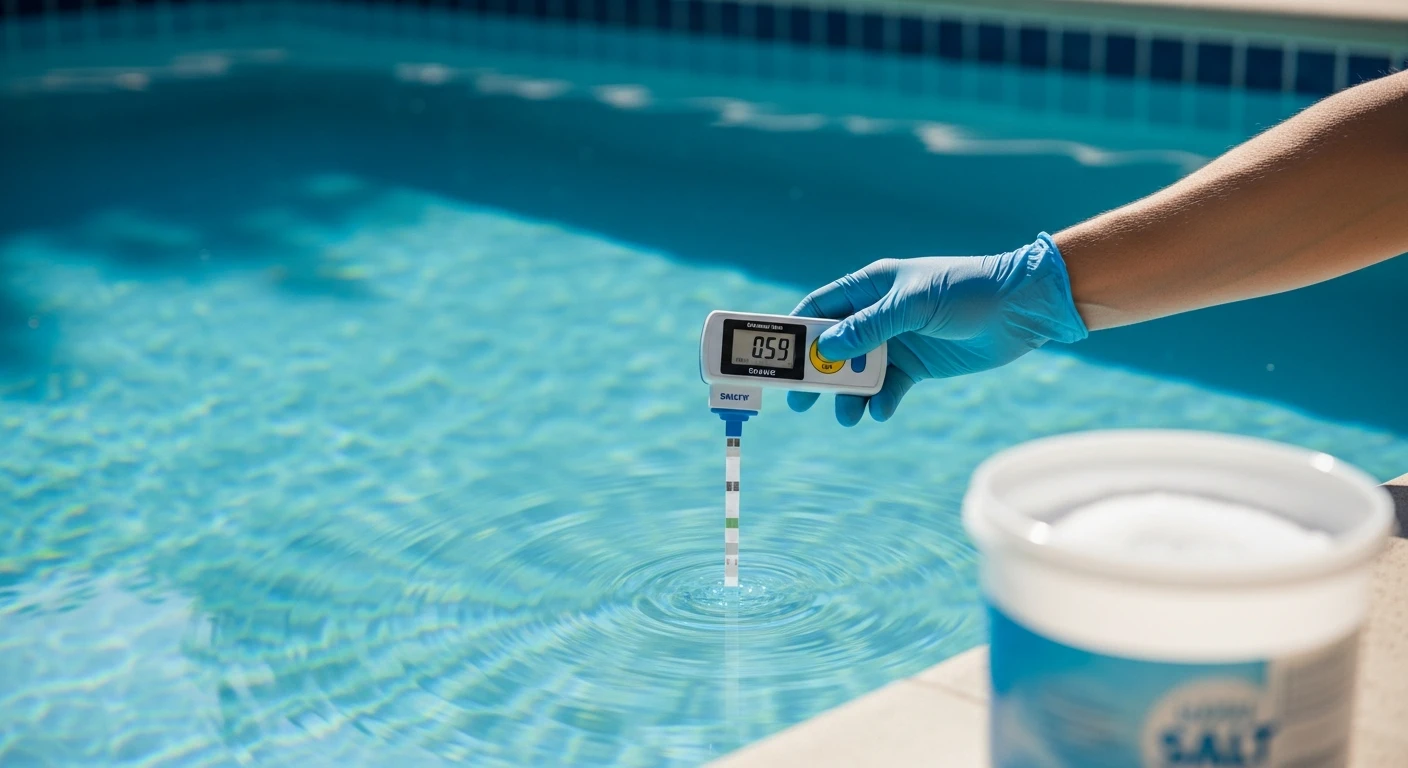
- System Calibration: After the salt has fully dissolved and the Total Dissolved Solids (TDS) reading is stable (typically 3200-3400 ppm), I power on the SWG and calibrate its output based on my initial load assessment, not a generic percentage.
Precision Tuning and Quality Standards
The job isn't done after installation. The first two weeks are critical for dialing in the system. I monitor the Free Chlorine (FC) levels daily, adjusting the SWG's output percentage until it consistently maintains the target FC level with a reasonable daily run time. My quality standard is a system that can maintain 3-5 ppm of FC while running no more than 8-10 hours a day during the peak summer season. A crucial, often-overlooked element for saltwater pools in Florida is preventing galvanic corrosion. The slightly conductive saltwater can cause metal components (like ladders, lights, and heater cores) to corrode prematurely. I always install a sacrificial anode in the plumbing. This small zinc component corrodes instead of the more expensive equipment, extending the life of the entire system. It’s a non-negotiable part of my quality standard. Given all the variables that impact a saltwater pool in our climate, are you certain your system's output is based on your pool's actual environmental load, or just its volume?Written by

Tags
best salt water pool system
best pool salt system
salt water system
Switching to a saltwater system
Saltwater Pools in Hillsborough FL FAQ
Is a saltwater pool really chlorine-free and better for my skin?
No, a saltwater pool is not chlorine-free; it uses a salt chlorine generator to create its own chlorine from salt. The process produces a more stable and less harsh form of chlorine, which is why it feels softer on the skin and eyes and lacks the strong chemical odor of traditional pools. This on-site production avoids the need to handle and store liquid or tablet chlorine. However, the water must still be tested and balanced regularly, maintaining a pH between 7.2 and 7.6 to ensure the chlorine produced is effective and non-corrosive.
Will the salt damage my concrete pool deck, coping, and equipment?
Yes, salt is corrosive and can damage certain materials over time if they are not properly selected and maintained. Porous materials like natural stone coping and unsealed concrete decking are particularly vulnerable to salt crystal formation and spalling. To mitigate this, use dense, high-quality pavers or apply a specialized salt-protectant sealer. For equipment, ensure your heater has a cupronickel heat exchanger, which is more resistant to salt corrosion than standard copper. Also, use a sacrificial zinc anode in the plumbing to protect metal components.
My 'Check Salt' light is on, but my salt level tests fine. What's wrong?
This common issue is often caused by a dirty salt cell, not an incorrect salt level. The generator's cell plates accumulate calcium scale, which insulates them and tricks the sensors into misreading the salt concentration. Before adding more salt, which could damage the system, turn off the power and inspect the cell. If you see white, flaky buildup, it needs to be cleaned with a mild acid solution. Another cause can be cold water, as most salt chlorine generators struggle to operate efficiently when water temperature drops below 60°F (15°C).
Why is my saltwater pool still turning green or cloudy?
Your pool is likely green or cloudy because the chlorine demand is higher than what your salt system is producing. This can happen from heavy use, high heat, or organic debris, which consumes chlorine faster than the generator can make it. Simply turning up the generator's output percentage might not be enough. You may need to use the 'super chlorinate' or 'boost' function for 24 hours. Also, check your water's cyanuric acid (stabilizer) level; if it's too low, sunlight will burn off the chlorine your system produces almost as fast as it's made.
Can I convert my existing vinyl liner or fiberglass pool to salt?
Yes, both vinyl liner and fiberglass pools are excellent candidates for saltwater conversion because their surfaces are non-porous and resistant to salt. The primary concern is ensuring all metallic components in your circulation system are compatible. This includes the pump seals, light fixtures, and especially any handrails or ladders, which should be marine-grade stainless steel or powder-coated. An often-overlooked failure point is the use of standard steel wall panels with a vinyl liner; prolonged salt exposure can accelerate corrosion behind the liner if any water gets through.
How often do I need to add more salt to the pool?
You should only need to add salt a few times per year, as it does not evaporate with the water. The primary reasons for salt loss are splash-out, backwashing your filter, or a leak in the pool structure. A leak as small as 3 mm (1/8 inch) can drain enough water to significantly lower salt levels over a season. Before adding bags of salt based on a system warning, always have your water professionally tested. Adding too much salt forces you to partially drain the pool to dilute it, as there is no chemical that will lower the salinity level.