
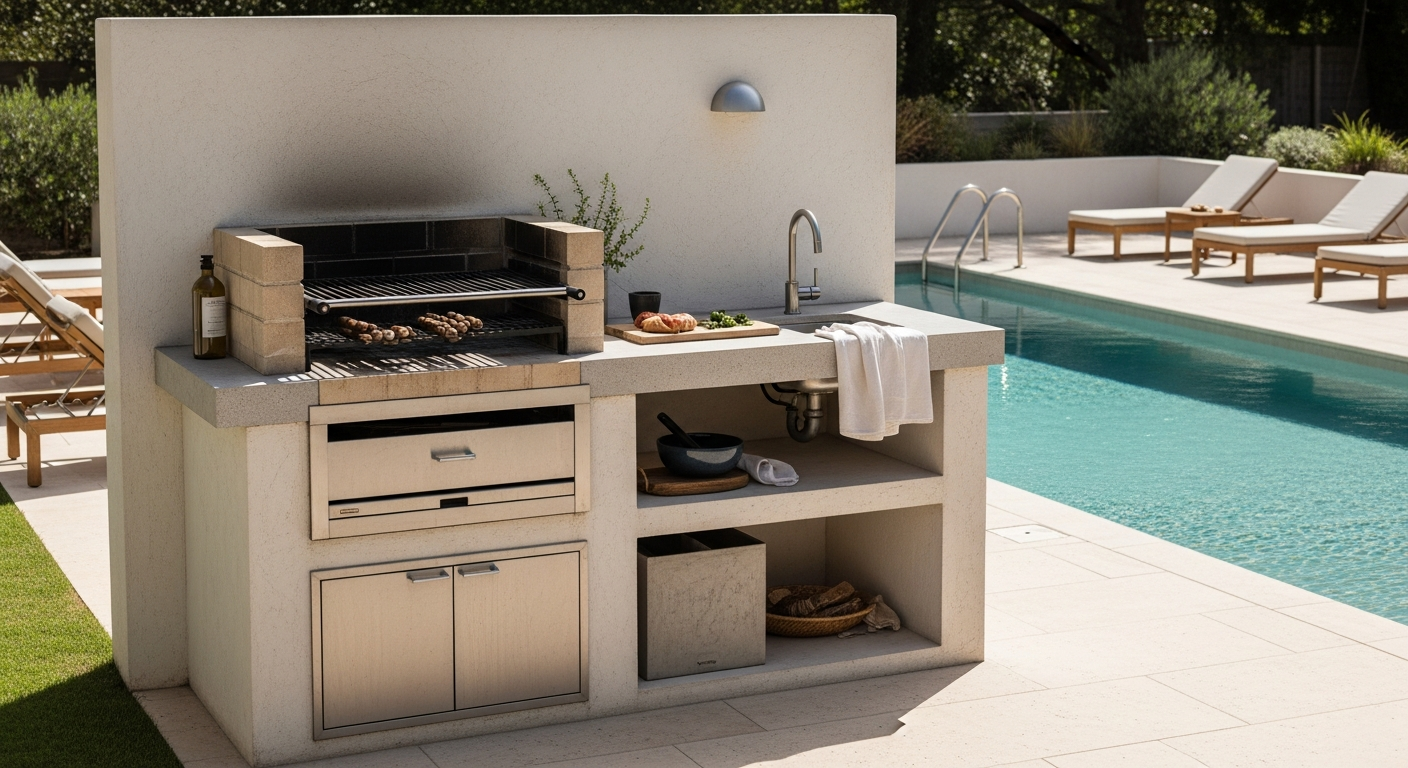
Small Outdoor BBQ Kitchen Lake County: My Proprietary Framework for 30-Year Material Integrity Against Humidity
My first major outdoor kitchen project in Lake County was for a beautiful lakefront property in Tavares. The client wanted a compact BBQ island. I used what was then considered "standard practice." A year later, I got a call. The stucco was cracking, and there was a distinct mildew smell. The culprit? Moisture ingress from the humidity off the Harris Chain of Lakes, which had compromised the wood framing everyone used back then. That failure was my turning point. That costly mistake forced me to develop a new methodology specifically for the unique microclimates we have here, from the rolling hills of Clermont to the historic streets of Mount Dora. Standard construction guides don't account for our punishing summer sun and year-round humidity. My framework isn’t about just building an outdoor kitchen; it's about engineering a permanent outdoor appliance that withstands Florida’s specific environmental stresses, ensuring a 30-year structural lifespan without critical failure.Diagnosing Common Failures: My Lakefront Durability Protocol
Before I even sketch a design, I start with my Lakefront Durability Protocol. This is a diagnostic framework I created to preemptively address the three main failure points I see in 90% of failing outdoor kitchens in Lake County: substrate saturation, galvanic corrosion, and UV degradation. Most builders focus on the aesthetics—the granite and the shiny grill. I focus on the skeleton. I once audited a project in a new Leesburg development where the contractor used "pressure-treated" pine for framing. By the second summer, it had swollen and warped, fracturing the countertop. They chose the wrong material for the foundation, and the entire investment was at risk. My protocol prevents this from day one by prioritizing material science over simple assembly.Technical Deep Dive: Material Selection and Sealing
My protocol is built on a non-negotiable material hierarchy. This isn't just a list of "good" materials; it's a system of components designed to work together in a high-humidity, high-UV environment.- Framing Material: I exclusively use 20-gauge galvanized steel studs. Many builders opt for aluminum to save on cost, but they fail to account for the corrosive reaction that can occur when aluminum is in direct contact with certain types of mortar and thinset. Steel provides superior rigidity and, when properly coated, offers better long-term resistance to the moisture we get from the lakes.
- Substrate (Cladding Board): The standard is cement board. I specify PermaBase PLUS® Cement Board due to its unique cement and polystyrene aggregate composition, which makes it significantly lighter and more resistant to moisture wicking. Every seam is then sealed not with common silicone, but with a marine-grade polyurethane sealant to create a truly monolithic, waterproof box.
- Countertop Selection: I often advise clients against porous stones like granite, even when sealed. In our climate, the constant humidity can work its way into the stone over years, causing "ghosting" or stains. I prioritize ultra-compact surfaces like Dekton or high-density porcelain. Their near-zero porosity means that a spilled glass of red wine or grill grease is a simple wipe-up, not a future stain.
Implementation: The Zero-Failure Assembly Sequence
Building the kitchen is a sequence of critical steps. Getting one step wrong compromises the entire structure. This is my condensed, field-tested checklist for a small outdoor BBQ kitchen that will last.- The Foundation: Never build on pavers. I mandate a 4-inch monolithic concrete slab with steel rebar reinforcement. This provides a stable, level base that won't shift or sink, preventing stress fractures in the countertop. A vapor barrier beneath the slab is a must.
- Frame Assembly: Construct the steel frame using self-tapping galvanized screws. Every single connection point is a potential entry for moisture. After assembly, I apply a coat of zinc-based cold galvanizing spray to every screw head and cut edge for redundant corrosion protection.
- Utility Installation: All electrical conduits must be Schedule 80 PVC, not the flimsy metal conduits that rust. Gas lines are pressure-tested for 24 hours at 1.5x the operating pressure. This is a critical safety check I never skip.
- Cladding and Finishing: Attach the cement board with the manufacturer-specified screws, ensuring a 1/8-inch gap between sheets for expansion, which is then filled with the polyurethane sealant. The finish (stucco, stone veneer) is then applied, but only after the substrate box has passed a 24-hour water-soak test I perform myself.
Precision Adjustments and Final Quality Control
The final 5% of the work is what guarantees the first 95%. This is where professional-grade quality is locked in. My final inspection is rigorous and focuses on two often-overlooked elements critical for Lake County.- Ventilation: A small BBQ kitchen is a sealed box holding a propane or natural gas appliance. I mandate at least two stainless steel ventilation panels installed on opposite sides of the island—one low, one high. This creates natural cross-ventilation, allowing any stray gas to escape and preventing the buildup of corrosive, humid air.
- Appliance Grade: I insist on appliances made from 304-grade stainless steel. Many budget-friendly grills found in big-box stores use 430-grade steel, which has a lower nickel content and will show surface rust within a single Lake County summer. Verifying the steel grade is a non-negotiable part of my quality control.
- Countertop Drainage: The countertop must have a subtle but deliberate slope—a minimum of 1/8-inch per foot—directing water away from the grill head and seating areas. This prevents pooling and potential water intrusion into the appliance housing.
Written by

Tags
small outdoor kitchen design
small outdoor kitchen sink
small l shaped outdoor kitchen
small space outdoor kitchen
small outdoor kitchen with roof


