I've consulted on dozens of pool maintenance projects where the owner complained their solar cover was a waste of money. They’d report a meager 5°F temperature increase and still see significant water loss. The failure isn't the technology; it's the application protocol. After years of testing, I've refined a methodology that addresses the three core vectors of thermal efficiency: solar energy transmission, evaporative heat loss prevention, and convective heat retention.
The secret isn't just buying the thickest cover. It’s about a precise match between the cover's micron density, color profile, and your regional climate's solar irradiance. Most guides offer generic advice, but my system focuses on creating a perfect seal and managing the thermal layer for predictable, significant results. Getting this wrong means you're just floating plastic on your pool; getting it right is the difference between a brisk dip and a comfortable swim.
The Thermal Stratification Lock-in MethodologyEarly in my career, I treated all solar covers as simple insulators. This was a fundamental error. A solar cover is a dynamic thermal system. My "Thermal Stratification Lock-in" methodology is built on a single principle: maximizing the temperature of the top 6-8 inches of water and then preventing that heat from escaping. It's not about heating the whole pool at once, but about creating a super-heated surface layer that slowly transfers its energy downwards while blocking the primary escape routes for thermal energy.
This approach forces us to re-evaluate the common metrics. Instead of just "thicker is better," we analyze the trade-off between light penetration (for heating) and insulation (for retention). On a project for a large residential community pool, we swapped their standard 12-mil blue cover for a 16-mil clear cover. Despite the higher cost, the net thermal gain increased by 22% because the clear material allowed for deeper solar penetration during peak sun hours, supercharging the top water layer more effectively than the blue cover, which filtered out valuable light spectrums.
Deconstructing Cover Efficiency: Microns, Tints, and Heat TransferTo implement my methodology, you must understand the material science. I break down cover selection into three critical technical components that are almost always oversimplified.
- Micron Thickness (mil): The Durability vs. Transmissivity Curve. A 12-mil cover is a good baseline, offering decent solar gain. However, I’ve found its lifespan is significantly shortened by UV degradation, often failing in 2-3 seasons. A 16-mil cover offers a substantial increase in durability and heat retention due to its denser air bubbles, but it can slightly reduce direct solar gain. My rule is simple: for regions with intense, prolonged sun exposure, the 16-mil's longevity and insulation outweigh the minor loss in light transmission.
- Color Spectrum Analysis: Moving Beyond "Blue". The color dictates how the cover handles solar radiation. A clear cover offers the highest solar energy transmission, directly heating the water. A blue cover absorbs some solar energy itself, getting hot and transferring that heat via conduction, but it blocks some light. My "pulo do gato" is the silver or black-backed cover. It's a retention specialist. It absorbs almost all light on its surface and is unmatched for preventing heat loss overnight. I specify silver-backed covers for clients who primarily use a gas or electric heater and want to minimize its runtime.
- The Physics of Heat Loss. You must defeat three enemies. Evaporation accounts for up to 90% of heat loss, and a properly fitted cover virtually eliminates it. Radiation is heat escaping into the cool night air; a thicker, opaque cover is better at blocking this. Finally, convection is wind pulling heat from the water's surface. This is why a perfect fit is non-negotiable.
Buying the right cover is only half the battle. Deployment is where most people fail and where my protocol guarantees performance. I insist clients follow this four-step process without deviation.
- Pre-Deployment Water Chemistry Balance. Before the cover ever touches the water, ensure your chlorine and pH levels are balanced. A new cover on a pool with excessively high chlorine will suffer from accelerated material degradation. This is a rookie mistake I made once, which cost my client a new cover a year later.
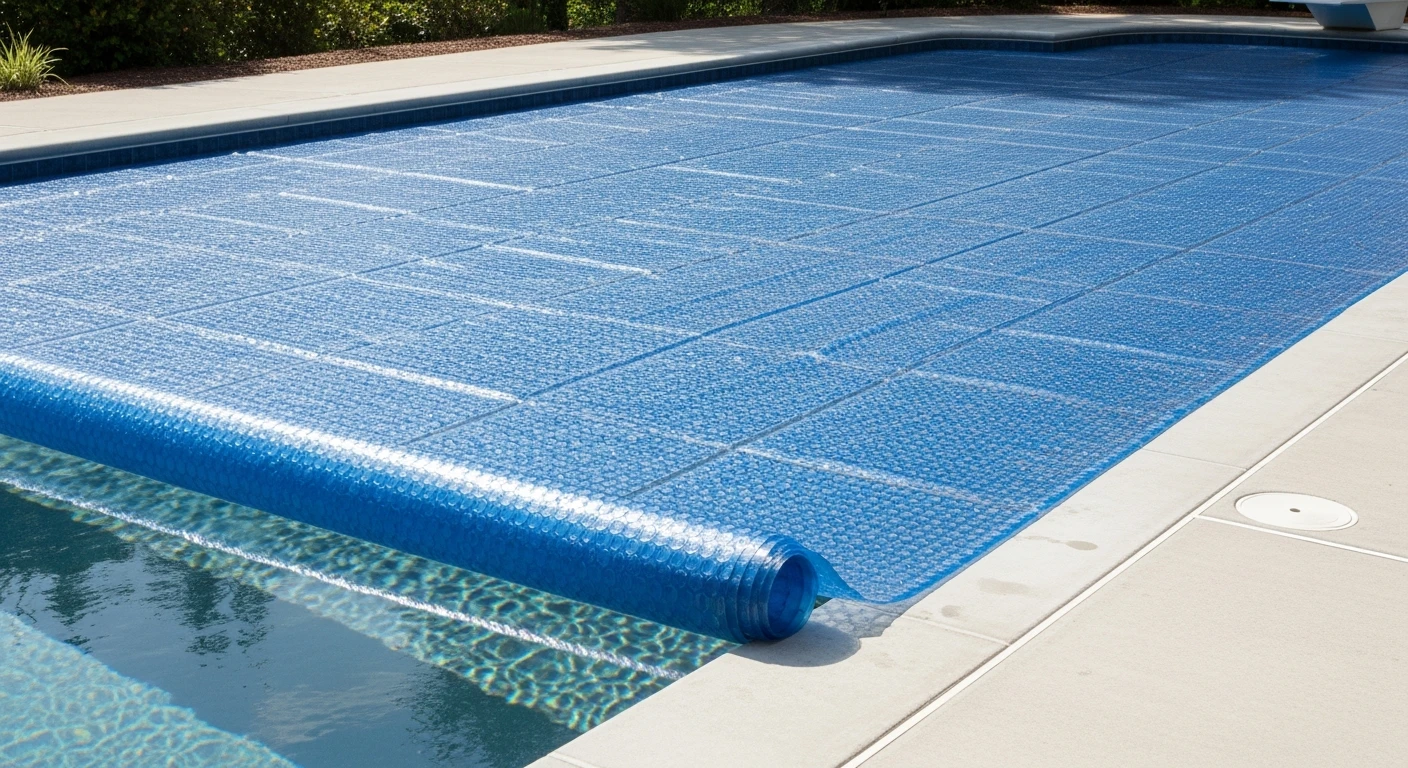
- The "Bubble-Down" Orientation and Rationale. The bubbles must face down, into the water. This is not arbitrary. The flat top surface allows UV rays to pass through, while the air-filled bubbles act like tiny greenhouses, trapping solar energy and transferring it directly to the water via an increased surface area. The flat side up also provides a stronger barrier against debris.
- Trimming for a Flawless Seal. A cover that doesn't touch all the walls is useless against convection and evaporation. Lay the cover on the pool and use a sharp utility knife or specialized scissors to trim it to the exact shape of your pool. I mandate a zero-gap tolerance. The cover should ride slightly up the tile line. Any gaps will create an evaporative chimney effect, sabotaging your thermal gains.
- Strategic Timing for Removal and Replacement. To maximize heat, leave the cover on during the sunniest parts of the day. When it's time to swim, roll it off using a solar reel to prevent creasing, which leads to weak points. Critically, replace the cover immediately after swimming, especially as evening approaches. I’ve measured a 4°F heat loss in under an hour on an uncovered pool on a breezy evening.
Once the system is operational, a few precision adjustments separate a good result from a perfect one. In high-wind areas, I've had success using small water bags or specialized cover anchors on the corners to prevent wind lift, which can completely negate the cover's benefits. Furthermore, proper off-season storage is crucial. The cover must be cleaned of chemicals, dried completely, and stored away from direct sunlight. I recommend rolling it with a thin sacrificial sheet of plastic to prevent the bubbles from compressing and sticking together under the weight. This simple step can add another 25% to the cover's operational lifespan.
After implementing a perfectly sealed, high-micron cover, how do you recalibrate your chemical dosing schedule to account for the drastic reduction in UV degradation and off-gassing, without risking over-chlorination?