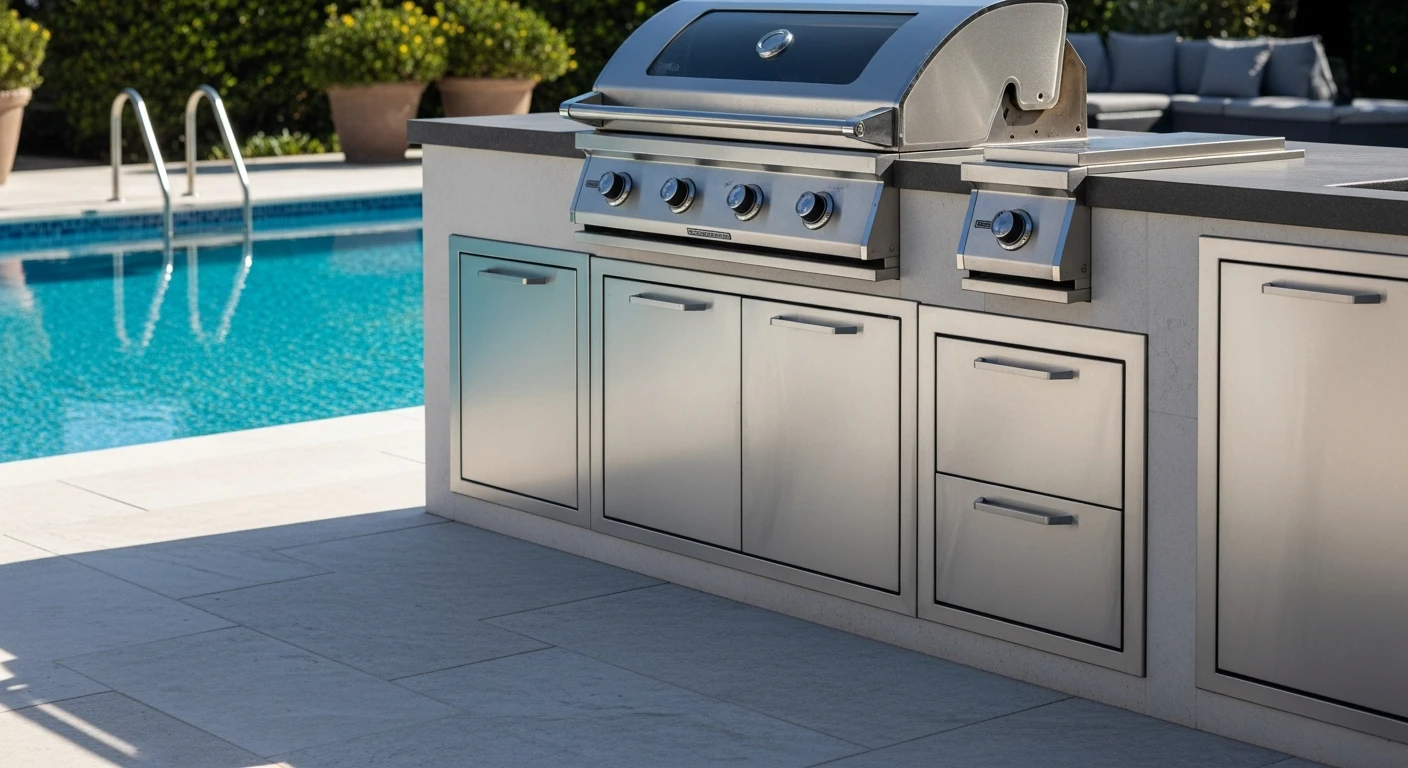
Stainless Outdoor Cabinets: The Grade Selection Protocol for a 30% Lifespan Extension
As an outdoor kitchen designer, I've seen firsthand how the wrong material choice can lead to catastrophic failure in just a few seasons. The most common mistake clients make is assuming "stainless steel" is a single, indestructible material. This misconception is costly. The real key to a lasting outdoor kitchen isn't just choosing stainless steel, but specifying the correct grade and construction methodology from the outset. My entire process is built on preventing premature corrosion and structural warping, which begins long before the cabinets are even ordered.
My approach sidesteps the generic advice and focuses on two critical, often overlooked, variables: the environmental chloride level and the cabinet's fabrication method. I learned this the hard way on a coastal project where a client's beautiful, but improperly specified, 304-grade cabinets developed significant "tea staining" and pitting within 18 months. That failure forced me to develop a proprietary assessment protocol that has since become the standard for all my high-end installations, directly increasing the functional lifespan of the asset.
My Unified Framework for Assessing Cabinet Integrity
Before I even consider a brand or style, I perform a three-point diagnostic on the project's requirements. This isn't about aesthetics; it's about engineering a solution that will withstand the elements. Many manufacturers focus on features, but I've found that the foundational integrity comes down to these core technical pillars. Ignoring them is the number one reason for warranty claims and client dissatisfaction down the line.
My methodology, which I call the "Material-Weld-Hardware Trinity," analyzes the cabinet system as a whole. A chain is only as strong as its weakest link, and in outdoor cabinetry, that weak link is almost never the flat panel of the door; it's the corner weld, the hinge pin, or the drawer slide. I insist on seeing cross-sections or corner samples from manufacturers to verify their claims, a step most designers skip.
Beyond the Spec Sheet: 304 vs. 316 Grade and the Molybdenum Factor
The technical heart of my selection process is choosing the correct stainless steel grade. For 80% of inland projects, 304-grade stainless steel is sufficient. It contains 18% chromium and 8% nickel, providing good corrosion resistance. However, for any project within 50 miles of a coastline or near a saltwater pool, I mandate the use of 316-grade stainless steel. The critical difference is the addition of molybdenum (typically 2-3%). This element drastically enhances resistance to chlorides, which are the primary culprits behind pitting and crevice corrosion. This is a non-negotiable specification for longevity in harsh environments.
Furthermore, I scrutinize the steel's gauge. I refuse to work with anything thinner than 18-gauge steel for structural components. While some brands use 20-gauge to cut costs, it lacks the rigidity to prevent warping under thermal expansion and the weight of granite countertops. Finally, I look for a fully welded construction. Knock-down or bolted cabinets introduce seams and fasteners that become moisture traps and points of failure. A continuous, polished weld is a sign of superior craftsmanship and structural soundness.
Pre-Installation Checklist: From Leveling to Hardware Fortification
A perfect cabinet can be ruined by a poor installation. My team follows a strict sequence to ensure the foundation is flawless, which prevents door binding and water intrusion issues years later. This is where theory meets practice, and small details make all the difference.
- Base Platform Verification: The concrete or paver pad must be perfectly level. We use a laser level to check for deviations. A variance of more than 1/8 inch across a 10-foot run requires self-leveling compound before a single cabinet is placed.
- Strategic Leg Adjustment: Every cabinet leg is individually adjusted to achieve perfect alignment. We start with the corner cabinet and work outwards, clamping adjacent cabinets together with cabinetry clamps before bolting them to ensure a monolithic and seamless front.
- Hardware Integrity Check: During assembly, we inspect all supplied fasteners. On more than one occasion, I've found that a premium cabinet brand supplied inferior 400-series stainless screws for their 304-grade cabinets. We replace them with 316-grade stainless fasteners across the board to prevent the hardware from becoming the initial point of rust.
- Countertop Support Planning: We ensure the cabinet layout provides adequate support for the countertop material, especially at sink and grill cutouts, to prevent stress fractures in the stone over time.
Tags
stainless steel outdoor grill cabinets
stainless steel exterior cabinets
stainless steel outdoor kitchen cabinet inserts
outdoor cabinet with stainless steel top
modular stainless steel outdoor kitchen cabinets