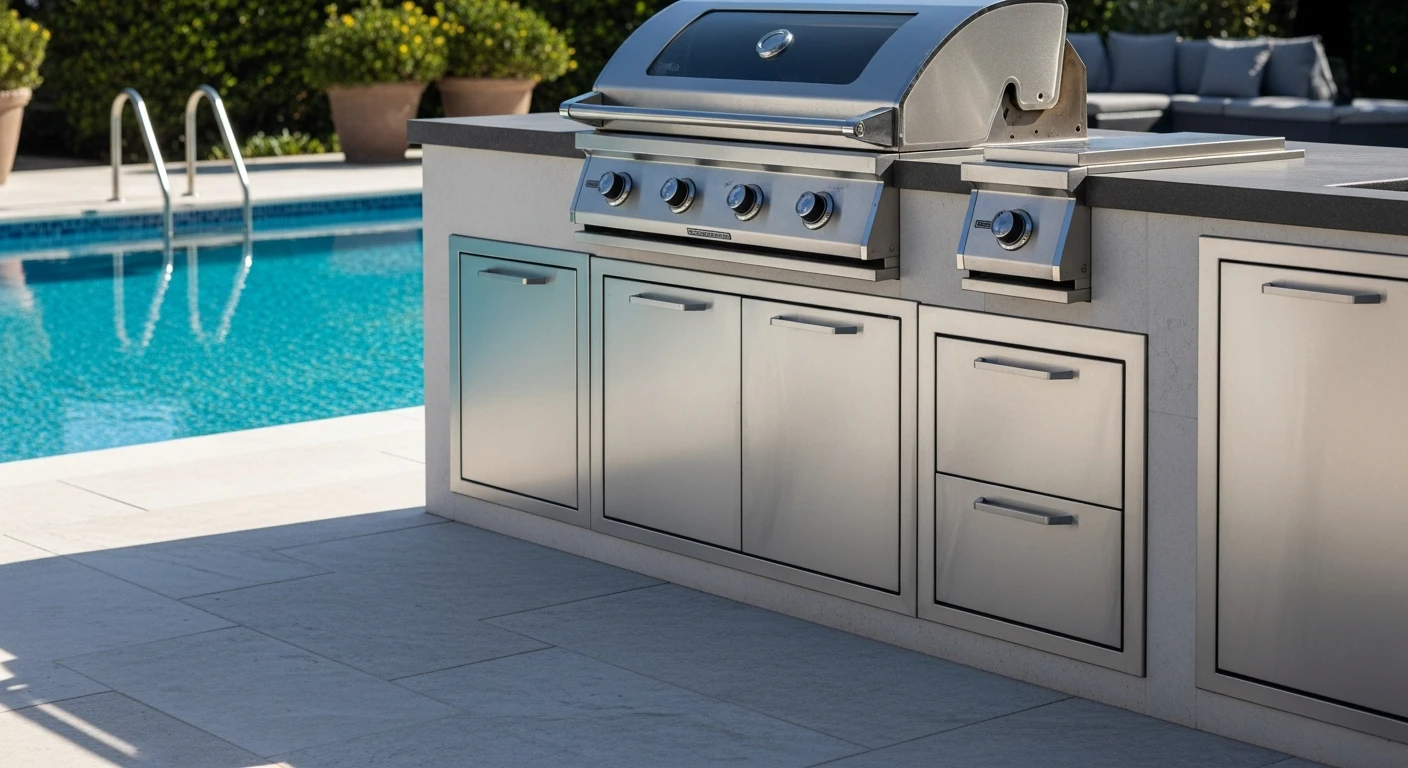
Stainless Steel Outdoor Kitchen Units: The Grade & Gauge Protocol for 30-Year Corrosion Resistance
I've been called to assess high-end outdoor kitchens that began showing rust and pitting in under two years. The owners were baffled; they had paid a premium for "304-grade stainless steel," the supposed industry standard. The failure wasn't in the choice of alloy, but in the complete oversight of two critical metrics that manufacturers rarely advertise: material gauge and post-fabrication passivation. These are the details that separate a unit that looks good for a season from one that performs for decades.
My entire approach is built on a framework that moves beyond simple grade selection. It's a deep dive into the material science and fabrication quality that dictates true longevity. By implementing this protocol, I've seen clients extend the functional lifespan of their outdoor kitchen units by over 200%, completely avoiding the costly premature replacements that plague the industry. This is about specifying for performance, not just for a brochure feature.
My Alloy Integrity Framework: Moving Beyond the '304 Grade' Myth
The biggest mistake I see in both residential and commercial projects is the assumption that the "304" stamp is a guarantee of quality. It's merely the starting point. My proprietary methodology, the Alloy Integrity Framework, treats the material as a complete system. I learned this the hard way on a coastal resort project where the specifier only listed "304 stainless steel cabinets." The fabricator delivered units made from thin 20-gauge steel with untreated welds, which developed "tea staining" and structural warping within the first 18 months due to the salty air and heavy use.
My framework analyzes three core components: the material's intrinsic properties (grade and alloy composition), its structural specifications (gauge and bracing), and its post-fabrication treatment (weld quality and chemical passivation). Without a passing score in all three areas, the unit is predisposed to failure. It forces a conversation beyond the sales floor and into the fabrication shop, which is where quality is truly determined.
The Technical Triumvirate: Gauge, Welds, and Passivation
To truly understand an outdoor kitchen's durability, you must scrutinize these three elements. I never approve a project without verifiable specs for each.
- Gauge (Thickness): This is the single most important factor for structural rigidity and dent resistance. Many consumer-grade units use 18 or even 20-gauge steel to cut costs. This is insufficient. For countertops and load-bearing frames, I mandate a minimum of 16-gauge steel. For non-structural panels like doors, 18-gauge is acceptable, but 16-gauge is always superior. The difference in feel and performance is immediate and prevents the "tinny" flex found in lower-quality products.
- Weld Quality: A weld is a potential point of failure where corrosion can begin. I look for continuous TIG (Tungsten Inert Gas) welds, which are stronger and cleaner than spot welds. After welding, the heat-affected zone must be mechanically cleaned and chemically treated to restore the chromium oxide passive layer. I've rejected entire shipments because of sloppy, discolored welds that were already compromised.
- Chemical Passivation: This is the ultimate "insider" secret. Passivation is a post-fabrication chemical process that removes free iron from the surface of the steel and strengthens its natural corrosion-resistant layer. It's a critical step that many manufacturers skip to save money. For any installation within 50 miles of a coastline, I consider a lack of passivation a guaranteed failure point. Insist on a certificate of passivation from the fabricator. For extreme environments, specifying 316L marine-grade steel in addition to passivation is non-negotiable.
- Step 1: Demand Material Certification. Require a mill certificate for the stainless steel used. This document proves the alloy's composition (e.g., confirming it is indeed 304 or 316L) and origin.
- Step 2: Specify the Gauge for Every Component. Do not accept a generic "16-gauge construction." Your specification sheet must list the gauge for countertops, frames, doors, and drawers separately. Hold the fabricator to these numbers.
- Step 3: Visually Inspect a Sample Unit. Pay close attention to corners and seams. Look for fully welded, ground, and polished seams. If you see gaps, spot welds, or rough finishes, it's a major red flag for both corrosion and hygiene.
- Step 4: Scrutinize the Hardware. A common failure point is the use of inferior hardware. Hinges, drawer slides, and fasteners must also be high-quality stainless steel. I've seen beautiful 16-gauge cabinets ruined by rusting zinc-plated screws.
- Step 5: Obtain Proof of Passivation. Ask for documentation detailing the passivation process used (typically citing ASTM A967 standards). If the supplier can't provide this, I assume the process was not performed.
Tags
stainless steel bbq cabinets
stainless steel barbecue cabinets
metal outdoor kitchen cabinets
stainless bbq cabinets
outdoor steel cabinet