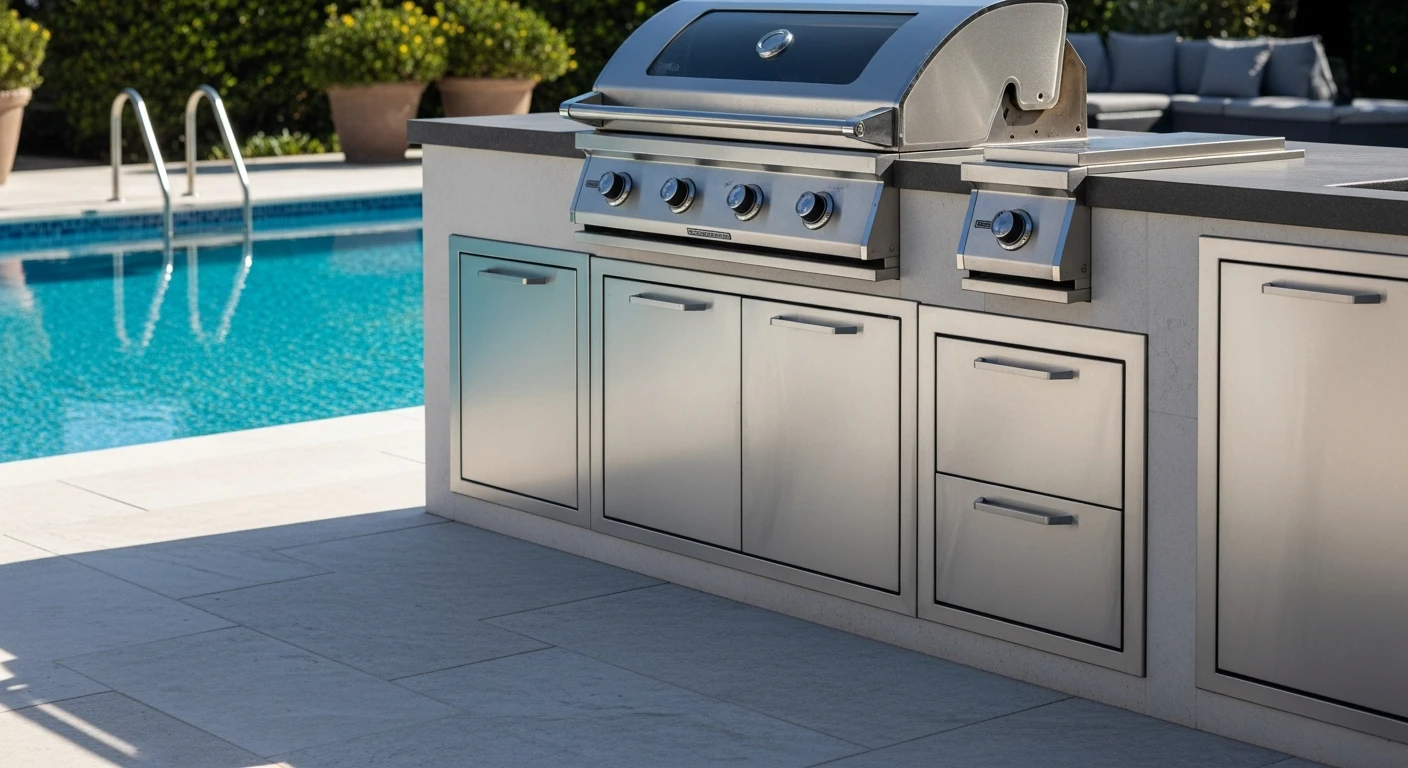
Stainless Steel Outdoor Kitchen Units: My 316L Marine-Grade Protocol for Zero Rust in Manatee County
After years of designing and specifying outdoor kitchens across Manatee County, I can tell you the single most expensive mistake homeowners make isn't choosing the wrong grill—it's selecting the wrong grade of stainless steel for our specific coastal environment. I've been called in to assess failing, rust-spotted units less than two years old in beautiful homes from Lakewood Ranch to Anna Maria Island. The issue is almost never a "bad product," but a fundamental misunderstanding of how our local humidity and salt spray attack metal. The standard **304-grade stainless steel**, often marketed as sufficient, simply lacks the molybdenum content required to resist the chloride-rich air we experience, especially west of I-75. My entire methodology is built around preventing this predictable failure. It’s not about overspending; it’s about a one-time investment in the correct material science to guarantee longevity against the harsh Florida elements, saving thousands in premature replacement and repair costs.My Coastal Corrosion Audit: A Pre-Purchase Diagnostic
Before a single dollar is spent on appliances or cabinetry, I perform what I call the **Coastal Corrosion Audit**. It's a proprietary assessment I developed after seeing a high-end installation on Longboat Key show tea-staining within six months. The contractor had used 304-grade units, assuming they were "good enough." They weren't. My audit focuses on two critical, non-negotiable variables: the specific micro-environment of the property and the material's chemical composition. It dictates a precise material specification that I will not deviate from.The Technical Divide: 316L vs. 304 Grade and Chemical Passivation
The core of the problem lies in the metallurgy. **304-grade stainless steel** is a fantastic material for indoor applications or dry climates. Here in Manatee County, it's a ticking time bomb. The air, particularly on our barrier islands, is saturated with chlorides (salt). These chlorides attack the passive chromium oxide layer of 304 steel, causing pitting and crevice corrosion. My protocol mandates the use of **316L marine-grade stainless steel**. The "L" signifies low carbon content, which minimizes carbide precipitation during welding, a major source of corrosion. More importantly, 316L contains molybdenum, an element that provides a massive boost in resistance to chloride corrosion. Furthermore, I insist on a post-fabrication **passivation** process. This is a chemical treatment that removes free iron from the surface and strengthens the protective chromium oxide layer. I’ve seen fabricators skip this step to cut costs, a fatal error that leaves even 316L steel vulnerable at its weld seams. It is a non-negotiable step in my quality control checklist.Implementation: The Zero-Failure Installation Checklist
Executing the installation correctly is as critical as selecting the right material. A pristine 316L unit can be compromised by a single incorrect fastener. I use a strict checklist for every project, whether it's for a new construction in Parrish or a waterfront renovation in Bradenton.- Material Verification: I require the fabricator to provide a Material Test Report (MTR) for the 316L steel sheets used. This is my proof of a material's origin and chemical makeup.
- Weld Seam Inspection: All welds must be smooth, fully penetrated, and free of discoloration. A blue or blackened weld indicates excessive heat, which destroys the corrosion resistance at the seam. It must be ground, polished, and re-passivated.
- Fastener Audit: Every single screw, bolt, and hinge must also be **316L stainless steel**. Using a cheaper 304 or zinc-plated screw will create a **galvanic corrosion** cell, where the less noble metal sacrifices itself and causes aggressive rust streaks on your expensive unit. This is the most common installation error I find.
- Site Drainage Plan: The base of the kitchen units must be installed on a perfectly level concrete pad with a slight grade away from the cabinets. I ensure no water can pool at the base, which is a primary catalyst for corrosion, especially with lawn fertilizers and pool chemicals present.
Precision Tuning and Long-Term Integrity Protocols
Once installed, the unit isn't just "finished." It requires a specific maintenance protocol tailored to its location within Manatee County. For a home on the Manatee River, I recommend a weekly rinse with fresh water and a monthly cleaning with a pH-neutral, chloride-free cleaner. For a home further inland, like in Parrish or Myakka City, a monthly rinse is often sufficient. The key is to never, ever use abrasive pads like steel wool or cleaners containing bleach, as they will instantly destroy the passive layer and induce rusting. I also advise on applying a specialized marine-grade wax or sealant twice a year to add an extra hydrophobic barrier against the elements. Instead of just accepting the standard "stainless steel" option, have you confirmed with your builder if they are using 316L grade for the fasteners and if the fabricator performs a nitric acid passivation post-welding?Written by

Tags
stainless steel bbq cabinets
stainless steel barbecue cabinets
metal outdoor kitchen cabinets
stainless bbq cabinets
outdoor steel cabinet