Average Cost for an Outdoor Kitchen in Sarasota: My Framework for Preventing Salt-Air Corrosion & Maximizing ROI
I've personally designed and overseen outdoor kitchen projects from the waterfront estates on Longboat Key to the newer developments in Lakewood Ranch, and the number one question is always cost. The quick answer is a range from $15,000 for a simple, high-quality setup to well over $75,000 for a fully equipped culinary space. However, providing just a number is a disservice. The real cost in Sarasota isn't just in the appliances; it's in building a structure that can withstand our specific coastal environment—the relentless sun, high humidity, and corrosive salt air. The most expensive mistake I see homeowners make is underestimating material degradation. A project that looks stunning on day one can become a rusted, warped liability within three years if the wrong specifications are used. My entire approach is built on a "coastal-first" principle, ensuring your investment doesn't just survive but thrives, directly impacting your property's long-term value and your personal enjoyment.Deconstructing the True Cost: My Sarasota-Specific Auditing Process
Before I even talk about grill models or countertop colors, my process begins with a site-specific environmental audit. This isn't a simple measurement of the patio. It's a technical assessment that forms the foundation of an accurate budget and a durable build. I've seen projects in mainland neighborhoods like Arlington Park have vastly different requirements than a home directly on the water in Siesta Key, and this initial phase is where we identify those critical variables. My methodology involves a three-point check: Salt Spray Zone Analysis, UV Exposure Mapping, and a full review of local Permitting and HOA Covenants. For instance, I can determine the necessary grade of stainless steel and the type of protective powder coating needed based on your home's proximity to the Gulf. A home even a few blocks inland can often use 304-grade stainless steel, while a beachfront property absolutely requires the higher chromium and nickel content of marine-grade 316L stainless steel to prevent pitting and corrosion. This single choice can impact the budget by 15-20% but increases the lifespan of your cabinets and appliances by over 50%.Material Selection & Structural Integrity Under Coastal Stress
This is where the budget truly takes shape. The Sarasota climate is an unforgiving stress test for building materials. Early in my career, I learned the hard way that using a standard galvanized steel frame, which might be fine in a dry climate, is a recipe for disaster here. The humidity and salt will compromise it in a few short years. My non-negotiable standard for framing is either welded aluminum tubing or concrete block (CMU), depending on the desired finish and structural load. For cabinetry, I steer clients away from wood, even teak, which requires constant maintenance. The best options for our area are marine-grade polymers (like StarBoard) or sealed PVC. For countertops, while granite is a popular choice, I often recommend a high-density porcelain or Dekton. I've seen certain resin-heavy quartz countertops yellow over time due to intense UV exposure on a south-facing lanai—a costly error that my initial UV mapping helps prevent.The Phased Build-Out: A Cost-Control Blueprint
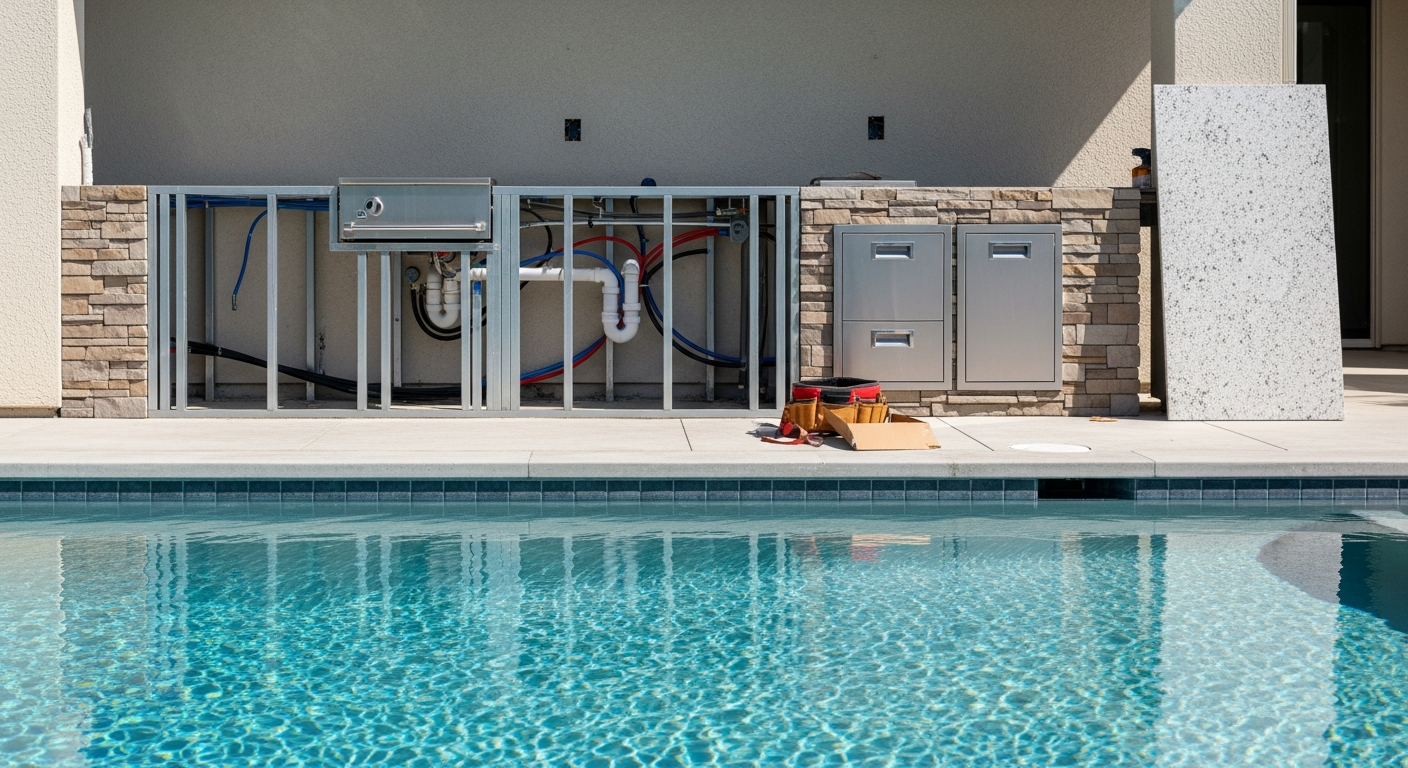
Breaking the project down into clear phases is critical for managing costs and ensuring no steps are missed. Here’s the exact implementation sequence I follow for every Sarasota outdoor kitchen project:- Phase 1: Site Preparation & Utilities. This involves precise layout marking and, crucially, running the necessary utilities before any construction begins. This includes trenching for a dedicated natural gas or propane line, plumbing for a sink and drain, and running a dedicated 20-amp GFCI electrical circuit for refrigerators and outlets. Proper drainage is also addressed here to prevent water from pooling against the structure, a common cause of premature failure.
- Phase 2: Structural Framing & Substrate. Once utilities are in place, the core frame is built. We then sheath the frame with a moisture-resistant substrate like a cement backer board. This step is a critical moisture barrier between the frame and the final finish material (like stone or stucco).
- Phase 3: Appliance & Component Installation. The grill, side burners, access doors, and refrigerator are fitted. I ensure every appliance has the correct clearance and, most importantly, the necessary insulated jacket if it's being installed into a combustible structure, a major safety and code requirement that is often overlooked.
- Phase 4: Cladding, Countertops & Finishing. The final veneer, whether it's stacked stone or stucco, is applied. The countertop template is made, and the final piece is installed. This is also when we install lighting, outlets, and any final trim.
Beyond the Basics: My Non-Negotiable Quality Checkpoints
There are a few details that separate a standard outdoor kitchen from a high-performance one designed for Sarasota. First is proper ventilation. A common error I've had to fix on other projects is a grill placed too close to the lanai ceiling without a vent hood. This leads to soot stains and potential fire hazards. A properly sized vent hood is essential for any covered outdoor kitchen. Second is lighting. I implement a layered lighting strategy using low-voltage, marine-grade LED fixtures. This includes task lighting directly over the grill, ambient lighting under the countertop, and safety lighting for steps. Finally, I personally manage the Sarasota County permitting process. Navigating the specific requirements for gas and electrical work in a hurricane-rated zone prevents costly delays and ensures the entire project is built to code, protecting your investment and your home. Have you properly calculated the long-term cost impact of galvanic corrosion between your stainless steel fasteners and the aluminum framing in Sarasota’s salt-rich air?Written by

Tags
cost for an outdoor kitchen
outdoor kitchen budget
average cost for outdoor kitchen
cost to build outdoor kitchen
outdoor kitchen prices