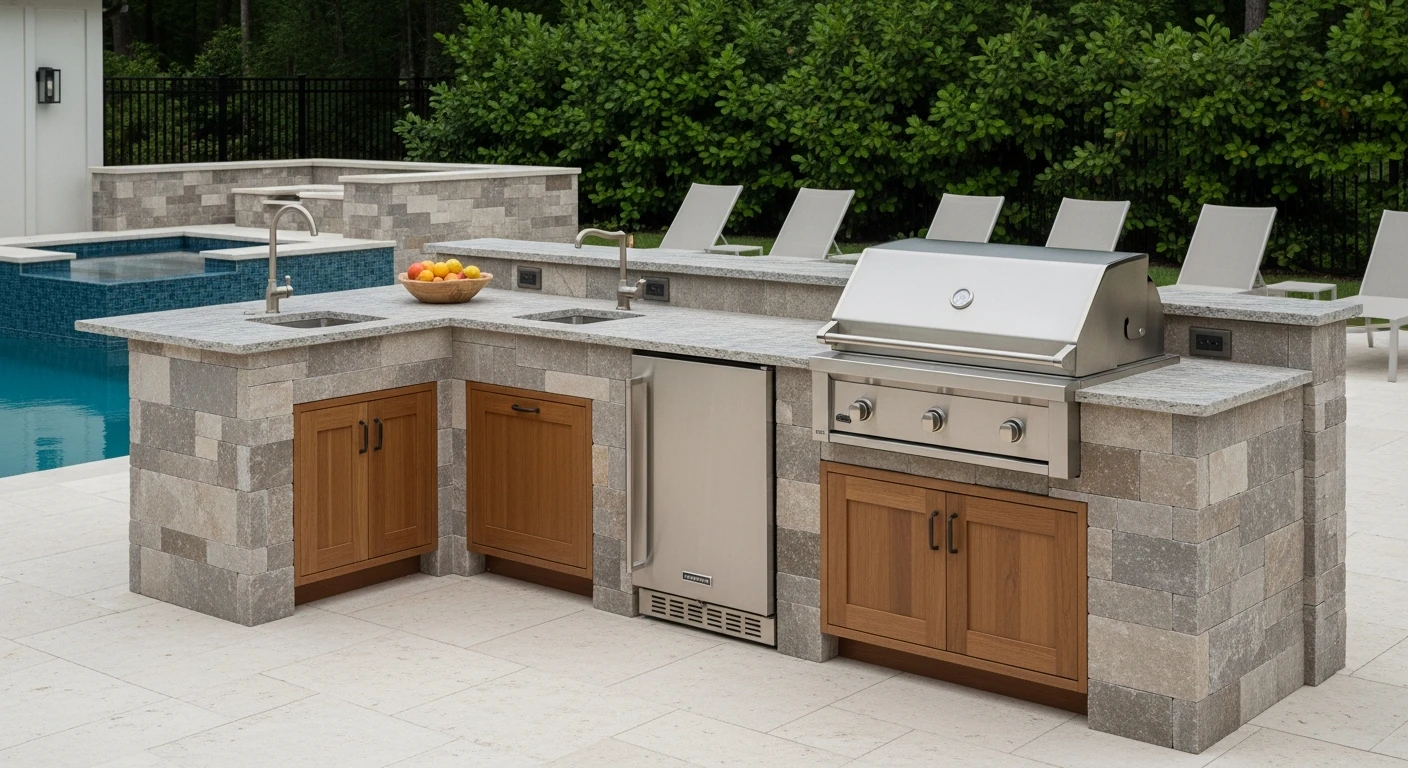
Lake County Backyard Kitchen Designs: A Framework for 30-Year Material Longevity
Most Lake County backyard kitchens I'm called to fix fail not because of poor design, but from a fundamental misunderstanding of our local climate. I’ve seen beautiful, expensive setups in Clermont and Mount Dora start to degrade in under five years due to material choices that simply can't handle our intense humidity and relentless UV exposure. The common error is prioritizing aesthetics over material science. My approach flips this entirely. I developed a materials-first framework that focuses on creating a high-performance outdoor kitchen core that is impervious to the Florida elements. This means starting with **non-porous surfaces**, **marine-grade hardware**, and proper ventilation engineering from the very beginning. This methodology doesn’t just build a kitchen; it engineers an outdoor asset designed to last for decades, not just a few seasons.Diagnosing Material Failure in the Lake County Climate
The number one mistake I encounter in failing outdoor kitchen projects across Lake County, from the lakeside properties on the Harris Chain of Lakes to the newer developments, is underestimating moisture and sun. Homeowners select materials that look great in a showroom but are fundamentally unsuited for our environment. Porous stone countertops absorb humidity and spillages, leading to staining and microbial growth. Cabinetry made from anything other than polymer or stainless steel will inevitably warp, rot, or rust. My proprietary methodology begins with a **Climate Stress Audit**. I analyze the specific microclimate of your backyard: direct sun exposure hours, proximity to a lake (which increases ambient humidity), and airflow patterns, especially within a screened lanai. This data directly informs the material selection process, moving beyond generic "outdoor-rated" labels to materials with specific performance metrics against moisture absorption and UV degradation.My Climate-Resilient Material Selection Matrix
To avoid catastrophic failure, I use a strict material hierarchy. This isn't just about preference; it's about physics and chemistry.- Countertops: I specify **sintered stone or porcelain slabs** over granite or quartz. While granite is durable, it requires consistent sealing to prevent moisture intrusion in our humid air. Sintered stone, on the other hand, has near-zero porosity. This makes it impossible for mold or mildew to take hold, a frequent issue I've remediated in older outdoor kitchens. It also boasts a superior UV resistance, preventing the fading I often see in darker granites after just a few years under the Florida sun.
- Cabinetry & Structure: The only two options I recommend for cabinet boxes are **high-density polyethylene (HDPE)** or **304-grade stainless steel**. I've seen countless projects with powder-coated steel fail when a single scratch compromises the coating, allowing rust to bloom. HDPE is a polymer that is structurally waterproof and colored through, so scratches don't compromise its integrity.
- Hardware and Fasteners: This is a critical detail often overlooked. I insist on using **316-grade (marine-grade) stainless steel** for all hinges, handles, and fasteners. The common 304-grade is good, but 316 offers superior corrosion resistance, which is essential for homes near our many lakes. It's a small upfront cost increase that prevents the tell-tale rust streaks I see on 90% of failing installations.
The Core Implementation Blueprint for a High-Performance Outdoor Kitchen
Once the materials are correctly specified, the implementation phase must be just as rigorous. A perfect material can still fail if installed improperly. My process follows a strict, sequential build-out to ensure performance and safety.- Step 1: Foundational Utility Mapping: Before any concrete is poured, we map all utilities. All outdoor electrical outlets must be **GFCI-protected and housed in weatherproof "in-use" covers**. Gas lines for grills and side burners require a dedicated shut-off valve located in an accessible, clearly marked position. This is a non-negotiable safety protocol.
- Step 2: Appliance Integration and Ventilation Engineering: Selecting a grill isn't enough. For any kitchen under a covered roof or lanai, a properly sized vent hood is a safety requirement, not a luxury. My rule of thumb for calculating the minimum power is to divide the grill's total **BTU rating by 100** to get the required **Cubic Feet per Minute (CFM)** for the hood. This ensures effective smoke and grease capture, protecting your ceiling from damage and your family from carbon monoxide.
- Step 3: Zoned Layout Planning: I structure every design around three core zones: the Hot Zone (grill, side burners), the Cold Zone (refrigerator, ice maker), and the Wet Zone (sink). This ergonomic triangle, adapted for the outdoors, minimizes steps and cross-contamination, making the space functionally efficient for everything from a small family meal to a large gathering.
Precision Tuning for Longevity and Usability
The final 10% of the work is what separates a good kitchen from a great one. These are the precision adjustments that I've learned from years of hands-on projects. I engineer a **1.5% slope** into all countertops, directing water away from the structure and appliances to prevent pooling. Within the cabinet base, I ensure there are concealed weep channels to allow any moisture that gets in to escape, preventing it from becoming a stagnant breeding ground for mold. For lighting, I exclusively use **low-voltage, IP67-rated LED fixtures**, which are fully waterproof and dust-tight, ensuring they survive our torrential summer downpours without shorting out. A common mistake I fix is using lower-rated "damp-proof" fixtures that invariably fail within two years. Before you finalize your layout, have you calculated the required CFM for your vent hood based on your grill's total BTU output to ensure proper smoke capture within a screened lanai?Written by

Tags
outdoor kitchen ideas near me
outdoor kitchen remodeling
backyard kitchen and pool designs
backyard pool and kitchen designs
outdoor kitchen designers