
Lake County Outdoor Kitchen Design: My Framework for a 20-Year Lifespan Against Florida Humidity
I’ve seen more outdoor kitchens in Lake County fail from material degradation than any other cause. The intense summer sun, relentless humidity, and sudden downpours create a uniquely corrosive environment that designers often underestimate. The typical approach of simply using "outdoor-rated" materials isn't enough; it’s a recipe for warped cabinets and rusted grills within five years. My entire design philosophy is built around mitigating these specific local pressures from the very first sketch. The critical error I consistently correct in projects from Clermont to Mount Dora is a failure to design for airflow and water runoff at a micro-level. It’s not just about a sloped counter. It’s about specifying cabinet systems with integrated ventilation channels and ensuring every appliance has an adequate air gap to prevent moisture buildup. This isn't just an aesthetic choice; it's a structural necessity that can increase the functional lifespan of the kitchen by over 50%.My Diagnostic Framework: The Climate-Adapted Zoning (CAZ) Method
Before I even consider layouts, I perform a site analysis based on my proprietary Climate-Adapted Zoning (CAZ) Method. This isn't about the classic "work triangle"; that's kitchen design 101. The CAZ method is a performance-based system that maps the project area against Lake County's specific environmental stressors: sun exposure paths, prevailing wind direction for smoke dissipation, and rainfall runoff patterns. I developed this after seeing a beautiful, expensive kitchen in a Tavares lakefront property become unusable in the afternoons due to radiant heat off the water and a poorly placed grill. The client was fighting smoke and sun glare every time they tried to cook. My method divides the outdoor space into three distinct performance zones. This forces a function-first approach that directly combats the climate challenges. The goal is to create a space that is not only beautiful but also comfortable and functional year-round, whether it's a humid July evening or a cool November afternoon.A Technical Deep Dive into CAZ Performance Zones
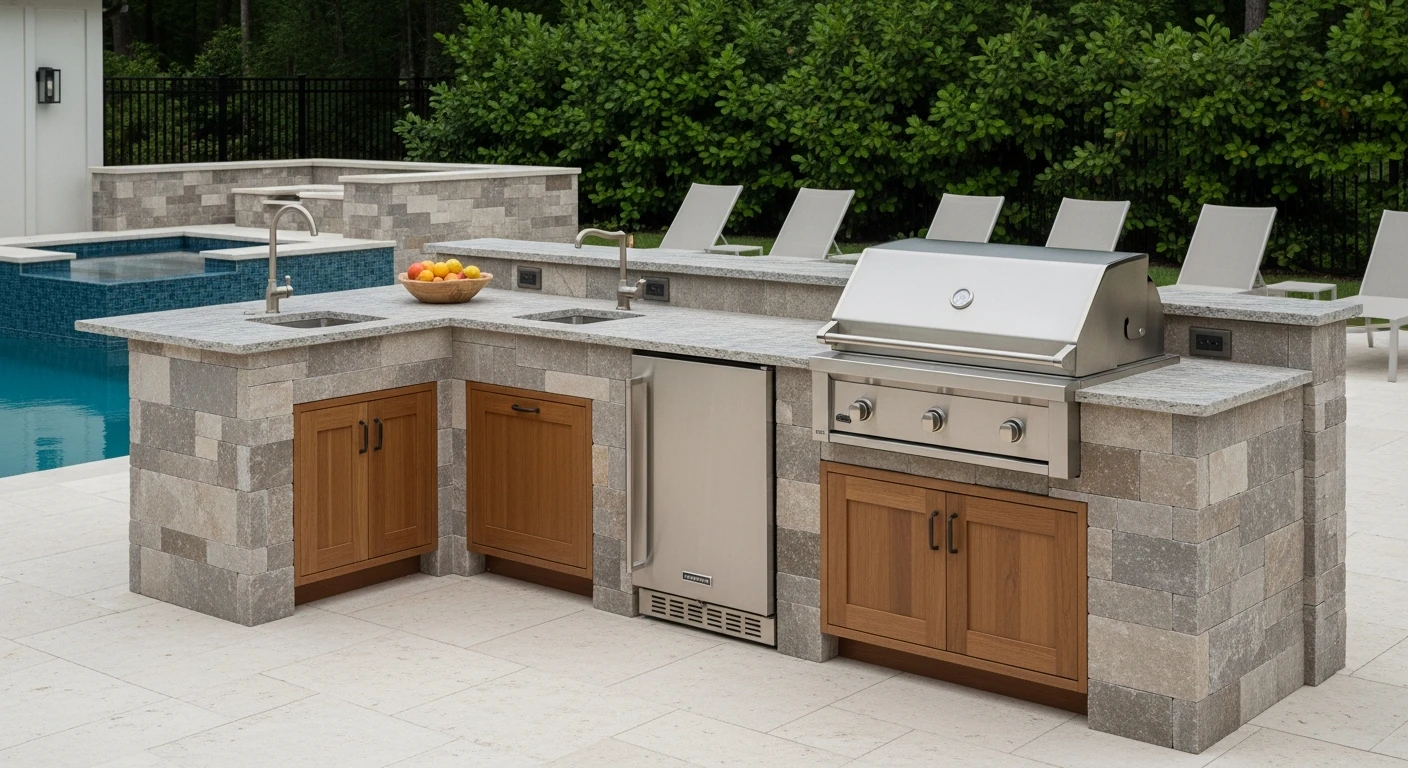
The CAZ method ensures every component is selected and placed for maximum longevity and usability.- The Hot Zone (Cooking & Heat): This is the core of the kitchen and the most frequent point of failure. I mandate the use of 304-grade stainless steel for all appliances, including grills and side burners. For homes on the Harris Chain of Lakes with even a hint of brackish air, I will sometimes specify non-corrosive 316-grade steel. Crucially, the grill's placement is determined by prevailing wind patterns, not just convenience, to ensure smoke is channeled away from seating areas and the main house. A powerful, properly sized vent hood is non-negotiable for any kitchen under a lanai roof to prevent smoke buildup and discoloration.
- The Cold Zone (Refrigeration & Prep): Using an indoor mini-fridge outside is a rookie mistake I see all the time. They can't handle the ambient heat and fail quickly. I only specify UL-rated outdoor refrigerators, which are designed to operate in temperatures up to 100°F. For countertops, I steer clients away from porous granite. Instead, I favor ultra-compact surfaces like sintered stone or non-porous quartzite, which resist staining, thermal shock from a hot pan, and UV fading from the Florida sun. All electrical outlets in this zone must be GFCI-protected and installed in weatherproof boxes.
- The Social Zone (Seating & Entertainment): This zone's success depends on comfort. I position seating to be upwind from the Hot Zone. I integrate multi-level lighting with dimmers to create ambiance and use ceiling fans to provide a breeze and deter mosquitoes—a constant battle in our region. The material for any bar top or seating counter must remain cool to the touch, making lighter-colored materials a practical necessity.
Implementation Protocol: From Foundation to First Cookout
A flawless design is useless without meticulous execution. I follow a strict five-step implementation process to translate the CAZ plan into a durable, high-performance outdoor kitchen.- Site & Utility Mapping: Before any groundbreaking, I precisely map all gas, water, and electrical lines. This is a critical step that avoids costly rerouting and ensures the appliance placement is 100% viable from an engineering standpoint.
- Foundation & Framing Construction: The structure must be built from non-combustible materials like steel studs or concrete block. I’ve had to tear out rotted wood frames built by less experienced contractors. The foundation must be perfectly level and pitched for drainage.
- Appliance & Cabinetry Integration: This is where precision matters. I ensure all appliances are installed with the manufacturer-specified clearance for ventilation. For cabinetry, I recommend marine-grade polymer (HDPE) or stainless steel systems that are completely impervious to water and will not warp or delaminate like wood or PVC.
- Countertop Templating & Installation: After cabinets are set, a precise template is made for the countertops. The installation requires sealing all joints with a UV-stable, mold-resistant exterior silicone to prevent water intrusion. A slight, almost imperceptible overhang of 1.5 inches is standard to protect the cabinet faces from rain.
- Final Systems Check & Commissioning: I personally test every single component—gas line pressure, water flow, GFCI trip functions, and lighting controls. The project isn't complete until every system performs flawlessly.
Precision Adjustments for Lake County's Environment
Beyond the main build, several small adjustments make a huge difference in longevity and user experience. I consider these my non-negotiable quality standards. For instance, I insist on installing a dedicated, sealed pull-out trash receptacle. An open trash can is an open invitation for pests, a significant issue in neighborhoods with dense foliage like those around The Villages. Furthermore, I specify an integrated drip tray or channel behind the sink and grill area. I've corrected designs where water pooled against the house wall, leading to moisture intrusion. This simple feature effectively manages water, directing it away from the home's foundation. It’s these small, experience-driven details that separate a standard outdoor kitchen from one that is truly built for Lake County. Given that your grill's BTU output directly impacts heat and smoke volume, have you calculated the precise CFM (Cubic Feet per Minute) ventilation requirements for your lanai to ensure it remains a comfortable social space and not a smoke trap?Written by

Tags
outdoor kitchen exterior ideas
bbq island countertop ideas
kitchen outside ideas
pergola outdoor kitchen designs
outdoor cook area designs


