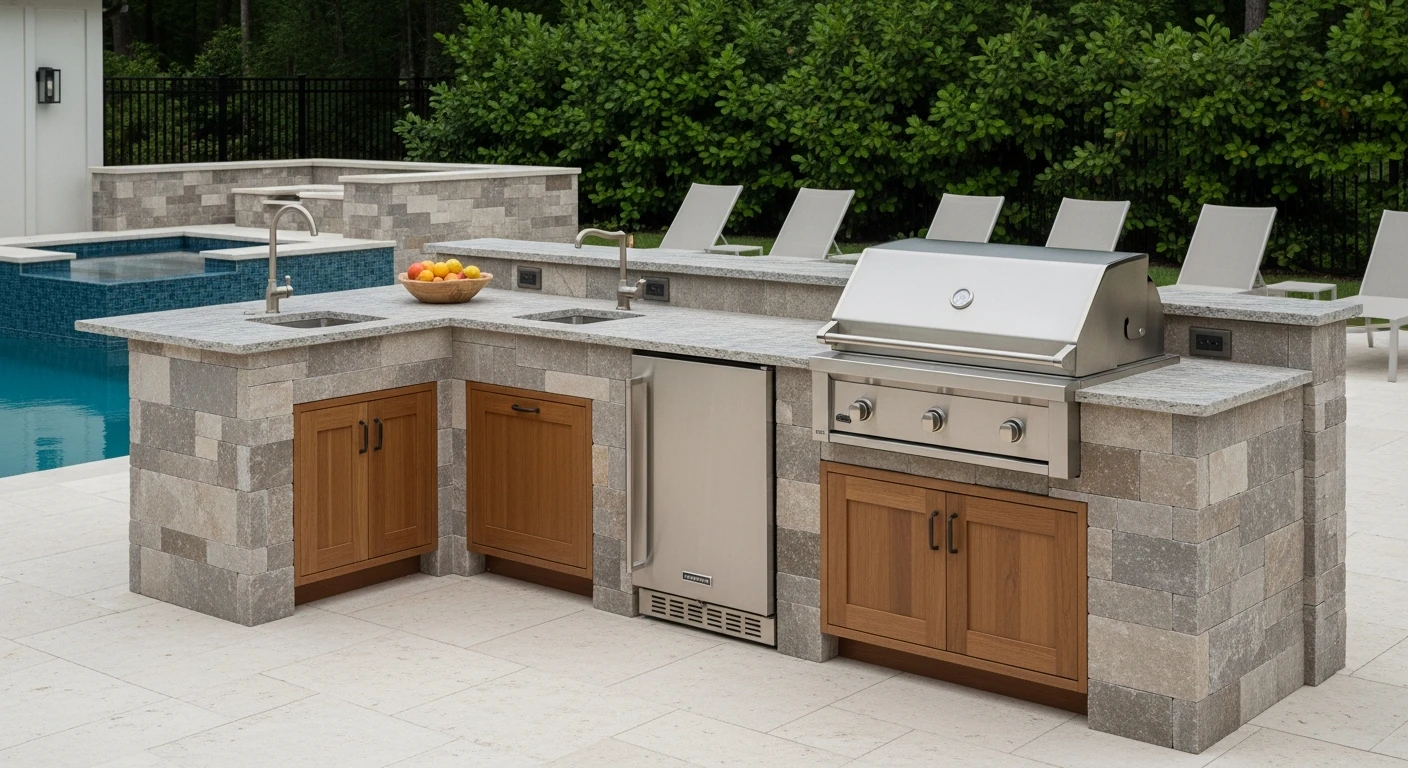
Manatee County Backyard Kitchens: A Framework for 99% Humidity & Salt Spray Resistance
Most backyard kitchen projects I see in Manatee County begin to show critical failure points within three to five years. The culprit isn't poor craftsmanship; it's a fundamental misunderstanding of our unique coastal environment. Standard "weather-resistant" materials simply don't hold up to the trifecta of intense UV exposure, corrosive salt air blowing in from the Gulf, and relentless humidity that defines life from Lakewood Ranch to Anna Maria Island. After remediating a high-end project in Bradenton Beach where the 304-grade stainless steel cabinets were showing rust spots in under 18 months, I developed a new approach. My methodology focuses on creating a completely sealed and resilient system, not just an assembly of outdoor-rated parts. This isn't about aesthetics alone; it's about engineering a functional outdoor space that delivers a tangible return on investment by eliminating premature decay and costly repairs.The Core Flaw in Standard Outdoor Kitchen Design: My Coastal Durability Framework
The typical approach treats an outdoor kitchen as indoor cabinetry placed outside. This is a fatal error in our climate. My proprietary Coastal Durability Framework is built on three pillars that directly counter Manatee County's specific environmental challenges. I’ve refined this over dozens of projects, from sprawling new builds in Parrish to tight-spaced lanai renovations on Longboat Key. It shifts the focus from simple weather resistance to active environmental defense. The framework addresses the failure points I consistently observe: moisture intrusion in cabinet bases, galvanic corrosion where different metals meet, and countertop staining from our intense sun and organic debris. It’s a system, not a checklist, designed to ensure a 20+ year operational lifespan for the core structure.Material Specification: Beyond "Weather-Resistant" Marketing
The materials you choose are the foundation of a resilient outdoor kitchen. The marketing terms are often misleading, so I rely exclusively on material specifications. Here is my non-negotiable material hierarchy for any project within 10 miles of the coast.- Structural Metals: I only specify 316 marine-grade stainless steel for all load-bearing components, including cabinet frames, fasteners, and grill interiors. The molybdenum content in 316 steel provides superior resistance to chloride corrosion from salt spray, a weakness in the more common 304 grade. This is the single most critical upgrade.
- Cabinetry & Cladding: Forget wood or steel-clad particle board. I primarily use high-density polyethylene (HDPE) or powder-coated aluminum cabinets. HDPE is a solid polymer, the same material used in marine applications, making it impervious to water. It will not swell, rot, or delaminate.
- Countertops: Granite is porous and can get incredibly hot in the Florida sun. I steer my clients toward ultra-compact surfaces like Dekton or certain quartzites. These are non-porous, highly resistant to UV fading, and can handle rapid temperature changes without cracking—a common issue when a hot pan meets a countertop cooled by a sudden rain shower.
Executing the Build: A Phased Approach for Manatee County Homes
A successful build is about methodical execution. I break every project into three distinct phases, ensuring all site-specific variables, from sun orientation to prevailing winds, are accounted for.Phase 1: Site Analysis and Workflow Mapping
The first step is always a site assessment. On a recent project in a golf course community, the client wanted the grill facing the pool for conversation. However, this placed the smoke path directly into the main lanai seating area. We reoriented the entire layout, creating a "hot zone" (grill, side burners) and a "cold zone" (refrigerator, sink) that mirrored an efficient indoor kitchen triangle while optimizing airflow away from guests. Proper workflow is as critical outdoors as it is indoors.Phase 2: The Utility Backbone
Retrofitting utilities is expensive and compromises the structure. My plans mandate a dedicated utility plan before any groundwork begins.- Electrical: All outlets must be GFCI-protected and housed in weatherproof "in-use" covers. I plan for at least four outlets: for the refrigerator, rotisserie, task lighting, and an auxiliary outlet for blenders or speakers.
- Plumbing & Gas: A licensed professional must run all lines. For gas grills, I insist on a dedicated shut-off valve located at the island itself, not just at the source tank. For sinks, proper drainage slope is critical to prevent standing water, which is a breeding ground for mosquitos.
Phase 3: Assembly and Sealing
This is where the system comes together.- Anchor the Base: The cabinet base must be anchored directly to the concrete slab or paver foundation and perfectly leveled. Any instability will translate into cracked countertops.
- Install Components: Every appliance must be installed according to its manufacturer's ventilation and clearance specifications. I’ve seen grills installed too close to vinyl siding, creating a serious fire hazard.
- Seal Every Seam: All countertop seams and the backsplash junction are sealed with a UV-stable, mold-resistant silicone sealant. This prevents water from penetrating the cabinet interiors, which is the number one cause of premature failure.
Fine-Tuning for Peak Performance and Longevity
The final 10% of the work ensures the next 10 years of performance. I focus on ventilation and lighting. For any grill placed under a covered lanai, a vent hood is not optional; it’s a safety requirement. I specify hoods with a minimum of 1200 CFM and baffle filters that can be easily cleaned. For lighting, I use a layered approach: bright, focused task lighting directly over the grill and prep surfaces, and softer, low-voltage ambient lighting for the seating and bar areas, all using marine-grade fixtures to prevent corrosion. Now that you understand the material science and structural protocols, have you factored in the impact of your lot's sun exposure and prevailing wind direction on your appliance placement and material longevity?Written by

Tags
outdoor kitchen ideas near me
outdoor kitchen remodeling
backyard kitchen and pool designs
backyard pool and kitchen designs
outdoor kitchen designers