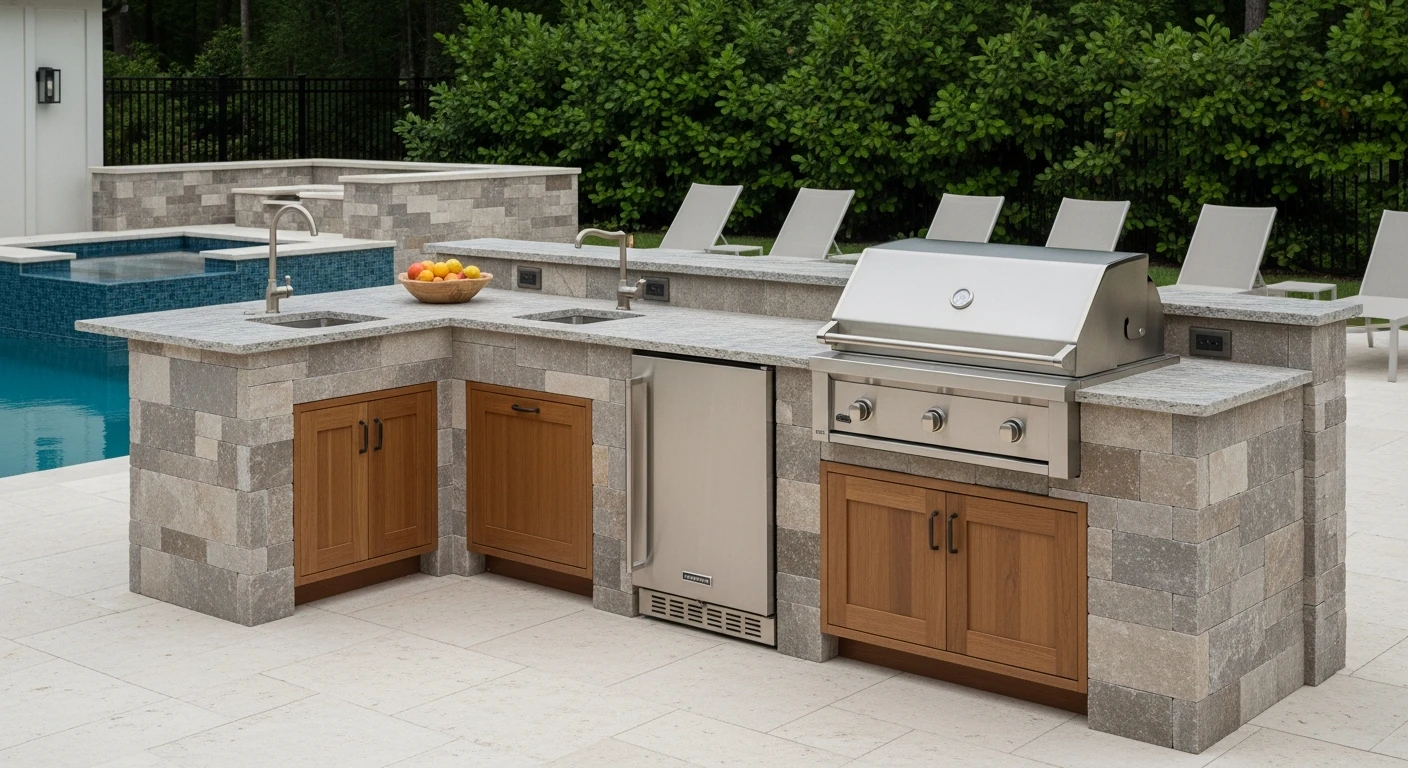
Simple Outdoor Kitchen Ideas Manatee County: A Framework for 99% Material Longevity Against Salt & Humidity
When I'm called to consult on an outdoor kitchen project in Manatee County, especially in waterfront areas like Anna Maria Island or the newer developments in Parrish, I often start by analyzing the failures of previous installations. The most common point of failure isn't the design itself, but a fundamental misunderstanding of our local subtropical climate. Homeowners invest in beautiful setups that begin to show signs of rust, warping, or mildew within two years because they apply indoor logic to an outdoor environment defined by extreme UV exposure, high humidity, and corrosive salt air. My approach sidesteps these costly errors by prioritizing material science and micro-climate analysis from day one. I've developed a methodology specifically for this region that focuses on creating a simple, functional, and astonishingly durable outdoor kitchen. It’s not about having the most expensive grill; it’s about building a framework that withstands a decade of Florida weather, not just a season. The goal is to achieve near-zero material degradation from environmental factors, a critical ROI for any homeowner.The Manatee County Climate Pitfall: Why Most DIY Kitchens Fail in Under 5 Years
The single biggest mistake I see is the selection of materials based on aesthetics over performance. A client in a beautiful Lakewood Ranch home once showed me their two-year-old outdoor kitchen where the "stainless steel" cabinet doors were peppered with rust spots. The issue wasn't the steel itself, but the grade. They had used 304-grade stainless steel, which is standard for many appliances, but it lacks the molybdenum content needed to resist the chloride corrosion from the salt air that drifts inland from the Gulf. This is a subtle but critical distinction that determines the entire lifespan of the investment. My proprietary method, the Coastal Durability Matrix, was born from correcting these exact types of expensive, avoidable errors. It forces a disciplined evaluation of every single component against local conditions.Deconstructing the Coastal Durability Matrix: Material Selection Protocol
The matrix isn't complicated; it's a priority system. It evaluates materials based on three core threats in Manatee County: moisture penetration, UV degradation, and salinity corrosion.- Cabinetry & Structure: Wood is a non-starter, even treated pine. It will warp or rot. My standard is marine-grade polymer (HDPE) for all cabinetry. It's impervious to water, will not delaminate, and is completely stable under intense sun. For framing, I use powder-coated aluminum exclusively. It's lightweight, strong, and provides a corrosion-proof foundation.
- Countertops: Porous stones like many granites can harbor mildew in our humidity. My go-to recommendation is sintered stone (like Dekton) or properly sealed, high-density concrete. These materials are non-porous, making them resistant to staining from things like mango or citrus, and they have exceptional UV stability, so their color won't fade after a few years of Bradenton sun.
- Appliances & Hardware: This is where precision matters most. For any project west of I-75, especially on the islands, I mandate 316-grade stainless steel for all appliances, handles, and fasteners. The extra 2% of molybdenum in its composition provides a significant increase in chloride resistance, preventing the pitting and rusting I see so often. It’s a non-negotiable specification for longevity.
My 3-Phase Blueprint for a Simple, Climate-Proof Manatee Outdoor Kitchen
Building a simple, effective outdoor kitchen here follows a strict, logical progression. I’ve refined this process over dozens of projects, from compact lanai kitchens in Palmetto to more expansive setups in Parrish.Phase 1: Site & Flow Analysis
Before a single tool comes out, I analyze the space. The key is to orient the primary cooking surface—the grill—to work with the prevailing breezes to vent smoke away from seating areas or the main house. Inside a screened lanai, a common feature in Manatee homes, this often means installing a dedicated low-profile vent hood, a step many people skip, leading to a greasy film on their patio furniture.
Phase 2: The Core Framework Build-Out
This phase is about structure and utilities. My process is systematic to ensure zero rework.
- Build the Aluminum Frame: We construct the base using welded or mechanically fastened 6061-T6 aluminum tubing. It’s light, incredibly strong, and will never rust.
- Run Utilities: All gas and electrical lines are run within the frame. A critical step here is using weatherproof junction boxes and GFCI outlets, a non-negotiable safety and code requirement in Florida.
- Install HDPE Cabinet Boxes: The polymer boxes are then fastened directly to the aluminum frame. They are perfectly square and will never swell or shrink with our humidity shifts.
Phase 3: Countertop & Appliance Integration
With the core structure in place, the final pieces are installed with a focus on sealing and water management.
- Countertop Templating & Installation: The countertop is installed with a slight overhang to create a drip edge, which directs rainwater away from the cabinet faces.
- Appliance Installation: The grill, refrigerator, and any other components are fitted. I pay close attention to ensuring there is adequate clearance for ventilation as specified by the manufacturer, a common oversight that can shorten appliance life.
- Final Sealing: Every seam, especially where the countertop meets the backsplash or wall, is sealed with a UV-stable, marine-grade silicone sealant.
The Final 5%: Post-Installation Checks for Peak Performance
Once construction is complete, my job isn't done. I perform a series of quality checks to ensure the system is truly ready for our climate. This includes a water-beading test on all sealed surfaces to verify the sealant has cured and is repelling moisture effectively. I also check the airflow around and through the cabinets; even with waterproof materials, preventing stagnant, humid air is key to stopping mildew before it can start. This final check is what separates a good-looking kitchen from one that performs flawlessly for years. Given the high humidity and potential for trapped moisture within a lanai, what specific passive ventilation design have you considered for your cabinet interiors to prevent the onset of mildew?Written by

Tags
outdoor kitchen exterior ideas
bbq island countertop ideas
kitchen outside ideas
pergola outdoor kitchen designs
outdoor cook area designs