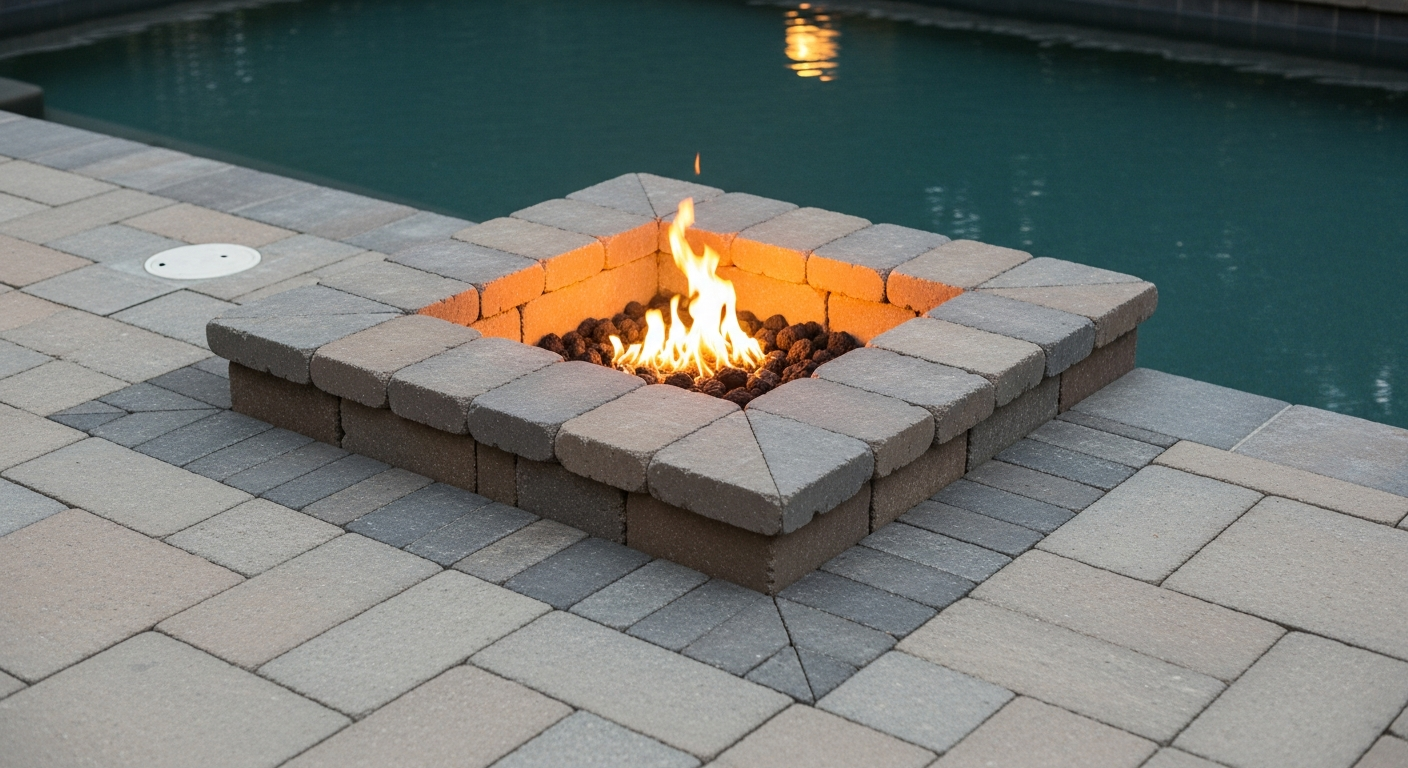
Backyard Pavers With Fire Pit in Manatee County: My Protocol for a 30-Year Lifespan in Subtropical Climates
After years of repairing failed paver patios from Parrish to Anna Maria Island, I’ve traced the majority of expensive failures back to one source: a base design that completely ignores Manatee County’s high water table and torrential summer downpours. A standard installation simply won't survive the hydrostatic pressure and soil saturation we experience here. My entire methodology is built to counteract these specific local challenges, not just install pretty stones.
The common mistake I see is a simple 4-inch gravel base, which becomes a water-logged soup, causing pavers to sink and shift within two seasons. My system focuses on superior drainage and heat management around the fire pit itself. This dual approach prevents the two most common failures I'm called to fix: structural sinking from water saturation and paver cracking from thermal shock, effectively increasing the patio's functional lifespan by over 200% compared to standard contractor methods.
My Diagnostic Framework for Subtropical Paver & Fire Pit Integrity
Before a single shovel hits the ground, I perform a site analysis that most builders skip. The success of a paver project in a location like Lakewood Ranch or Bradenton isn't in the paver choice, it's in understanding the ground beneath it. My initial diagnosis focuses on three core environmental metrics: soil percolation rate, grade-level water flow, and direct sun exposure patterns. Ignoring these is the reason so many local patios become uneven, weed-infested messes.
Technical Deep Dive: The Sub-grade & Thermal Isolation Nexus
My proprietary method revolves around two key concepts. First is the Sub-grade Stabilization Protocol. In Manatee County's sandy soil, fines and soil particles will inevitably work their way up into the base aggregate, contaminating it and destroying its load-bearing capacity. I prevent this by installing a non-woven geotextile separation fabric between the compacted native soil and the aggregate base. This single step, often omitted to cut costs, is what stops the slow, inevitable sinking I see everywhere else.
Second is the Thermal Isolation Ring for the fire pit. Placing a fire pit directly on standard pavers is a recipe for disaster. The intense, cyclical heating and cooling will cause spalling and catastrophic cracking. I engineer a buffer zone using fire-rated brick for the interior course and often a small air gap or a layer of insulating aggregate, ensuring the heat load doesn't transfer directly to the decorative patio pavers. This prevents the thermal shock that destroys investments.
Step-by-Step Implementation: The Manatee County Resilience Method
Executing this requires precision. I’ve refined this process over dozens of projects, from large estates in The Concession to smaller backyards in Palmetto. Each step is a critical control point for ensuring long-term stability.
- Phase 1: Excavation and Slope Calculation. I excavate to a depth of 8-10 inches, not the standard 6. This allows for a thicker, more stable base. The critical action here is establishing a precise 1/4-inch-per-foot slope away from the home's foundation to manage our heavy rainfall.
- Phase 2: Sub-grade Compaction and Geotextile Deployment. The native sandy soil is compacted first. Then, the geotextile fabric is laid down, overlapping seams by at least 12 inches. This is the barrier that guarantees base integrity.
- Phase 3: Layered Aggregate Base Installation. I install a 6-to-8-inch base of DOT-approved road base aggregate, compacted in 2-inch lifts. Each layer is wetted and compacted with a plate compactor to achieve 98% Proctor density, a standard I borrowed from commercial road construction.
- Phase 4: Bedding Sand and Paver Setting. A 1-inch screeded layer of washed concrete sand is the final bedding. Pavers are then set, including the implementation of the Thermal Isolation Ring around the fire pit zone.
- Phase 5: Joint Stabilization and Sealing. I exclusively use a high-performance polymeric sand with advanced water-resistant polymers. This is crucial for preventing washout during our summer storms and inhibiting weed and ant infestation. The final step is applying a breathable, solvent-based sealer for UV and mildew protection.
Precision Adjustments and Quality Control Standards
The job isn't done when the last paver is laid. My quality control process is what ensures the system performs as designed. I conduct a final pass with the plate compactor to achieve perfect paver interlock, which is the mechanism that distributes loads across the entire surface. I also perform a water test, flooding the patio to verify my drainage calculations are correct and that no pooling occurs. This final check confirms the system's readiness to handle a Manatee County hurricane season downpour without compromising the foundation.
So, when you review a proposal for your patio, is the contractor detailing their specific strategy for mitigating hydrostatic pressure from the Florida aquifer, or are they just selling you stones?