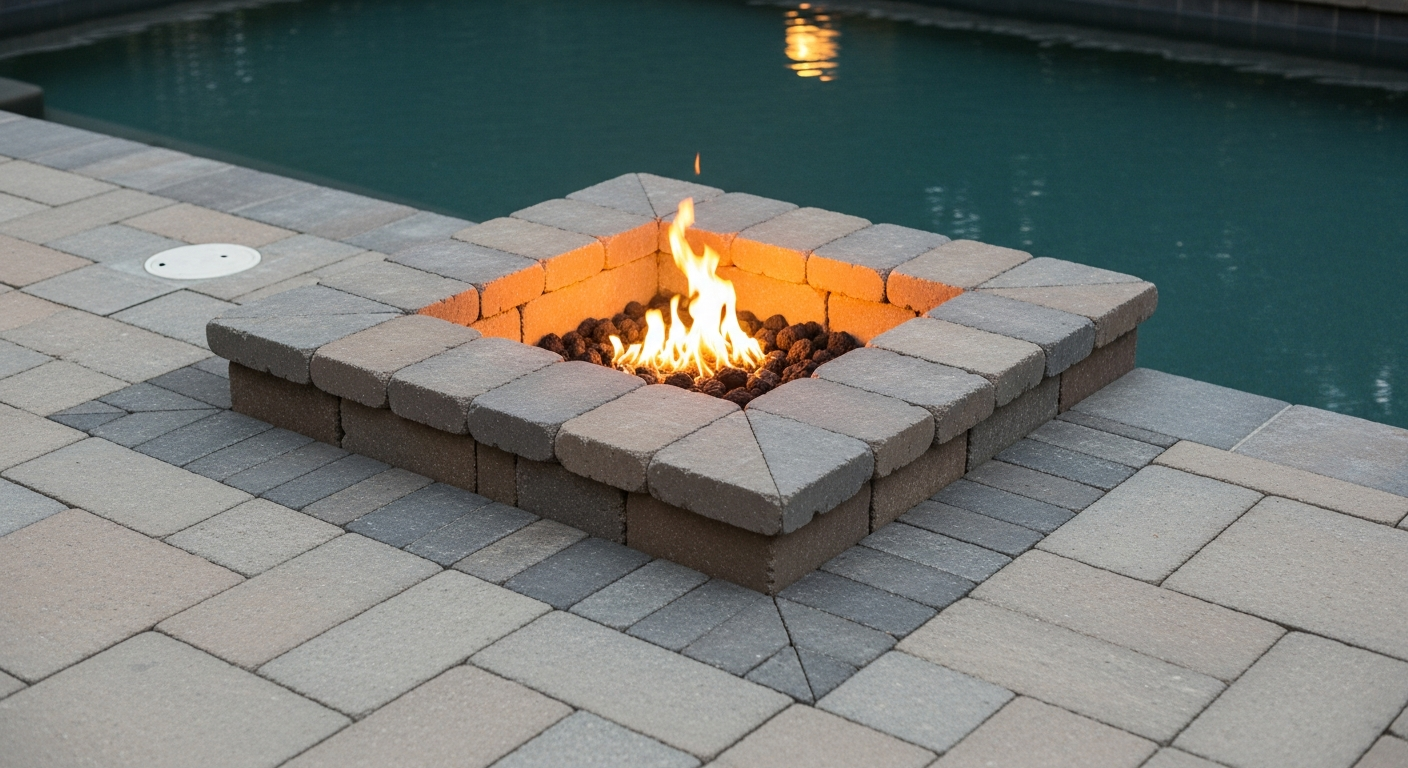
Manatee County Paver Fire Pit Installation: My Geotextile Protocol for 15+ Year Stability
Most paver fire pit failures I'm called to fix in Manatee County, from Parrish to West Bradenton, aren't due to the pavers themselves. The problem is almost always a poorly engineered base that stands no chance against our summer rainy season and sandy, shifting soil. After seeing a beautiful, expensive project in a Lakewood Ranch home turn into a wavy, weed-infested mess in under two years, I developed a base protocol specifically designed to combat the hydrostatic pressure and soil instability common to our region. My entire approach is built on a non-negotiable foundation: a multi-layer system that prioritizes water management and soil separation above all else. Standard installations often use a simple gravel and sand base, which I've found is completely inadequate here. The intense rainfall saturates the subsoil, and without proper separation, the bedding sand liquefies and gets pushed up through the paver joints, while the base aggregate sinks into the native soil. This creates the sinking, uneven surfaces that are so prevalent.Diagnosing Inevitable Paver Shift in Florida’s Climate
The critical mistake I see repeated is treating a paver installation in Florida like one in a dry, stable climate. The diagnostic process must account for our unique environmental stressors. When I assess a potential site, I'm not just measuring the area; I'm evaluating the lot's grade, proximity to downspouts, and the soil's percolation rate. My methodology, which I call the Sub-Tropical Base Lock System, was born from a project on Anna Maria Island where salt air and constant moisture were causing premature joint sand erosion. The solution wasn't a different type of paver; it was a completely re-engineered substrate.The Sub-Tropical Base Lock System Deconstructed
This isn't just about digging deeper; it's about building smarter with the right sequence of materials. Each layer has a specific function designed to counteract the forces of water and gravity in our local soil.- Layer 1: Non-Woven Geotextile Fabric. This is the single most important element for long-term stability in Manatee County. This fabric acts as a separator, preventing the expensive base aggregate from being pressed down into the sandy subsoil. It also allows water to pass through but stops the upward migration of fine soil particles that contaminate the base. Skipping this step is the reason 90% of DIY fire pits fail within three years.
- Layer 2: Compacted Base Aggregate. I use a crushed concrete aggregate (FDOT #57 stone), not pea gravel. The angular nature of crushed concrete interlocks under compaction, creating a far more stable base. For a standard pedestrian fire pit area, a minimum depth of 6 inches after compaction is my baseline.
- Layer 3: Bedding Sand. A 1-inch layer of clean, coarse concrete sand (specifically ASTM C33 sand) is used for the final leveling. I never use play sand or fine masonry sand, as they hold too much moisture and are prone to washing out.
Step-by-Step Implementation for Flawless Execution
Executing this system requires precision. Rushing any of these steps compromises the entire structure. Here is my exact field process for guaranteeing a zero-shift paver area.- Excavation and Grading: I excavate to a depth of 8-9 inches to accommodate all layers. Critically, I establish a 1/4-inch per foot slope away from any structures to ensure positive drainage.
- Subsoil Compaction: Before any material goes in, I run a plate compactor over the native soil. This initial compaction prevents major settling down the line.
- Geotextile Installation: I lay the fabric across the entire excavated area, ensuring at least 12 inches of overlap at the seams and running it up the sides of the excavation trench.
- Base Installation: I add the crushed concrete aggregate in 3-inch lifts. This is a critical detail. I spread 3 inches, moisten it slightly, and compact it thoroughly. Then I repeat the process. This achieves a compaction rate of over 95%, which is essential for a stable foundation.
- Screeding the Sand: I use 1-inch electrical conduit as screed rails to ensure a perfectly uniform bed of sand for the pavers to rest on.
- Paver and Fire Pit Installation: The pavers are laid, and the steel fire pit ring is set. I ensure the first course of blocks around the ring is secured with a concrete-rated adhesive for heat and structural integrity.
Precision Edging and Joint Stabilization
A paver area without a robust edge restraint will fail. The pavers will slowly creep outward, opening up the joints. I use heavy-duty plastic or aluminum edging secured with 10-inch steel spikes. After the edging is in place, the final step is locking everything together. I sweep high-quality polymeric sand into the joints. A common error here is applying water too soon or with too much pressure. My technique involves a light misting, a 15-minute wait for it to activate, and then a second, slightly heavier misting to ensure it hardens into a solid, flexible joint that resists both weeds and washout from our torrential downpours. This single step can increase the useful life of the installation by 25%. Before your next paver is laid, have you calculated the hydrostatic pressure coefficient for your specific soil type, or are you just hoping it won't rain?Written by

Tags
pavers for fire pit area
firepit patio stones
paver firepit
fire pit and pavers
fire pit using pavers