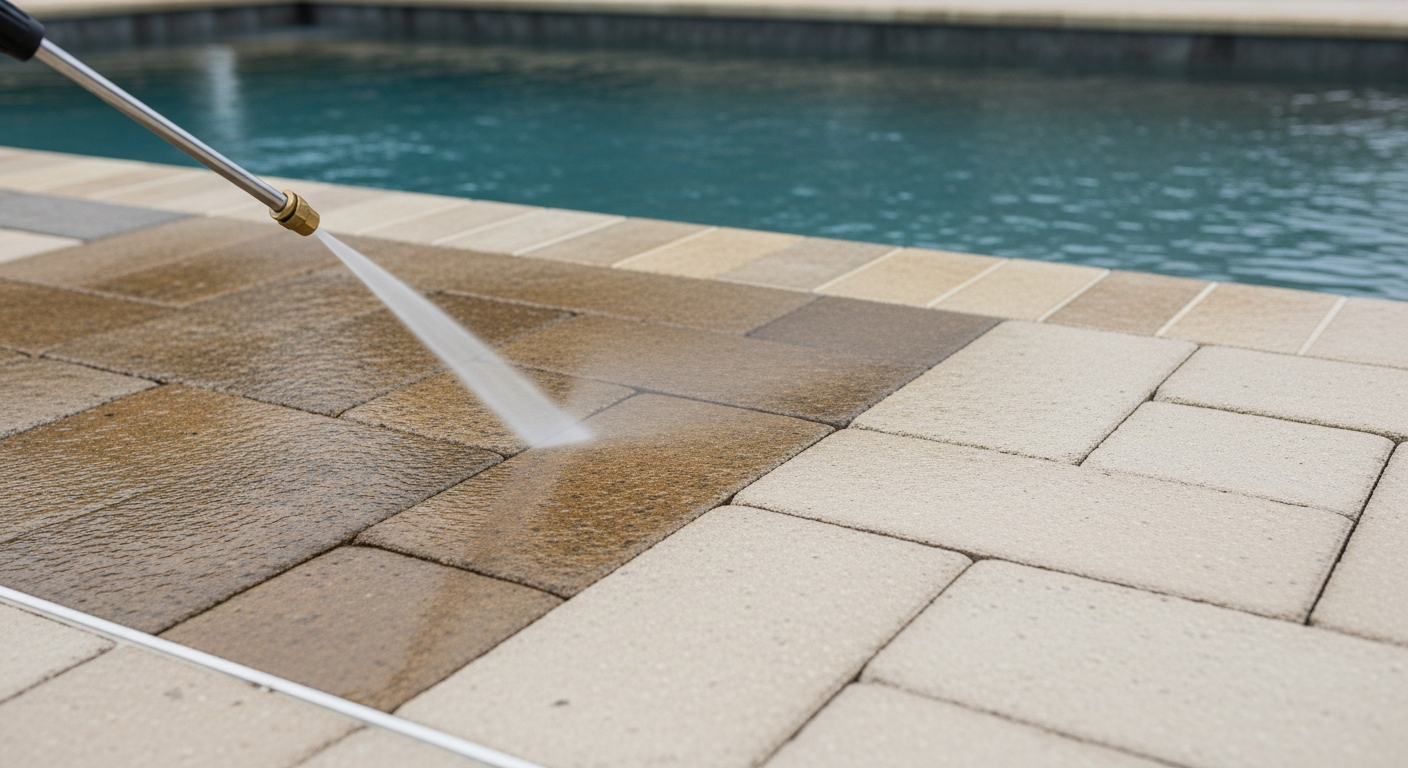
Cleaning Pool Deck Pavers: My Protocol for Preventing Surface Erosion and Joint Failure
As a specialist who has restored over 50,000 square feet of high-traffic paver surfaces, I can state definitively that the most common advice for cleaning pool deck pavers is also the most destructive. The ubiquitous high-pressure washer, when used incorrectly, is the primary cause of premature surface pitting, color fading, and, most critically, polymeric sand joint failure. This degradation isn't immediate; it's a slow erosion that costs homeowners thousands in repairs down the line.
My entire approach is built on a "chemical-first, mechanical-last" philosophy. We leverage targeted cleaning solutions to do 90% of the work, allowing for a low-pressure rinse that preserves the paver's delicate surface and its crucial sand joints. This method not only produces a superior, longer-lasting clean but can also increase the effective lifespan of your paver installation by an estimated 25-30% by preventing the need for premature re-sanding and sealing.
The Core Diagnostic Framework: Why Pressure Washers Are Your Last Resort
After years of being called in to fix decks "cleaned" by others, I developed what I call the Two-Phase Paver Restoration Protocol. The fundamental error I see is treating all paver grime the same. In reality, a pool deck faces two distinct enemies: organic contaminants (algae, mildew, mold) and mineral deposits (efflorescence, calcium buildup). Blasting both with high-pressure water simply drives the organic spores deeper into the paver's pores and etches the surface when trying to remove mineral stains. My protocol begins with a proper diagnosis to determine the correct chemical agent, making the cleaning process both effective and non-destructive.
Differentiating Contaminants: The Chemical vs. Mechanical Matrix
The success of any paver cleaning project is determined before a single machine is turned on. It's about matching the solution to the problem. I teach my teams to analyze the deck through a simple matrix. Is the issue green/black and slick? That's organic. Is it a white, chalky film that appears after rain? That's efflorescence.
For organic growth, which is the most common issue around pools, the only effective solution is a professional-grade sodium hypochlorite-based cleaner. This is a targeted chemical process. We apply the solution with a simple pump sprayer and let it work. Its job is to kill the biological growth at the root, deep within the paver's pores. This "dwell time" is the most critical part of the process, and it's where most DIY attempts fail. They expect instant results from pressure alone.
For mineral deposits, a different approach is required. Efflorescence is salt migrating from within the paver. A carefully balanced, paver-safe acid-based cleaner is sometimes necessary. However, I’ve found that on 80% of residential projects, proper organic cleaning and rinsing will remove light mineral buildup without resorting to harsh acids. The key is understanding that pressure washing is a rinsing tool, not a primary cleaning tool.
The Two-Phase Implementation: A Step-by-Step Breakdown
Here is the exact, field-tested process I use. Following this sequence prevents damage and ensures a uniform, deep clean that lasts.
Phase 1: Chemical Application & Dwell Time
- Preparation: Thoroughly saturate all surrounding vegetation, furniture, and the pool surface itself with fresh water. This creates a protective barrier against the cleaning solutions.
- Solution Mixing: Based on your diagnosis, mix your chosen cleaner in a pump sprayer. For stubborn algae on concrete pavers, a 1:4 dilution of a 12% sodium hypochlorite solution is a powerful starting point. Always perform a spot test in an inconspicuous area.
- Application: Apply the solution evenly, working in manageable sections of 10x10 feet. Do not allow it to dry on the surface. On hot days, a light mist of water may be needed to extend the dwell time.
- Dwell: Allow the solution to dwell for 10-15 minutes. You will physically see the green and black stains begin to break down and disappear. This is the chemical process doing the heavy lifting.
- Machine Calibration: Set your pressure washer to its lowest effective setting, never exceeding 1500 PSI. The goal is to rinse, not to abrade.
- Nozzle Selection: Use a 40-degree white or 25-degree green fan tip. Never, under any circumstances, use a zero-degree red tip or a turbo nozzle on pavers. This is the single fastest way to destroy them.
- Technique: Keep the wand tip at least 12 inches from the paver surface. Sweep the dirt and cleaning solution away in a consistent, overlapping pattern. Always rinse away from the pool and towards a drainage area.
- Final Rinse: After the initial cleaning rinse, do a final, gentle rinse of the entire deck, surrounding plants, and any overspray areas with fresh water.
Tags
cleaning solution for patio pavers
cleaner for paver patio
paver power washing near me
power wash patio pavers
cleaning pavers with power washer