
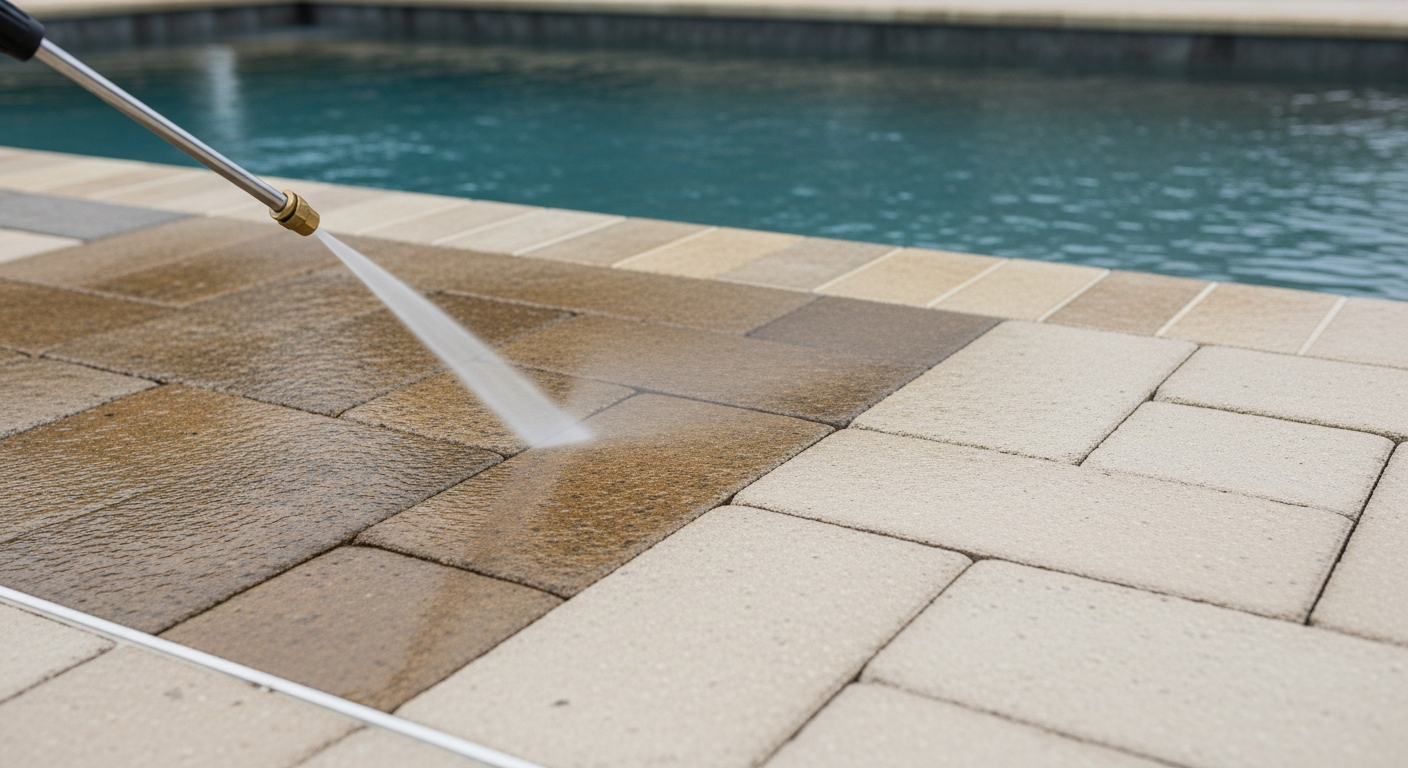
Pressure Cleaning Pavers: My Protocol for Preventing Sub-Base Erosion and Joint Failure
As a hardscape restoration specialist, the most destructive mistake I see isn't stains or weeds; it's damage caused by improper pressure cleaning. Many professionals and homeowners use high PSI (Pounds per Square Inch) as a blunt instrument, effectively blasting away the single most critical component of a paver system: the jointing sand. This doesn't just make the surface look clean; it compromises the interlocking mechanism, leading to paver sag, shifting, and ultimately, sub-base failure.
My entire approach is built on a "low-impact, high-volume" philosophy. It prioritizes the structural integrity of the paver installation over the brute force of the cleaning process. This methodology extends the life of the paver surface by an estimated 30% by treating it as a flexible, interconnected system, not a solid concrete slab.
The Paver Integrity Audit: My Pre-Wash Diagnostic Framework
Before a single drop of water is sprayed, I conduct what I call the **Paver Integrity Audit**. This isn't just a visual inspection; it's a diagnostic process to determine the precise cleaning parameters. I once inherited a large commercial project where the previous contractor had used a 4,000 PSI machine with a turbo nozzle, creating "etching" marks across thousands of square feet of architectural pavers and completely displacing the joint sand. That costly mistake reinforced my belief that diagnosis must precede action. My framework analyzes three core variables: paver type, joint condition, and contaminant profile. This dictates the pressure, nozzle selection, and cleaning agents required to clean effectively without causing iatrogenic damage.
Decoding the PSI-GPM-Angle Triage
My proprietary method, the **PSI-GPM-Angle Triage**, is the technical heart of the audit. It's a system for balancing pressure, water flow, and attack angle.
- PSI (Pounds per Square Inch): This is the force. For most concrete pavers, I never exceed 1,600 PSI. For softer clay or natural stone pavers, I might dial it down to 1,200 PSI. The goal is to lift the stain, not to erode the paver's surface or blast out the joint material.
- GPM (Gallons Per Minute): This is the rinsing power. This is the metric most amateurs ignore. I use a machine that delivers at least 3.5 GPM. A higher GPM allows me to use lower pressure because the volume of water does the heavy lifting of carrying away dirt and debris. It's the difference between a sharp knife and a wave.
- Angle & Nozzle Selection: I almost exclusively use a 40-degree (white) fan tip. It provides a wide, gentle spray pattern. I maintain a consistent distance of 10-12 inches from the surface. The 0-degree (red) nozzle is forbidden in my practice; it's a tool for stripping, not cleaning, and it will destroy paver joints instantly. For large, flat areas, a professional-grade surface cleaner attachment is non-negotiable, as it guarantees a uniform finish and contains the water pressure vertically.
- Site Preparation: I first protect all adjacent surfaces, including doors, windows, and delicate landscaping. All drainage points are checked to ensure they are clear.
- Pre-Soak Application: I saturate the entire paver surface with clean water. This step is critical because it prevents the cleaning solution from absorbing too quickly and drying on the surface, which can cause streaking.
- pH-Neutral Cleaner Application: I apply a professional-grade, pH-neutral paver cleaner using a low-pressure applicator. Harsh acidic cleaners can cause efflorescence and permanently discolor the pavers. The cleaner is allowed a specific dwell time, typically 10-15 minutes, to break down grime.
- The Controlled Wash: Using the pre-determined PSI, GPM, and nozzle, I clean in a systematic, overlapping pattern. I work from the highest point of the installation downwards, using a consistent sweeping motion to guide the dirty water towards the drainage areas. I never point the wand directly down into the joints.
- Thorough Rinsing Protocol: After the initial cleaning pass, a final, high-volume rinse is performed to ensure no cleaning agents or loosened debris remain on the surface.
Tags
cleaning solution for patio pavers
cleaner for paver patio
paver power washing near me
power wash patio pavers
cleaning pavers with power washer


