Cost to Build Outdoor Kitchen: My Framework for Eliminating 30% in Unforeseen Overruns
Most articles on outdoor kitchen costs give you a useless range, from a few thousand to over $50,000. This is because they focus on the visible components—the grill, the refrigerator, the countertops. After a decade of designing and troubleshooting these projects, I can tell you the real cost drivers are buried underground and hidden within the walls. The budget blowouts I've witnessed, some exceeding 40% of the initial estimate, almost always stem from underestimating the "Big Three": utilities, foundation, and proper ventilation.
My entire approach is built on a principle I call Utility-First Budgeting. Instead of picking your dream grill first, you must first map the cost of getting gas, electricity, and water to its location. This reverses the conventional process and immediately exposes the most volatile expenses. This methodology has consistently saved my clients from the most common and costly mistakes, turning a vague estimate into a predictable project plan.
The Utility-First Diagnostic & My Cost-Containment Framework
The single biggest error I see is budgeting with a "shopping list" mentality. People list appliances and finishes, get a material total, and add a generic percentage for labor. This is fundamentally flawed. An outdoor kitchen is not furniture; it's a small-scale construction project with complex systems. My cost-containment framework forces a shift in perspective by analyzing the project's core infrastructure before a single aesthetic choice is made. I treat the location and the land as the primary cost variable, not the brand of the grill.
My framework assesses three critical, often-ignored factors: Utility Pathway Complexity, Geotechnical Load Requirements, and Airflow Dynamics. For example, a project 15 feet from the house on stable soil with direct access to a gas stub-out is a completely different financial undertaking than one 50 feet away, across a patio, and in a region with a deep frost line. The latter could easily triple the foundational and utility costs, even if the appliances are identical. I force my clients to get hard quotes for trenching, conduit, and plumbing before they even look at a countertop sample.
Deconstructing the "Big Three" Cost Multipliers
My diagnostic process drills down into the technical specifics that drive up to 70% of the foundational cost. I’ve seen projects derailed because these were treated as afterthoughts.
- Utility Mapping & Load Calculation: This isn't just about running a pipe. We calculate the total BTU load for all gas appliances to ensure the line is sized correctly from the meter. For electrical, we determine the required amperage for refrigerators, lights, and outlets, mandating dedicated circuits with GFCI protection. I once had to oversee a project where a 20-foot trench for an undersized gas line had to be re-excavated, adding an unplanned $3,500 to the budget.
- Structural Integrity vs. Materiality: The choice of a heavy concrete or granite countertop directly impacts the required footing depth and rebar schedule for the foundation. In colder climates, a slab that doesn't extend below the frost line will heave and crack, destroying the entire structure. The weight of a specialty item like a pizza oven requires a significantly reinforced concrete base, a cost factor many online "calculators" completely ignore.
- The Appliance "Insulated Jacket" Protocol: This is my non-negotiable safety and cost-saving rule. When installing a grill into a combustible structure (like a wood or steel-stud frame), you must use the manufacturer's specified insulated jacket. It’s a metal liner that creates an air gap, preventing heat transfer. Skipping this $300-$800 component to save money is a catastrophic error that creates a serious fire hazard and will void your homeowner's insurance. It's the most critical and most frequently overlooked line item.
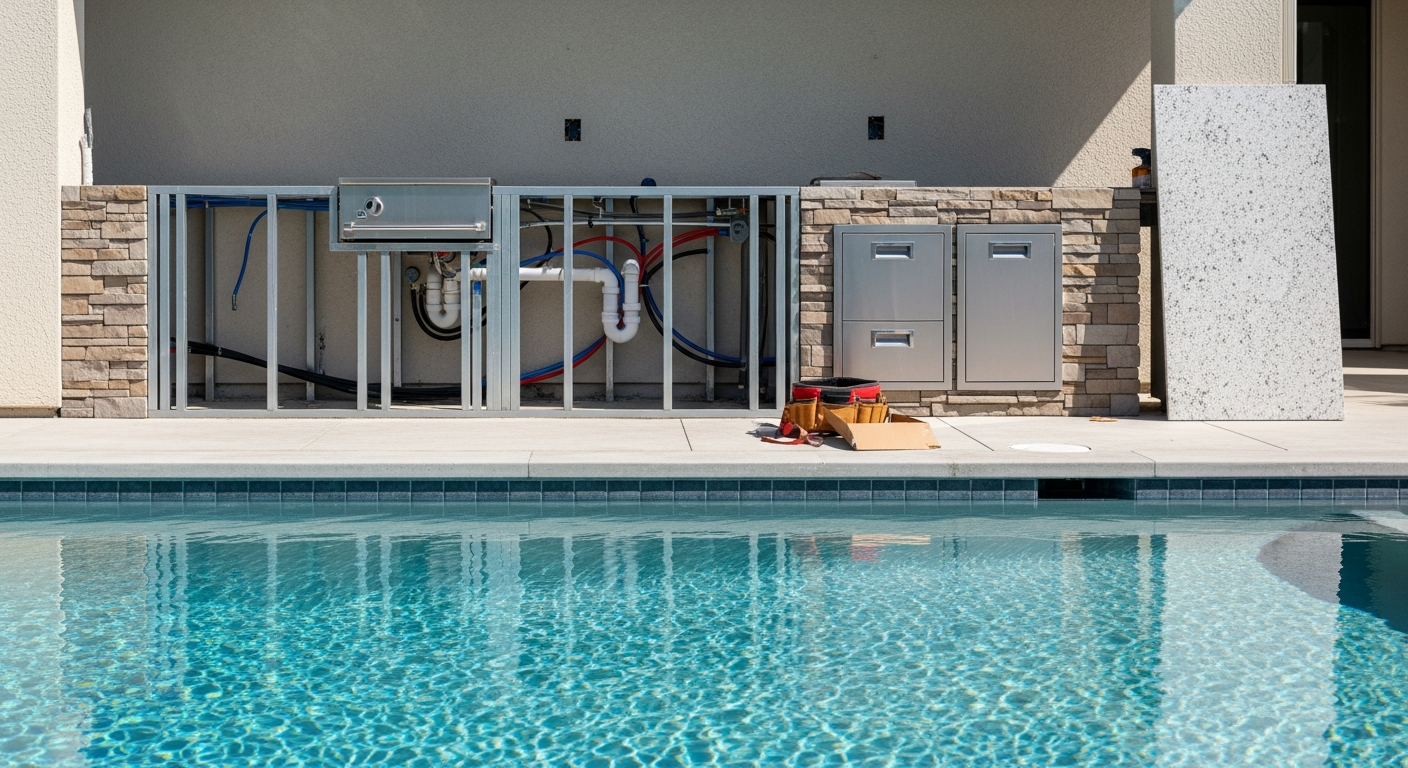
- Phase 1: Foundation & Utility Rough-In: This is the point of no return. After a final site plan is approved, we perform all excavation and trenching. All plumbing, gas lines, and electrical conduits are laid in the ground. Only then do we pour the concrete slab or footings. This phase requires the most coordination, including Permit Acquisition and inspections, and must be completed before any framing begins.
- Phase 2: Framing & Cladding: We construct the core island structure, typically with steel studs for fire resistance. All necessary cutouts for appliances are measured and framed precisely. The exterior cladding (stone veneer, stucco, etc.) is then applied, leaving appliance cavities open.
- Phase 3: Countertop & Appliance Installation: A precise template of the finished structure is made for the countertop fabricator. While the countertop is being cut, we install heavy items like the grill and refrigerator into their cavities, ensuring they are perfectly level and secured. The countertop is then installed on top.
- Phase 4: Final Utility Hookup & System Testing: This is the final and most critical step. A licensed plumber makes the final gas connections and performs a thorough leak test. An electrician wires the outlets and appliances. We then test every single component—igniters, lights, pumps—to ensure full functionality before project handover.
Tags
low cost outdoor kitchen
outdoor kitchen budget
backyard kitchen cost
outdoor kitchen estimate
outdoor kitchen price range