Outdoor Kitchen Cost: My Framework for Eliminating 40% in Unforeseen Infrastructure Expenses
My name is on the line with every outdoor kitchen project I scope. After years of analyzing budget overruns, I pinpointed the single most costly error clients make: they budget for the appliances first. This is a backwards approach that guarantees unforeseen expenses. The true cost of an outdoor kitchen isn't the grill; it's the hidden framework of utilities, foundation, and structural support that can easily double the initial estimate if not planned with surgical precision.
I developed the Foundation-First Costing Model to reverse this. It shifts the primary financial focus from the visible "finish" elements to the critical, invisible "rough-in" phase. By accurately costing the infrastructure—the gas lines, the electrical conduits, the concrete slab—before a single appliance is selected, I provide my clients with a budget that holds up under pressure, often preventing overruns of up to 40% that plague typical projects.
The Foundation-First Costing Model: A Diagnostic Approach
The standard method of getting a quote based on linear feet and appliance choices is fundamentally flawed. It creates a misleadingly low initial number. My diagnostic process begins not with a catalog of grills, but with a site survey focused on three core cost drivers that are almost always underestimated. I've seen a six-figure project nearly derail because the cost to run a 1-inch gas line over 75 feet through difficult terrain was treated as an afterthought.
My methodology forces these difficult conversations to the forefront. We map the utility pathways, assess the geotechnical requirements for the foundation, and determine the necessary structural framing based on the *types* of materials planned, not just their appearance. This diagnostic phase provides a go/no-go budget figure for the infrastructure alone. If that number is viable, we proceed. If not, we re-evaluate the location or scale, saving immense time and financial distress.
Deconstructing the True Cost Drivers: Beyond Appliances
Most articles will give you a price for a grill, a sink, and some stone veneer. That's surface-level information. My analysis dives into the components that dictate 70% of the final cost and are non-negotiable once construction begins.
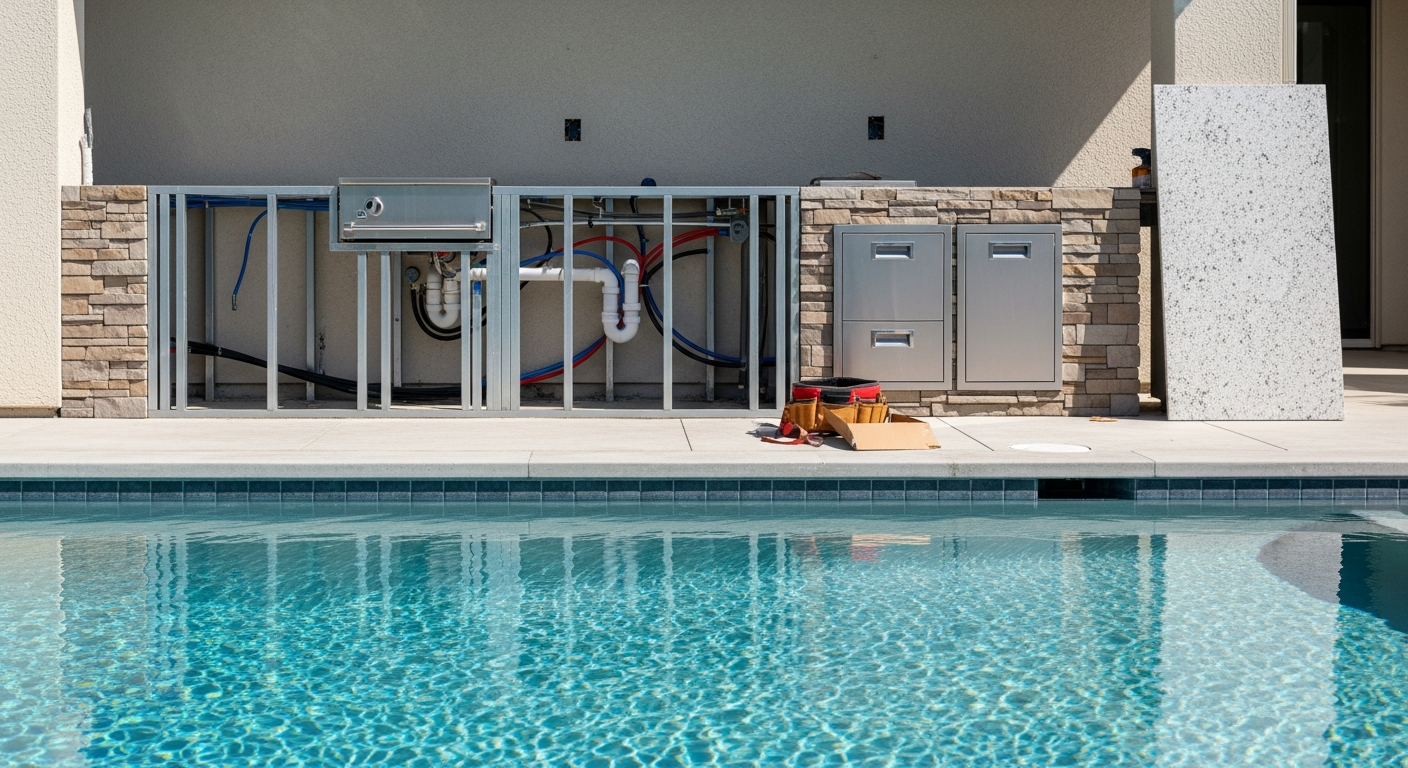
- Utility Mapping & Trenching: This is the number one source of budget creep. We don't just ask "where is the gas line?"; we ask about the required pipe diameter, pressure, the cost per linear foot for trenching in your specific soil type, and the code requirements for burial depth and conduit. A simple electrical run for a refrigerator and lighting requires dedicated GFCI-protected circuits, and the cost to run armored cable underground is substantially different from an interior run.
- Structural Base & Framing Integrity: A floating paver patio cannot support a 2,000-pound structure with granite countertops. You need a reinforced concrete slab. The cost of this slab, including rebar and vapor barriers, is a foundational expense that must be calculated first. For the framing, I almost exclusively specify steel studs over wood. While the initial material cost is about 15% higher, it offers near-total immunity to moisture and pests, preventing catastrophic failures I've had to remediate in older wood-framed kitchens.
- Material Selection vs. Climate Exposure: Choosing materials is not just an aesthetic decision; it's a technical one. In coastal areas with salt air, I mandate 316-grade stainless steel for all appliances and hardware, which carries a premium but prevents the corrosion that will destroy lesser 304-grade steel in under five years. Similarly, the porosity of your chosen stone for countertops determines its susceptibility to staining and freeze-thaw cracking in colder climates. These are long-term cost factors.
- Phase 1: The Infrastructure Audit & Quote. We obtain hard quotes for all utility work (plumbing, gas, electrical) and the foundation slab. This number becomes a fixed, non-negotiable line item. This is your true starting cost.
- Phase 2: Frame & Core Construction. With the foundation set, we budget for the steel framing, cement board, and any necessary waterproofing membranes. This is the second fixed-cost container.
- Phase 3: Appliance Shell Allocation. Only now do we select appliances. We know the exact budget remaining. If the desired grill is too expensive, the client must choose a more affordable model; they cannot steal funds from the infrastructure budget, as it's already spent.
- Phase 4: Finishes & Countertops. This is the final, most flexible stage. The budget for veneers, countertops, and hardware is what's left. This empowers the client to make smart trade-offs on visible items without compromising the structural integrity of the project.
Tags
cost for an outdoor kitchen
average cost of outdoor kitchen
average cost for outdoor kitchen
cost to build outdoor kitchen
outdoor kitchen prices
Outdoor Kitchen Cost FAQ
What is a realistic all-in budget for a good quality outdoor kitchen?
A realistic starting budget for a professionally installed, high-quality outdoor kitchen is between $15,000 and $30,000. This range typically covers a durable stone or paver structure, a premium built-in gas grill, stainless steel access doors, a sink, and a compact refrigerator. The final cost is heavily influenced by your choice of countertop material, such as granite versus concrete, and the complexity of running new utility lines for gas, water, and electricity. Underestimating the cost of licensed plumbers and electricians is a common mistake that can add thousands to an initial estimate.
How much do appliances add to the total cost compared to the structure itself?
Appliances often account for 30% to 50% of the total outdoor kitchen cost, and skimping here is a long-term mistake. A basic 32-inch built-in grill might be $1,500, while a high-performance model with a sear zone and rotisserie can easily exceed $5,000. Remember that outdoor-rated appliances, especially refrigerators and ice makers, must withstand extreme temperature swings and moisture, making them significantly more expensive than their indoor counterparts. Investing in 304-grade stainless steel is non-negotiable for longevity and rust prevention, especially in coastal or humid climates.
Are prefabricated outdoor kitchen kits a cheaper and better option than custom builds?
Prefabricated kits can lower initial labor costs, but they are not always the cheaper or better long-term solution. While a kit might save you 20-30% upfront compared to a fully custom masonry build, you sacrifice design flexibility and material quality. The biggest hidden issue with many kits is their vulnerability to foundation problems; if your patio slab isn't perfectly level and stable, the pre-built modules can shift and crack. A custom-built concrete block or steel frame structure is anchored to a proper footing, ensuring it won't move with ground settlement.
What are the hidden costs of utility hookups that I should plan for?
Utility hookups for gas, water, and electricity can easily add $3,000 to $8,000, a cost many homeowners overlook. The price escalates with distance from your home's main lines; trenching 50 feet across a landscaped yard is far more expensive than tapping into a line just 10 feet away. A critical, non-obvious cost is the potential need for a dedicated GFCI-protected circuit for appliances, which requires a licensed electrician to run a new line from your main panel. Never assume you can simply use an existing outdoor outlet, as it may not support the load.
Why does the choice of countertop material impact the price so much?
Countertop material dramatically impacts the budget because it dictates both material and specialized labor costs. For example, poured concrete countertops are labor-intensive and can cost $100-$150 per square foot, while a good quality granite slab might be $70-$120. The most critical factor people miss is thermal expansion; dark-colored granite or quartz can get dangerously hot in direct sun and has a higher risk of cracking from thermal shock during rapid temperature changes. Lighter-colored, high-density materials like Dekton or specialized outdoor porcelain are more expensive but offer superior durability against weather and heat.
Do I need a permit for an outdoor kitchen, and how does that affect the cost?
Yes, you will almost certainly need a permit if your outdoor kitchen involves new gas, electrical, or plumbing lines, which adds between $500 and $2,000 to the project cost. This fee covers the application, plan review, and required inspections by your local building department to ensure all work is up to code. Proceeding without a permit is a major risk; if discovered, you could face heavy fines and be forced to tear down the entire structure. A professional contractor will handle the permitting process, but it's a real cost that must be factored into your initial budget.