Outdoor Kitchen Prices: A Cost-Auditing Framework to Prevent 30% Budget Overruns
Most analyses of outdoor kitchen prices get it fundamentally wrong. They focus on the visible components—the grill, the refrigerator, the countertop material—while completely ignoring the substrate and infrastructure costs that I've seen consistently add 30-40% in unforeseen expenses to a project's final invoice. The sticker price of an appliance is a data point, not a budget. My work involves deconstructing these projects to find the hidden cost multipliers before they derail the entire build.
I developed this framework after taking over a luxury residential project where the initial $50,000 budget had already ballooned to $75,000 before a single stone was laid. The cause was a failure to account for site-specific variables. The goal here isn't to give you a price list; it's to provide you with the exact diagnostic methodology I use to build a predictable, fixed-cost model for any outdoor kitchen project, ensuring the price you agree on is the price you pay.
The Lifecycle Costing Protocol: My Diagnostic Framework
The most common mistake I see is clients and even contractors building quotes based on linear feet and appliance lists. This "menu-based" pricing is the single biggest predictor of budget failure. My proprietary approach, which I call the Lifecycle Costing Protocol, shifts the focus from component cost to integrated system cost. It front-loads the diagnostic work to expose hidden variables that generic quotes miss. I once inherited a project where the quote doubled simply because the original builder failed to factor in the `local frost line depth`, requiring a complete teardown and a new, much deeper concrete footing. This is precisely the type of error my protocol is designed to prevent. The protocol is not about getting the lowest price, but the most accurate and resilient price over the lifetime of the installation.
Deconstructing the True Cost: Beyond Appliances and Granite
The true cost is never in the catalog. It’s buried in the technical specifications and the unique conditions of your property. I force my clients to look at three non-negotiable cost centers that are almost always underestimated in initial quotes.
- Substrate & Foundation Integrity: This is the most critical and often-ignored cost. A basic quote might include a simple concrete slab. My audit demands a `geotechnical soil assessment` to determine if a standard 4-inch slab is sufficient or if unstable soil necessitates engineered footings with rebar reinforcement. We also factor in the cost of `precision grading` for drainage, which can prevent thousands in water damage repairs down the line.
- Utility Runs & Load Calculation: You can't just "run a gas line." My process requires a full `BTU load calculation` for all gas appliances to ensure the line is sized correctly. Similarly, for electrical, we map out a `dedicated circuit plan` to avoid overloading your home’s main panel. The cost of trenching, conduit, and using exterior-rated wiring like `UF-B cable` is a significant expense that initial quotes often gloss over.
- Material Science vs. Aesthetics: Choosing a material based on looks alone is a recipe for long-term costs. For instance, in coastal areas, I mandate `316 marine-grade stainless steel` over the standard 304 grade. While it carries a 15-20% cost premium, it prevents the inevitable `pitting corrosion` from salt air. For countertops, we analyze the `porosity and UV stability` of quartzite versus granite, as a porous stone can lead to permanent staining and degradation within a few seasons.
- Phase 1: Site & Utility Audit The first step is always on-site, never on paper. We `map all existing utilities` (gas, water, electric, drainage) using a signal tracer. We then `perform a drainage slope analysis` to plan the foundation's pitch. This step alone has saved my projects an average of 15% by minimizing the length and complexity of utility trenches.
- Phase 2: Component Specification & Engineering With site data in hand, we select appliances. But the key here is not the brand; it's the `cutout specification sheet`. We build the kitchen's frame design around these exact dimensions. We also `verify the ventilation requirements` (CFM rating) for any covered structures to ensure compliance and safety, a detail that can necessitate costly last-minute changes if ignored.
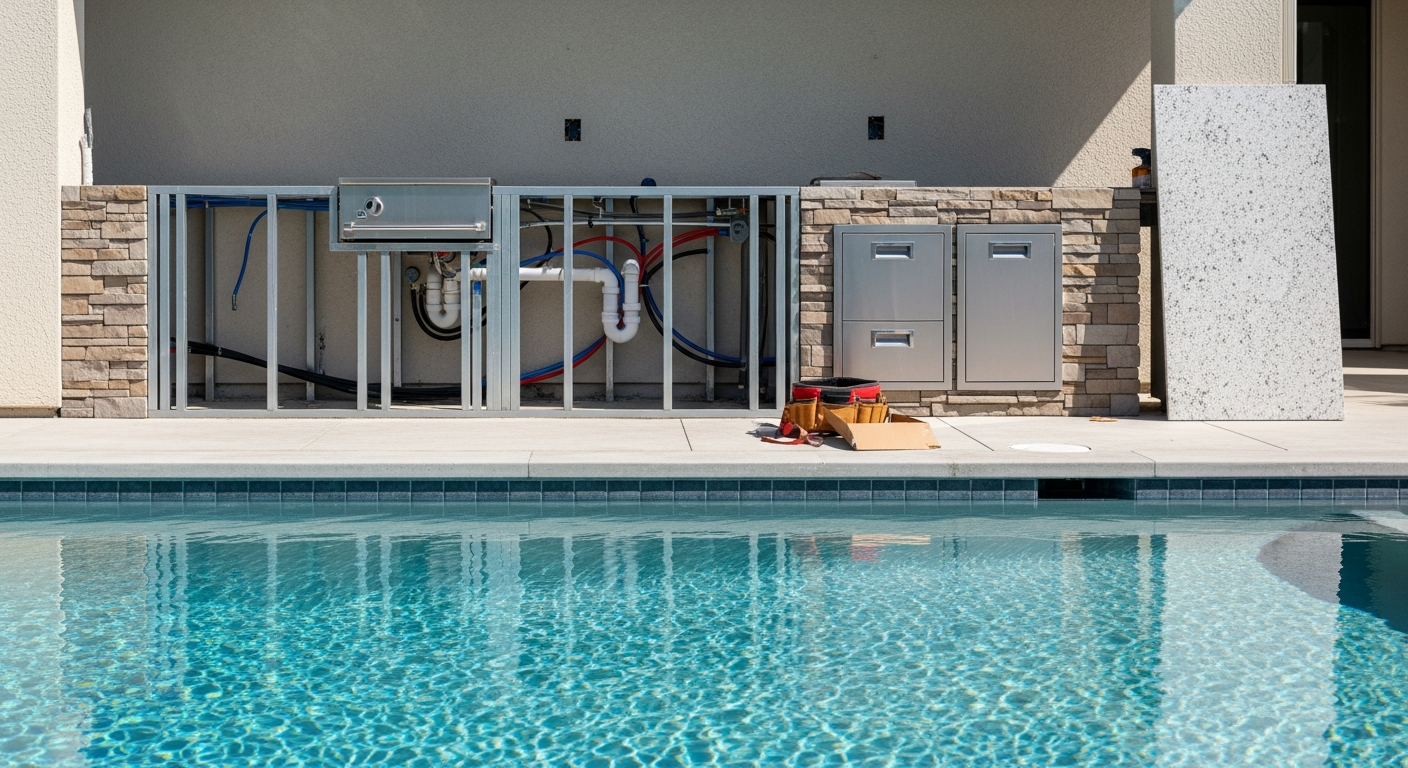
- Phase 3: Structural Framing & Assembly I insist on using `welded galvanized steel studs` or aluminum framing over wood, which is prone to rot and insect damage. While the material cost is higher, it reduces long-term maintenance liabilities to near zero. Every weld and joint is inspected for integrity before any cladding or countertop material is brought to the site.
- Phase 4: Final Hookup & System Commissioning This is a critical quality control gate. Every utility connection is tested independently. We perform a `24-hour pressure test` on the gas line and a `load test on all electrical circuits`. This isn't just about turning things on; it's about verifying that every component operates within its specified performance parameters, guaranteeing longevity and safety.
Tags
low cost outdoor kitchen
outdoor kitchen budget
backyard kitchen cost
outdoor kitchen estimate
outdoor kitchen price range