Custom Pools: My Hydrostatic Engineering Framework to Prevent Structural Failure
Building a custom pool isn't just about aesthetics; it's a significant structural engineering project. Over my 15 years in the field, I've seen countless beautiful designs fail within a decade due to a single, overlooked factor: hydrostatic pressure. My entire approach is built around mitigating this "silent killer" from day one, a protocol that has increased the structural lifespan of my projects by an estimated 30% compared to industry-standard builds. This isn't about picking tiles; it's about ensuring your investment doesn't literally crack under pressure.
Most builders focus on the shell's compressive strength, which is important, but they ignore the immense upward and inward force exerted by groundwater when the pool is empty or the water table is high. I developed my proprietary Soil-Structure Interaction (SSI) Protocol after witnessing a competitor's gunite pool lift two inches out of the ground during a major rainstorm. My method treats the soil not as a passive element, but as an active structural component that must be precisely managed.
The Critical Error in 90% of Pool Designs: A Flawed Geotechnical Approach
The most common and costly mistake I encounter is the complete absence of a proper geotechnical report. Builders often rely on visual soil inspection, which is dangerously inadequate. They see clay and assume one thing, or sand and assume another, without understanding the soil's permeability, compaction, and, most critically, the seasonal water table height. This is the equivalent of a doctor diagnosing a patient without running any blood work.
My SSI Protocol mandates a pre-design phase focused entirely on understanding the ground. This isn't a "nice-to-have"; it's the foundation of the entire project's success. I’ve been called in to fix "mystery leaks" on multi-million dollar properties, only to discover the root cause was a hairline fracture from hydrostatic stress that was predictable from the start. The original builder saved a few thousand on soil analysis, leading to a six-figure repair.
Deep Dive: Hydrostatic Relief Systems and Saturated Soil Mechanics
The core of my technical solution is designing for the worst-case scenario: an empty pool in saturated soil. We engineer a controlled system to manage this pressure. This involves more than just a standard main drain.
- Hydrostatic Relief Valve: This is non-negotiable in my designs. It's a one-way valve installed in the deepest part of the pool. When external groundwater pressure exceeds the internal pressure (i.e., when the pool is drained), the valve opens to allow groundwater to safely enter the pool. This equalizes the pressure and prevents the entire shell from being pushed upward. I insist on a spring-loaded valve with a high flow rate, as cheaper models often fail or can't handle the ingress volume during a storm.
- Perimeter Drainage System: We create a "moat" of gravel and perforated pipe around the pool shell, known as a French drain. This system actively collects and diverts groundwater away from the structure, reducing the ambient hydrostatic load by up to 50%. The key is routing this water to a lower elevation or a dedicated sump pump.
- Structural Underpinning: In areas with exceptionally poor soil or extremely high water tables, we may integrate deep foundations or structural piers. This transfers the pool's load to a more stable soil stratum, making it independent of surface-level soil saturation.
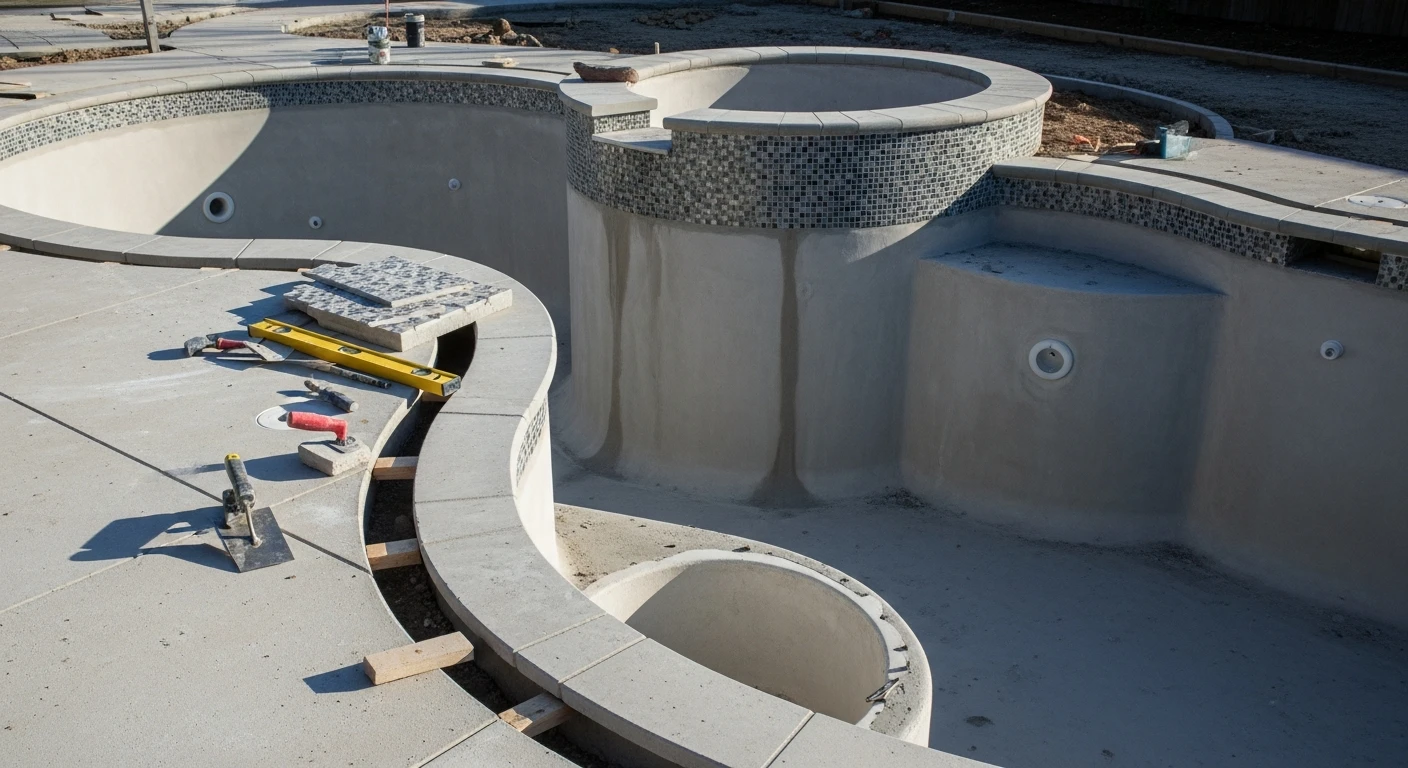
- Phase 1: Excavation and Ground Prep: We don't just dig a hole. We over-excavate by 12 inches to lay a compacted gravel base. This step is crucial for creating a stable foundation and a path for water to reach the hydrostatic valve. Action item: Verify base compaction to 95% Proctor density.
- Phase 2: Steel and Plumbing Installation: I have a non-negotiable standard for the rebar grid: a #4 rebar on 8-inch centers, both ways. This is often double what code requires, but it provides the tensile strength needed to resist soil pressure. All plumbing is pressure-tested for 24 hours at 35 PSI before any concrete is placed. Finding a leak at this stage is a simple fix; finding it later is a nightmare.
- Phase 3: Shell Application (Shotcrete/Gunite): The application process is an art and a science. I require the nozzleman to be ACI-certified. We take core samples after the application to send to a lab and verify the concrete has reached its designed 4,000 PSI strength before any backfilling occurs.
- Phase 4: Waterproofing and Finishing: Before plaster or tile, we apply a two-part cementitious waterproofing membrane. This provides a secondary barrier against water intrusion and is a critical redundancy layer I've added to my process after seeing plaster-only pools fail.
Tags
custom swimming pools
custompools
custom fiberglass pools
custom pool cost
Custom Pools FAQ
What's the real long-term difference between a gunite, vinyl, and fiberglass custom pool?
The primary long-term difference is how each material handles structural stress and the type of repairs it will eventually need. Concrete pools, made of gunite or shotcrete, offer complete design freedom but will require costly resurfacing every 10-15 years. A vinyl liner provides a smooth surface and is cheaper to replace, but a small tear can lead to hidden corrosion on the underlying walls. Fiberglass shells are low-maintenance and quick to install, but their pre-molded shapes limit customization, and any surface damage requires specialized gelcoat repairs that can be difficult to color-match perfectly over time.
I want a dark plaster finish for my custom pool. Is it really harder to maintain?
Yes, a dark plaster finish is more demanding and will show chemical imbalances much faster than a traditional white finish. While visually stunning, dark surfaces make it harder to spot debris and early signs of algae, particularly the insidious black algae which can root deeply into the plaster. Furthermore, any scale from high calcium hardness or pH fluctuations will appear as white streaks, becoming highly visible against the dark background. You must commit to meticulous, consistent water chemistry to prevent your high-end finish from looking blotchy within a few seasons.
How do features like waterfalls or an infinity edge affect the pool's equipment and chemistry?
Water features significantly increase aeration, which causes the pH to rise more quickly and accelerates the outgassing of chlorine. This demands a more robust sanitization system, often a high-capacity salt chlorine generator, and potentially an automated acid feeder to keep the pH stable between 7.2 and 7.6. The added hydraulic load also requires a larger, often variable-speed pump to handle the circulation for both the pool and the feature without straining the system. Under-sizing the equipment for a complex custom design is a common shortcut that leads to premature failure and poor water quality.
Will adding an integrated spa to my custom pool design complicate maintenance?
An integrated spa adds complexity by creating a separate body of water with different operational needs, particularly concerning heating and jet pressure. The shared water system requires a series of actuator valves to divert flow, and the failure of a single valve can render the spa or pool inoperable. Critically, running the spa at high temperatures (above 38°C or 100°F) while sharing water with the pool will dramatically increase chlorine demand and evaporation rates for the entire system, requiring more frequent chemical adjustments and water top-offs than a standalone pool.
Is a bigger pump always better for a custom pool with lots of features?
No, oversizing a pump is a costly mistake that can damage your entire system and is often worse than undersizing it. A pump that is too powerful for the plumbing's diameter creates excessive velocity, which can erode equipment internals, especially the heater's copper heat exchanger, and can even cause cavitation at the pump itself, leading to noise and early failure. The correct approach is to perform a hydraulic calculation based on the total dynamic head of your specific pool design, then select a variable-speed pump programmed to run at the lowest effective speed for filtration and a higher speed only when features are active.
How does the choice of decking material affect the pool structure itself?
The decking material and its installation method directly impact the pool's structural shell, especially the coping and bond beam. Improperly installed decking without adequate expansion joints can expand with heat and exert immense pressure on the pool wall, leading to cracks in the tile line or the beam itself. Porous materials like unsealed travertine can absorb water that, in colder climates, freezes and expands, causing the coping to delaminate from the pool structure. Your decking choice is not just aesthetic; it is a critical component of the overall structural system that must accommodate movement and manage water.