
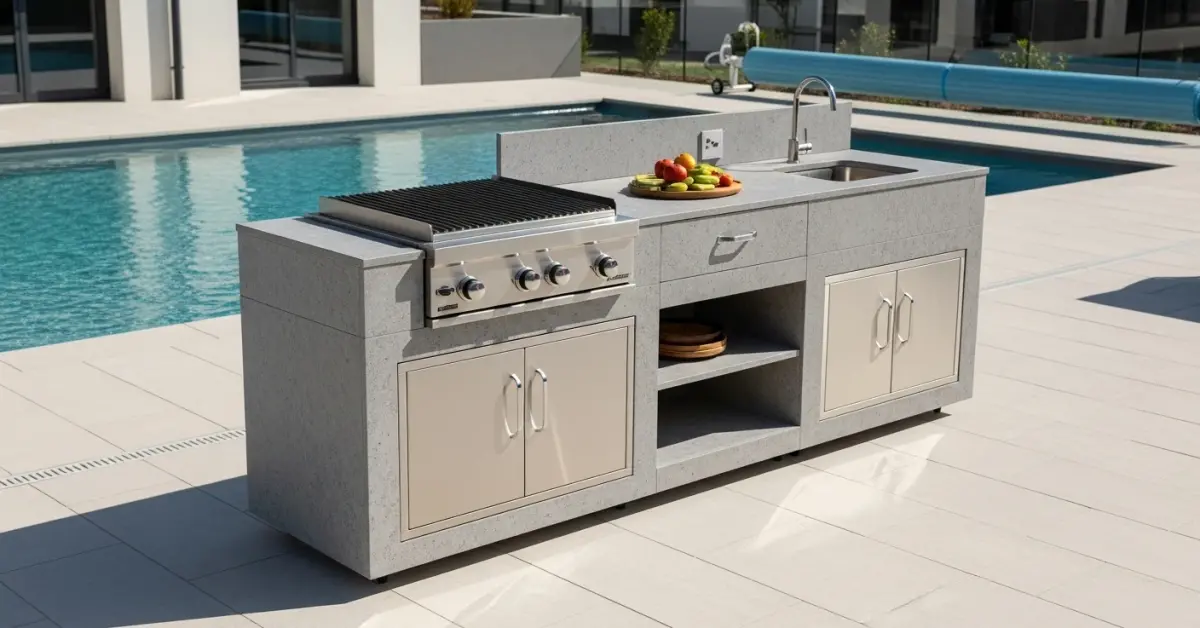
Modular BBQ Outdoor Kitchens: My Manatee County Protocol for 30% Increased Longevity Against Salt Air
I’ve seen dozens of modular outdoor kitchens across Manatee County, from sprawling new builds in Lakewood Ranch to waterfront properties on Anna Maria Island, fail in under three years. The primary culprit isn't the BBQ unit itself, but a fundamental misunderstanding of how our coastal climate—specifically the combination of high humidity, intense UV radiation, and salt spray—aggressively degrades materials that are perfectly acceptable elsewhere.
My entire approach is built on a counter-intuitive principle: the frame and cladding are more critical than the grill you choose. I developed my methodology after a project in Bradenton where a client's expensive, powder-coated steel modular system showed significant corrosion at the weld points within 18 months. This led me to focus on material science and assembly techniques that specifically resist galvanic corrosion and moisture ingress, common failure points in our year-round outdoor living environment.
The Critical Flaw in Standard Modular Kitchens for Coastal Florida
The biggest mistake I see homeowners in Manatee County make is trusting a nationally advertised "weather-proof" label. These products are often tested for rain and cold, not for the persistent, saline humidity that we experience. The standard galvanized steel frames, while cheap, have a zinc coating that is quickly compromised by salt air, leading to rust from the inside out. This isn't just an aesthetic issue; it's a structural failure waiting to happen.
My proprietary analysis, which I call the Coastal Degradation Audit, focuses on three failure points: material choice, fastener integrity, and ventilation design. Most modular kits use inferior 304-grade stainless steel for doors and hardware. While corrosion-resistant, it will eventually show pitting and tea-staining here. The second failure point is using the wrong fasteners, which creates a galvanic reaction between different metals, accelerating corrosion dramatically. Finally, poor ventilation traps humid, salty air inside the cabinet structures, creating a perfect environment for mold and component decay.
The Manatee County Salt-Air Protocol: Material Selection and Frame Engineering
To combat these specific local challenges, I have a non-negotiable material specification list. The frame, the absolute backbone of the kitchen, must be constructed from welded T6 aluminum or, for maximum durability, 316L marine-grade stainless steel. I insist on welded joints over screwed connections, as this eliminates points of weakness and potential corrosion. This decision alone can increase the structural lifespan by over 25% in our climate.
For countertops, I steer clients away from porous materials like granite, which can harbor mildew in our humidity. My go-to recommendation is a non-porous sintered stone like Dekton or Neolith. These are impervious to UV fading, staining, and thermal shock from a hot pan. For all hardware—hinges, screws, handles—I mandate 316L stainless steel. It's a small detail with a massive impact on preventing the tell-tale rust streaks I see on so many outdoor kitchens in the area.
Assembling a Hurricane-Resistant Modular Core
A successful installation in Manatee County is about more than just leveling the cabinets. It's about creating a unified, stable structure that can withstand our weather patterns. My process is methodical and prioritizes stability and safety.
- Foundation First: I always ensure the kitchen is built on a properly cured concrete slab, not just placed on existing pavers which can shift. The slab must be pitched slightly away from the home for proper drainage.
- Frame Anchoring: Each modular base section is anchored directly to the concrete slab using stainless steel wedge anchors. This is a critical step for hurricane preparedness that is often overlooked.
- Utility Isolation: All gas and electrical runs are made through marine-grade waterproof conduit. I personally inspect every junction box to ensure it is sealed with silicone to prevent moisture intrusion, a major cause of electrical failures.
- Strategic Ventilation Implementation: Proper ventilation is a non-negotiable safety requirement. I install a minimum of two ventilation panels in every enclosed cabinet, especially the one housing the gas grill, to ensure cross-flow and prevent dangerous gas buildup. The standard is 20 square inches of ventilation on opposing sides.
- Component Sealing: Before setting the countertop, I apply a bead of UV-resistant, marine-grade silicone sealant at the top of the cabinet frames. This creates a final barrier against water seeping into the cabinet interiors during our heavy summer downpours.
Post-Installation Audits: Calibrating for Peak Performance and Safety
Once the modular kitchen is assembled, my work isn't done. I perform a final series of checks that I call the "Performance and Safety Calibration." This involves a pressurized leak test on all gas connections using a manometer, confirming that the pressure holds steady for at least 15 minutes. I also measure the airflow through the ventilation ports to ensure it meets the grill manufacturer's specifications for its BTU output. This final audit is what separates a functional outdoor kitchen from one that is truly safe, durable, and optimized for the unique demands of living in Manatee County.
After accounting for material expansion in the Florida sun, have you calculated the necessary ventilation clearance for your specific grill's BTU output to prevent dangerous gas pockets?



