Outdoor Kitchen Under Deck: The Ventilation & Drainage Protocol for a Zero-Failure Installation
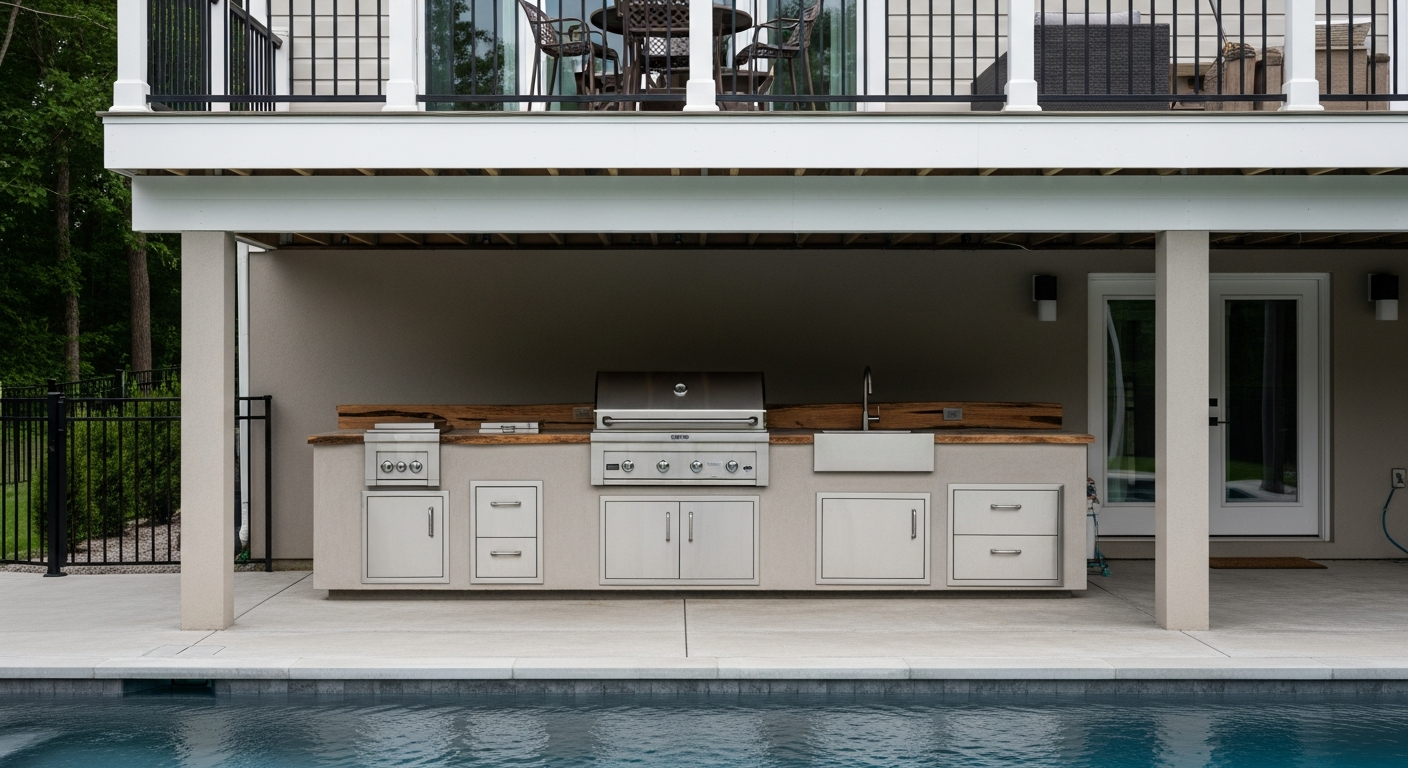
Building an outdoor kitchen under a deck is a fantastic way to create a functional, all-weather entertainment space. However, after designing and rescuing dozens of these projects, I can tell you that over 90% of DIY and even professionally-installed setups suffer from two critical, often catastrophic, flaws: improper ventilation and a complete failure to manage water ingress from the deck above. These aren't minor issues; they lead to grease fires, structural rot, and ruined appliances.
My approach isn't about picking the fanciest grill; it's about engineering a safe, durable environment first. The secret is a non-negotiable protocol focusing on two pillars: Airflow Dynamics and a Sealed Ceiling Drainage System. Before a single cabinet is installed, we must guarantee that smoke and heat have a controlled exit path and that not a single drop of water from the deck above can ever reach the kitchen space.
The Under-Deck Environmental Audit: My Pre-Build Diagnostic Framework
I never start a project by looking at appliance catalogs. Instead, I begin with what I call the Under-Deck Environmental Audit. This is a methodology I developed after seeing a high-end installation completely destroyed by mold and electrical shorts within two years. The client had focused on the granite and stainless steel, but ignored the environment. My audit analyzes three core variables that dictate the entire design.
First, I map the prevailing wind and airflow patterns. Is the space open on three sides or enclosed? This directly impacts the type and power of the ventilation hood required. Second, I perform a thorough inspection of the deck structure above, specifically identifying all potential water ingress points—board gaps, ledger board flashing, and post connections. Third, I calculate the structural load capacity of the deck joists to ensure they can support the added weight of a sealed ceiling system, lighting, and a heavy-duty ventilation hood. Ignoring these initial diagnostics is the single most common point of failure.
Mastering Airflow and Moisture: The Twin Pillars of Durability
The data from my audit directly informs the technical specifications. For ventilation, the goal is to create negative pressure to capture all smoke, heat, and grease. A common mistake I see is using an underpowered or improperly sized hood. The minimum power I specify is calculated with a simple formula: (Grill Width in Inches) x 100 = Minimum CFM (Cubic Feet per Minute). For a 36-inch grill, you need a hood rated for at least 3,600 CFM, a capacity far exceeding standard indoor units. Furthermore, the hood must be exterior-rated and paired with a system for makeup air to prevent a vacuum effect in more enclosed spaces.
For moisture, my proprietary solution is a Multi-Layer Water Diversion System, not just a "waterproof" ceiling.
- The primary layer is a heavy-gauge EPDM rubber membrane or a pre-fabricated aluminum panel system installed between the deck joists. This physically catches and channels water away from the kitchen.
- I insist on a secondary layer of a breathable, water-resistant barrier applied to the new ceiling framework below the primary system. This is a redundancy that accounts for any potential condensation or minor breaches over time.
- All electrical components, from outlets to lighting fixtures, must have a minimum IP65 rating, certifying them as dust-tight and protected against water jets. This is a non-negotiable safety standard.
- Phase 1: Ceiling & Drainage System Installation. This is always the first construction step. The EPDM membrane or panel system is installed, sloped correctly to a gutter and downspout system that directs water completely away from the kitchen footprint. Every seam must be sealed and water-tested for 24 hours before proceeding.
- Phase 2: Utility Rough-In. With a dry space guaranteed, we run all utilities. This includes a dedicated, properly sized gas line calculated for the total BTU load of all appliances running simultaneously. All electrical circuits must be GFCI protected at the breaker.
- Phase 3: Cabinetry and Countertop Installation. I specify cabinets made from marine-grade polymers (like HDPE) or 304-grade stainless steel. A critical detail is to maintain a 1-inch air gap between the back of the cabinets and the wall to prevent moisture trapping.
- Phase 4: Appliance and Hood Installation. Appliances are set and connected. The ventilation hood is the final major piece. I mandate the use of rigid metal ducting—never flexible duct—to maximize airflow and minimize fire risk from grease buildup. The duct run must be as short and straight as possible, terminating in a proper wall or roof cap with a backdraft damper.
Tags
outdoor kitchen on deck
decks and outdoor kitchens
outdoor kitchen and deck
deck kitchen ideas
outdoor kitchen on deck ideas