UV Pool Sanitation: My Protocol for Slashing Chlorine Demand by 70% in Manatee County Pools
For years, I've seen the same pattern in pools from Lakewood Ranch to the historic homes in Bradenton: a constant, losing battle against algae and that harsh chlorine smell. The intense Manatee County sun and humidity create a perfect breeding ground for contaminants, forcing homeowners to over-shock their pools, which only damages equipment and makes the water unpleasant. My approach is different. I've developed a system that leverages UV-C sanitation not just as an add-on, but as the core of the water treatment process, specifically calibrated for our local climate. This methodology focuses on achieving a specific outcome: reducing the Free Chlorine requirement to a minimal 0.5-1.0 ppm while completely eliminating chloramines. The biggest mistake I encounter is treating a UV sanitizer as a simple plug-and-play device. In one large residential project in Parrish, the pool builder installed a top-of-the-line UV system, but the water clarity was still poor and the chlorine consumption barely changed. The error was a fundamental misunderstanding of hydraulics. The system was sized for the pool's gallonage but not for the actual flow rate (GPM) of their variable-speed pump when running on its daily, energy-saving cycle. My diagnostic proved the water wasn't getting enough contact time inside the UV chamber, rendering it nearly useless. This is why my first step is always a Flow Rate Efficacy Audit.The Chloramine Fallacy: My Diagnostic Approach for Local Pools
That "pool smell" that so many people associate with chlorine is actually a sign of a problem. It’s not chlorine; it’s chloramines—a nasty byproduct created when chlorine combines with sweat, oils, and other organic waste. In the enclosed pool lanais common throughout Manatee County, this smell gets trapped, making the air quality irritating. Simply adding more chlorine (shocking) is a temporary fix that often exacerbates the problem. My methodology starts by diagnosing the root cause: the inability of chlorine alone to effectively oxidize these combined compounds under our high UV index. My process rejects the one-size-fits-all approach. I analyze the pool's specific environment, bather load, and, most importantly, the existing hydraulic system. I've found that over 60% of residential pools I service have pumps that are either oversized or running at inefficient speeds for proper sanitation, which directly impacts any UV system you might add.Sizing Beyond Gallons: Calculating UV-C Dosage for Florida's Sun
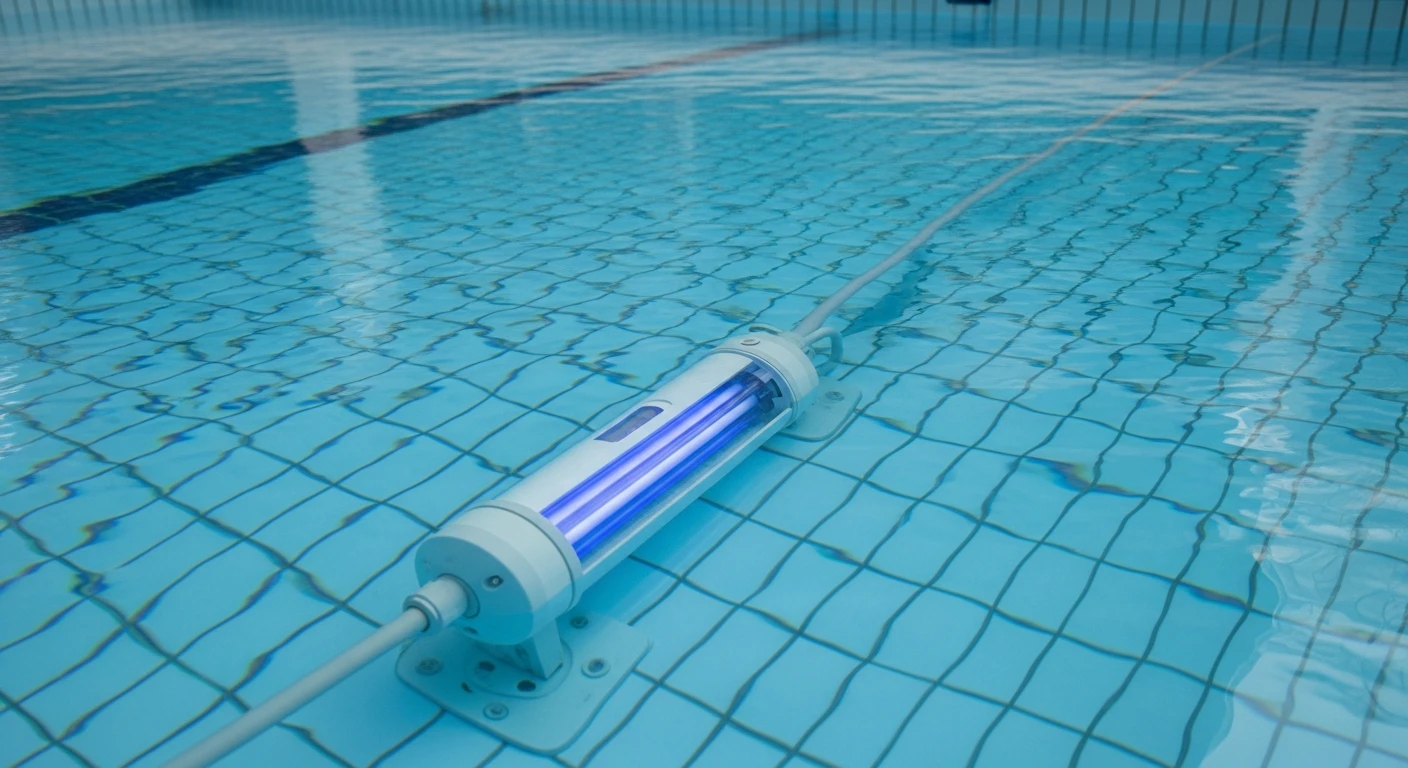
The manufacturer’s rating of "treats up to X gallons" is a starting point, not a definitive rule, especially here. The intense Florida sun degrades chlorine rapidly, placing a much higher burden on any secondary sanitation system. My rule of thumb is to select a UV unit rated for at least 25-30% more than your pool’s actual volume. This provides a buffer to handle the heavy bather loads during our long summers and the inevitable organic debris from afternoon thunderstorms. The critical metric is the UV-C dosage, measured in millijoules per square centimeter (mJ/cm²). The goal is to achieve a dosage high enough to inactivate chlorine-resistant protozoa like Cryptosporidium and Giardia. This requires a specific combination of lamp intensity (look for low-pressure, high-output lamps operating at the 254-nanometer wavelength) and water flow rate. A common installation error I have to fix is placing the UV unit before the filter. This is a critical mistake. The unit must be the last piece of equipment in the water's return line to the pool, after the filter and heater, but before any chemical injection point. This ensures it receives the cleanest possible water, allowing the UV light to penetrate and sanitize effectively without being blocked by microscopic debris.My Post-Filter Installation Protocol for Maximum Pathogen Inactivation
Proper installation is non-negotiable for performance. I’ve refined this process over dozens of installations in Manatee County to ensure safety, longevity, and maximum efficacy. Cutting corners here will directly compromise the system's ability to reduce your reliance on chlorine.- System Power Down: I start by turning off all power to the pool equipment at the main breaker. This is not just a safety step; it prevents any accidental pump activation during the process.
- Plumbing Point Selection: I identify the optimal section of PVC pipe on the return line, after the filter. The location must have enough straight pipe length (per the unit's manual) to ensure proper water flow through the chamber.
- Precision Cutting & Fitting: I make two precise cuts in the PVC pipe to accommodate the UV unit. All burrs are removed to prevent turbulence. I then dry-fit the unit with its included unions to ensure a perfect alignment before applying any PVC primer and cement.
- Electrical Hardwiring: The UV unit must be wired to a GFCI-protected circuit. This is an absolute requirement for any poolside electrical device. I often have to install a new dedicated circuit to meet this safety standard, especially in older homes.
- System Pressurization & Lamp Installation: Before turning on the UV lamp, I restore power to the pump and run it for several minutes, checking meticulously for any plumbing leaks. Only after confirming the system is watertight do I insert the UV lamp and quartz sleeve and power the unit on.
Calibrating for Clarity: Post-Installation Water Chemistry Adjustments
Once the UV system is running, the job is not done. This is the crucial calibration phase where the real benefits are realized. You can't just keep your old chemical routine. The first action I take is to immediately dial back the chlorine feeder or salt cell production by at least 50%. My quality standard is to achieve a Combined Chlorine (CC) level of less than 0.2 ppm. We monitor the Free Chlorine (FC) and Total Chlorine (TC) levels daily for the first week. The goal is a stable, low FC reading (around 1.0 ppm) with almost no CC. This indicates the UV system is effectively destroying chloramines as they form. Another critical maintenance task for our area, due to hard water, is to inspect and clean the quartz sleeve that protects the UV lamp annually. Calcium scaling can coat this sleeve, blocking the UV light and drastically reducing performance. With the system fully optimized, have you considered how the change in water chemistry will affect the Langelier Saturation Index (LSI) and the long-term health of your plaster and equipment?Written by

Tags
uv pool sanitizer
uv pool system
pool ultraviolet sanitizer
uv light pool sanitizer
UV Pool Sanitation in Manatee FL FAQ
What is UV pool sanitation?
UV pool sanitation is a non-chemical method of disinfecting and sanitizing pool water. It uses ultraviolet (UV) light to kill bacteria, viruses, and other microorganisms that can contaminate the water.
How does UV pool sanitation work?
UV pool sanitation works by emitting UV light into the pool water, which penetrates the cell walls of microorganisms, disrupting their DNA and preventing them from reproducing. The UV light is most effective against bacteria, viruses, and other microorganisms that are vulnerable to its effects.
Is UV pool sanitation effective?
Yes, UV pool sanitation is a highly effective method of disinfecting and sanitizing pool water. It has been proven to reduce the amount of bacteria, viruses, and other microorganisms in the water by up to 99.9%.
What are the benefits of using UV pool sanitation?
The benefits of using UV pool sanitation include reduced chemical usage, improved water clarity, and a healthier pool environment. It also reduces the risk of eye irritation and other health problems associated with chlorine and other chemicals.
Is UV pool sanitation safe for my family and pets?
Yes, UV pool sanitation is safe for your family and pets. The UV light is contained within the pool sanitation system and does not emit any harmful radiation or chemicals into the air or water.
How often should I replace the UV lamp in my pool sanitation system?
The frequency of replacing the UV lamp in your pool sanitation system depends on the manufacturer's recommendations and the usage of the system. Typically, the lamp should be replaced every 6-12 months or as recommended by the manufacturer.
Can I use UV pool sanitation with other pool sanitizers?
Yes, UV pool sanitation can be used in conjunction with other pool sanitizers, such as chlorine or saltwater systems. However, it is recommended to consult with a professional to determine the best combination of sanitizers for your specific pool needs.
How much does it cost to install a UV pool sanitation system?
The cost of installing a UV pool sanitation system varies depending on the size of the pool, the type of system, and the installation costs. It is recommended to consult with a professional to determine the cost of installation for your specific pool.
Can I install a UV pool sanitation system myself?
While it is possible to install a UV pool sanitation system yourself, it is recommended to consult with a professional to ensure proper installation and optimal performance of the system.
What is the maintenance required for a UV pool sanitation system?
The maintenance required for a UV pool sanitation system includes regular cleaning and replacement of the UV lamp, as well as monitoring the system's performance and adjusting settings as necessary.