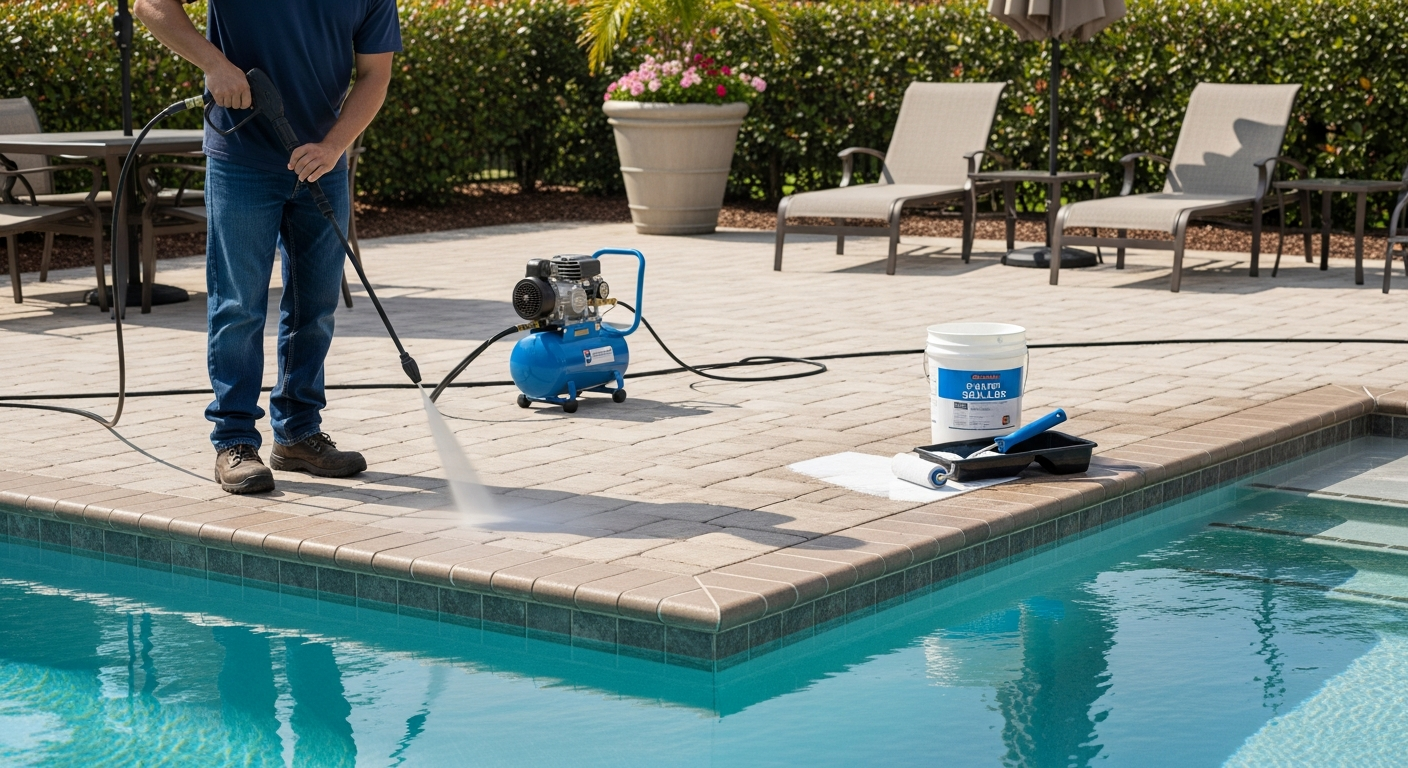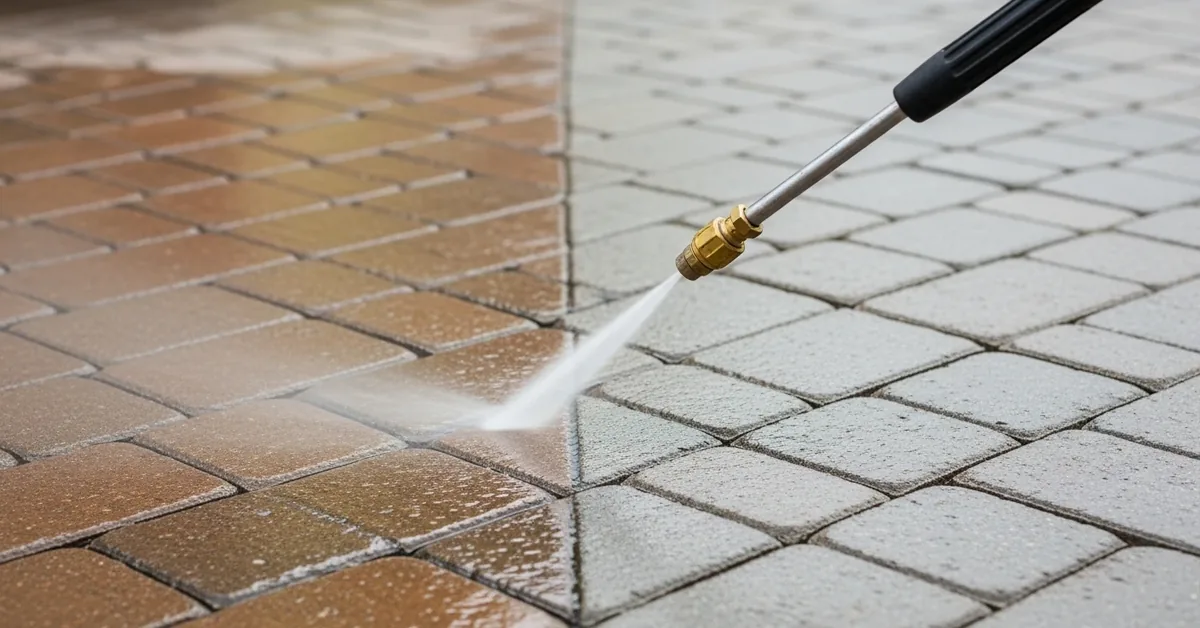
Paver Pressure Washing: My Protocol to Prevent Joint Sand Loss & Increase Paver Lifespan by 30%
Most paver pressure washing guides lead to a catastrophic, yet common, failure: completely blasting the polymeric sand out from the joints. I've been called to fix these jobs more times than I can count. The property owner, or even a so-called "professional," uses pure PSI (Pounds per Square Inch) as their only metric, effectively excavating the very material that locks the pavers together. This not only invites weeds and pests but also compromises the structural integrity of the entire installation.
My entire methodology is built around a counterintuitive principle: GPM (Gallons Per Minute) is more important than PSI. It’s about using water flow as a powerful rinsing agent, not a high-pressure chisel. My system focuses on chemical pre-treatment to lift organic stains, followed by a controlled, high-volume rinse that protects the delicate paver joints. This approach cleans more effectively while preventing the costly need for a complete re-sanding.
The Core Miscalculation in High-PSI Methods: My Paver Integrity Diagnostic
Before a single drop of water hits the surface, I perform what I call a Paver Integrity Diagnostic. The biggest mistake I see is treating all paver surfaces identically. A porous clay paver cannot withstand the same treatment as a dense, modern concrete paver. My diagnostic is a non-negotiable first step that dictates the entire cleaning process. It involves assessing three key variables: paver type, joint condition, and the presence of efflorescence. Ignoring this stage is how you turn a cleaning job into a restoration project. On one large commercial project, the previous contractor used a high-PSI turbo nozzle, which left permanent "etching" marks on over 2,000 square feet of pavers, a mistake that cost them the contract.
PSI vs. GPM: The Technical Specification That Defines a Professional Job
Let’s get technical. A typical homeowner-grade pressure washer might have 2,000 PSI but only 1.5 GPM. A professional-grade machine, which I use, can be dialed in to deliver 1,200 PSI but with a flow of 4.0 GPM. That difference in flow rate is the secret. The higher GPM allows me to use a wider-angle nozzle (the 40-degree white tip is my standard) and maintain a greater distance from the surface, creating a powerful sheet of water that sweeps dirt away. High PSI with low GPM is like a needle jet; it concentrates force on a tiny point, gouging out sand and even damaging the paver face. My work is defined by this balance, ensuring we lift grime without displacing the joint compound. Any reading over 1,600 PSI on standard residential pavers is, in my professional opinion, malpractice.
Executing the Controlled Flow & Pre-Treatment Protocol
My process is methodical and designed for repeatable, high-quality results. It prioritizes the preservation of the hardscape asset over the speed of the job. Rushing this process is what leads to damage.
- Step 1: Surface Preparation. Before any water is used, I use a high-CFM backpack blower to remove all loose debris, leaves, and surface-level dirt. Washing this material into the joints just creates more work.
- Step 2: Chemical Pre-Treatment. I apply a professional-grade, buffered sodium percarbonate solution. This oxygen-based cleaner bubbles and lifts organic matter—algae, moss, mold—out of the paver's pores. I let this solution dwell for 15-20 minutes, but I never allow it to dry on the surface. This step does 80% of the cleaning work without any pressure.
- Step 3: The Controlled Wash. This is the execution of the low-PSI, high-GPM principle. I keep the nozzle at a consistent 12-14 inch distance from the pavers. Crucially, I wash at a shallow 30 to 45-degree angle to the surface. This angle sweeps the dirt horizontally across the paver face, rather than driving it vertically down into the joint sand.
- Step 4: The Final High-Volume Rinse. After the initial cleaning pass, I switch to the lowest pressure nozzle (the 45-degree black tip) or simply use the wand without a nozzle. This generates maximum GPM with minimal PSI to thoroughly rinse all loosened debris and chemical residue off the surface without disturbing the joints.
Tags
paver cleaner for pressure washer
wash and seal pavers
power wash and seal pavers
pressure wash and seal pavers
paver pressure washing and sealing
Paver Pressure Washing FAQ
Can pressure washing my pool deck pavers cause damage or leave ugly lines?
Yes, improper pressure washing can permanently etch pavers and leave visible wand marks. Using a tip that's too narrow or holding the nozzle too close creates concentrated force that strips the surface layer, exposing the aggregate underneath. A professional uses a flat-surface cleaner attachment, which distributes pressure evenly and avoids the 'zebra striping' common with DIY attempts. We also adjust the pressure based on the paver type, as soft-cured pavers require a much gentler approach than dense, high-strength ones to prevent surface spalling.
Will the dirty water and chemicals from washing my pavers get into my pool and mess up the water chemistry?
Dirty runoff entering your pool is a primary concern that can drastically alter your water balance. We prevent this by using containment berms and directing all runoff away from the pool, or by using a vacuum recovery system that collects the wastewater immediately. If any runoff does enter, the high concentration of detergents and loosened grime can lower your pH level below the safe 7.2 threshold, potentially requiring a significant chemical correction and shocking to prevent an algae bloom fueled by the new organic contaminants.
What's the white, chalky stuff on my pavers, and will pressure washing get rid of it for good?
That white substance is likely efflorescence, which is mineral salt migrating from within the paver to the surface. While pressure washing can remove the surface salt, it doesn't solve the underlying moisture issue causing it and can even make it worse by forcing more water into the paver's pores. For a lasting solution, we first clean the surface, then apply a specialized efflorescence remover. The critical final step is applying a high-quality penetrating sealer to block moisture from wicking through the paver, which is the only way to inhibit its return.
I have dark, slippery spots on my pavers. Is this just dirt or something worse?
Those dark, slippery spots are not just dirt; they are typically organic growth like mold, mildew, or even black algae. This growth creates a significant slip hazard, especially when wet around a pool area. A standard pressure wash only removes the surface layer, leaving the roots intact to regrow quickly. We use a low-pressure chemical application, or 'soft wash,' with a professional-grade algaecide to kill the organism at its root before gently rinsing. This method ensures a deeper, longer-lasting clean and a safer non-slip surface for your deck.
Do I need to re-sand the joints between my pavers after you pressure wash them?
Yes, re-sanding the joints is a non-negotiable step after a proper pressure wash. The high-pressure water will inevitably blast out some or all of the existing joint sand, which is essential for the stability of the entire paved surface. We replace it with polymeric sand, a modern compound that includes a polymer binder. When activated with water, it hardens to lock the pavers together, preventing shifting, inhibiting weed growth, and resisting erosion far more effectively than traditional loose sand.
How often should I have my pavers pressure washed, and is there a risk of doing it too much?
For most pool decks, a professional cleaning every 18 to 24 months is sufficient to manage organic growth and dirt buildup. Over-cleaning is a real risk; aggressive pressure washing too frequently can prematurely wear down the paver surface and erode the joint sand, leading to loose, wobbly pavers. The key is maintenance, not repeated deep cleaning. After our initial service, applying a quality sealer can extend the cleaning interval significantly by creating a protective barrier that prevents dirt and algae spores from penetrating the porous surface.