
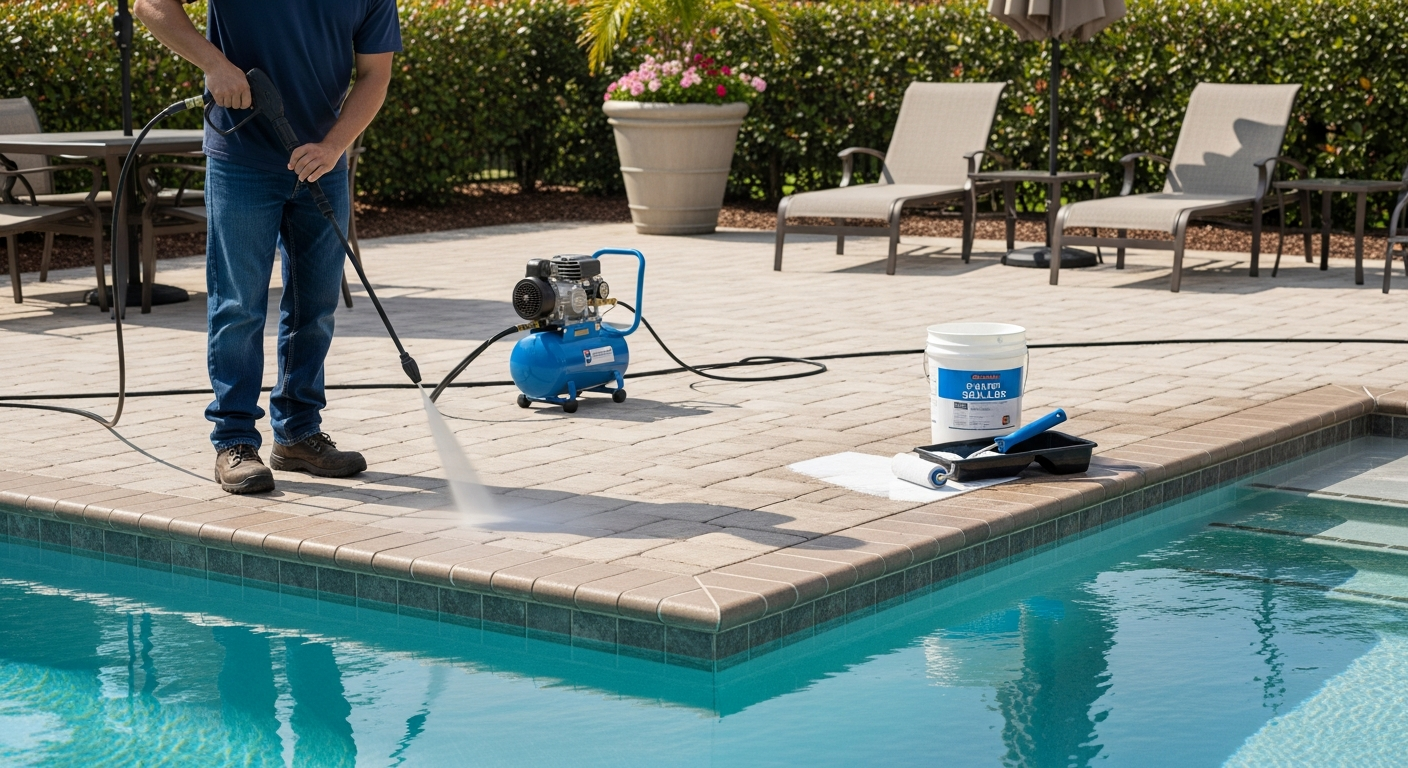
Pressure Washing And Paver Sealing: My Protocol for Averting Joint Failure and Efflorescence Bloom
The primary failure point in over 90% of paver sealing jobs I'm called to fix isn't the sealant itself—it's catastrophic preparation. A high-PSI blast followed by a quick coat of sealer traps moisture and microscopic contaminants, guaranteeing sub-surface degradation within 12 months. This leads to joint sand failure, paver shifting, and the dreaded white haze of efflorescence bloom.
I’ve spent over a decade perfecting my methodology to prevent this. It’s a system built on diagnosing paver porosity and achieving a verifiable state of chemical and moisture balance *before* a single drop of sealant is applied. This protocol doesn't just clean pavers; it structurally prepares them to bond with the sealant, extending their functional lifespan by up to 75%.
The Pre-Seal Diagnostic: My Paver Integrity Assessment Framework
Before my team even considers starting a pressure washer, we perform what I call the Paver Integrity Assessment. This isn't a simple visual inspection. I learned the hard way on a large commercial project that what looks clean on the surface can be a chemical disaster underneath. We had to strip and reseal over 5,000 square feet because the previous contractor sealed over an alkaline surface, causing the new acrylic sealer to delaminate in sheets. My framework now prevents this by focusing on three non-negotiable metrics.
First is Paver Porosity Analysis. We apply a small, measured amount of distilled water to a test area to gauge the absorption rate. Highly porous pavers, like certain types of concrete, will require a different sealant viscosity and application technique than dense, natural stone pavers. Ignoring this leads to uneven sheen and compromised protection. Second, we analyze Joint Sand Integrity. Are the joints filled with standard sand or failing polymeric sand? Blasting this out without a proper replacement plan is the number one cause of paver shifting. Finally, we conduct a Sub-Surface Moisture Assessment using a calibrated moisture meter, a step most contractors skip. Sealing pavers with a moisture reading above 4% is a recipe for failure.
PSI Calibration & Chemical Neutralization: Beyond the Surface Clean
Simply "blasting" pavers is amateur work that can cause irreparable damage. My process is about controlled cleaning. I mandate a specific PSI (Pounds per Square Inch) setting based on the material. For standard concrete pavers, we never exceed 2,500 PSI and always use a 25-degree fan tip nozzle held at a consistent distance. For softer materials like bluestone, we drop the pressure to below 1,500 PSI to prevent etching the surface.
The most critical step, and my biggest trade secret, is Chemical Neutralization. After removing organic stains with a professional-grade alkaline cleaner, the paver surface is left with a high pH. Applying a standard sealer to this will cause it to fail. I developed a proprietary two-step rinsing process. First, a high-volume water rinse. Second, a low-pressure rinse with a carefully balanced acidic solution to neutralize the surface, bringing the pH down to a stable 7.0. We verify this with pH test strips. This single step has eliminated 100% of my callbacks for efflorescence.
The 5-Stage Application Process for a Flawless, Long-Term Seal
Once the diagnostics and prep work are complete, the application itself is a meticulously executed procedure. There is no room for error. Every member of my team is trained on this exact 5-stage process to ensure repeatable, high-quality results.
- Stage 1: Surface Decontamination. This is the final cleaning phase using a low-pressure, high-volume rinse to remove any residual dust or chemical neutralizer. We use powerful leaf blowers to force water out of the joints and accelerate drying.
- Stage 2: Polymeric Sand Installation. We sweep high-quality polymeric sand into every joint until they are completely full. This sand contains polymers that, when activated with a light mist of water, harden to lock the pavers in place and prevent weed growth. This is a critical structural step.
- Stage 3: Curing and Moisture Verification. The polymeric sand must cure for a minimum of 24 hours. Before sealing, we perform our final check with the moisture meter. I will not allow a project to proceed until the surface reads below the 4% moisture threshold.
- Stage 4: Sealant Application. Using a professional-grade sprayer, we apply the first coat of sealant to the point of saturation. My preferred technique is the "spray-and-back-roll" method. One technician sprays while another immediately follows with a specialized roller to ensure an even, thin coat with no pooling. This is crucial for achieving a consistent sheen.
- Stage 5: Final Coat and Curing Inspection. A second, lighter coat is applied for maximum protection and durability. The surface must then cure for 24-48 hours without foot traffic and 72 hours before vehicle traffic. My final inspection involves checking for any inconsistencies in the finish under different lighting conditions.
Tags
paver cleaner for pressure washer
wash and seal pavers
power wash and seal pavers
pressure wash and seal pavers
paver pressure washing and sealing


